4.7.1.1,4.7.1.2 - Crude oil, alkanes and fractional distillation
Learn how crude oil formed, recognise the alkane family and explain how a refinery separates hydrocarbons by fractional distillation. These ideas connect the molecules in an underground resource to the fuels and chemical feedstocks used in everyday life.
Crude oil and hydrocarbons
Crude oil is a mixture of many compounds found in rocks, rather than a single substance with one chemical formula.
Its source was ancient biomass, material from living organisms, consisting mainly of plankton. The remains were buried in mud. Over geological time, heat and pressure changed this material into crude oil. Oil can accumulate in pores in rocks; it is not normally an underground lake. Its formation takes far longer than the timescale on which people extract and use it, so crude oil is a finite resource. New oil cannot replace consumption quickly enough to make it renewable on a human timescale.
Most compounds in crude oil are hydrocarbons. A molecule of a hydrocarbon contains carbon and hydrogen atoms only. Methane, , qualifies, whereas ethanol, , does not because it also contains oxygen. “Contains carbon” alone is therefore not enough to identify a hydrocarbon.
Hydrocarbon
A compound whose molecules contain only hydrogen and carbon atoms.
Different hydrocarbons have different numbers and arrangements of atoms. Mixing them together does not chemically join them. Each molecule keeps its identity, which is why a physical separation process can separate crude oil into more useful groups of substances. This distinction matters later: separation rearranges where molecules are collected; cracking changes the molecules themselves.
The alkane homologous series
Most hydrocarbons in crude oil are alkanes, a family in which carbon atoms are joined by single carbon–carbon bonds.
A homologous series is a family of compounds with the same general formula and similar chemical properties. Successive members differ by one group. Carbon makes four bonds and hydrogen makes one. In these alkanes, a chain of carbon atoms has enough hydrogen atoms to complete all four bonds around every carbon. They are called saturated hydrocarbons.
For an alkane, , where is the number of carbon atoms.
| Name | Number of carbon atoms | Molecular formula |
|---|---|---|
| Methane | 1 | |
| Ethane | 2 | |
| Propane | 3 | |
| Butane | 4 |
Worked example 1 — propane
There are three carbon atoms, so substitute into the alkane formula:
The total matches the named propane row.
Worked example 2 — an unfamiliar chain length
For eight carbons, use the same relationship:
The formula can be deduced without memorising the eight-carbon name. By contrast, has two fewer hydrogen atoms than the required , so it is not an alkane in this series.
A molecular formula counts atoms. A fully displayed formula shows every atom and every bond. In the structures below, each line represents one covalent bond; a carbon in the middle of a chain has two carbon neighbours and two hydrogen neighbours. An end carbon has one carbon neighbour and three hydrogen neighbours. Methane has no carbon neighbour and four hydrogen neighbours.
[DIAGRAM: asset_name: First four alkanes; asset_slug: 8462_c46_alkanes; caption: Fully displayed formulae show all atoms and bonds in methane, ethane, propane and butane.; description: Four labelled fully displayed straight-chain structures, with four bonds at every carbon and one at every hydrogen.]
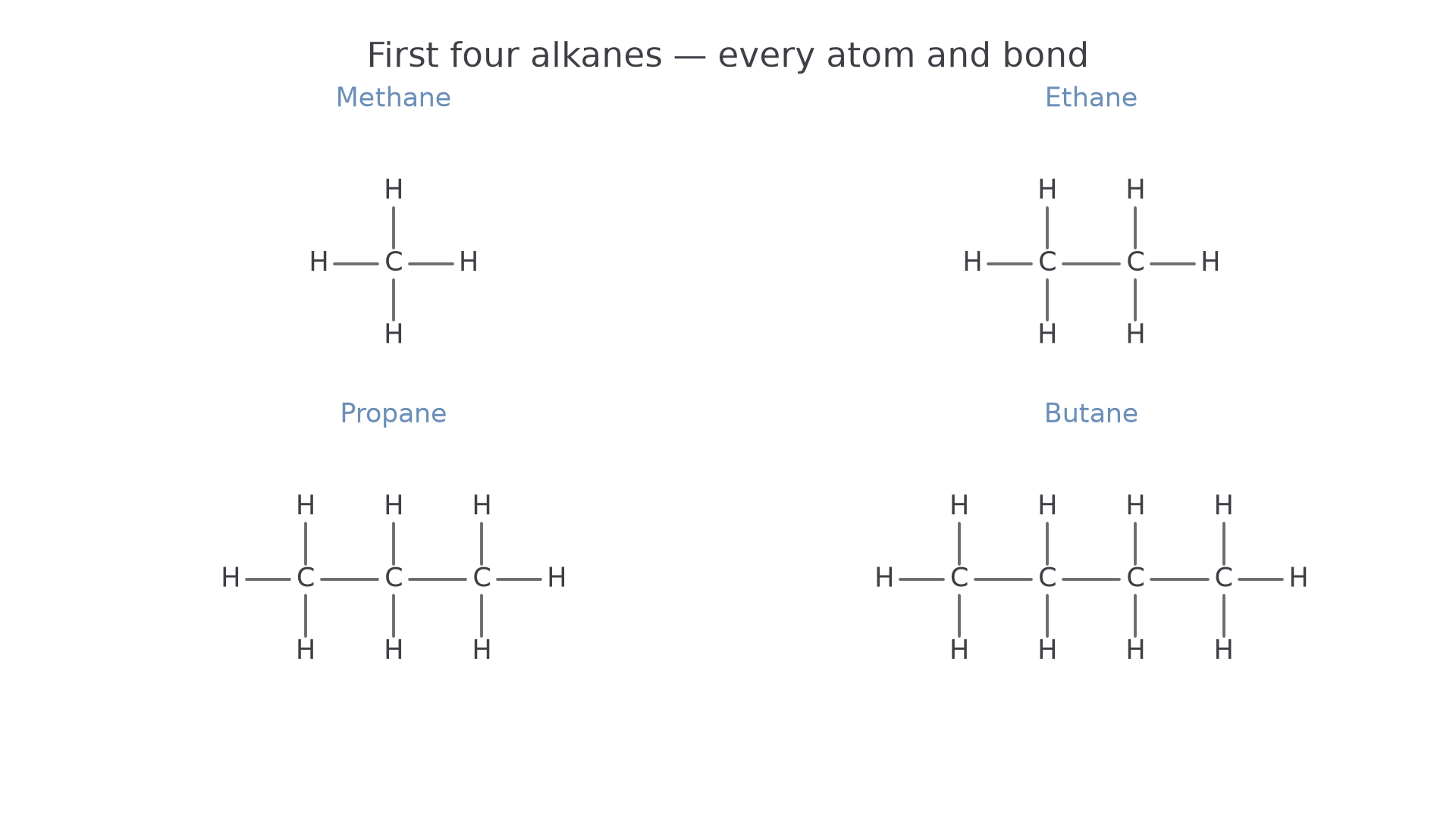
A ball-and-stick model can show the same connections in three dimensions. Rotating that model changes its appearance, not its molecular formula or which atoms are connected. The flat crosses in displayed formulae are a clear way of recording bonds; they do not mean all the bonds in a real molecule lie at right angles in one plane.
Continue this lesson.
You’re previewing NovaLearn without an account. Create a free account to read the rest.
Create free account