99-102 - Two-Dimensional Collisions (CP10)
This lesson connects two-dimensional momentum with Core Practical 10, using ICT and video analysis of collisions to test momentum conservation in perpendicular components. You will then compare kinetic energy before and after a collision and derive the non-relativistic relation , keeping vector momentum separate from scalar kinetic energy.
Momentum As Vector Accounting
Imagine filming from directly above as one small sphere rolls into a second sphere on a horizontal table. Before the collision there may be one track. After the collision there are often two tracks at angles. The important move is not to force those angled tracks back into one line. Momentum is a vector, so it has direction as well as magnitude.
Momentum is:
| Symbol | Meaning | Unit |
|---|---|---|
| momentum | ||
| m | mass | kg |
| velocity |
For a two-sphere system, conservation of linear momentum means:
In two dimensions, use perpendicular components:
Momentum conservation in two dimensions
, (), with measured from the positive axis. Valid for a system with negligible external impulse during the collision.
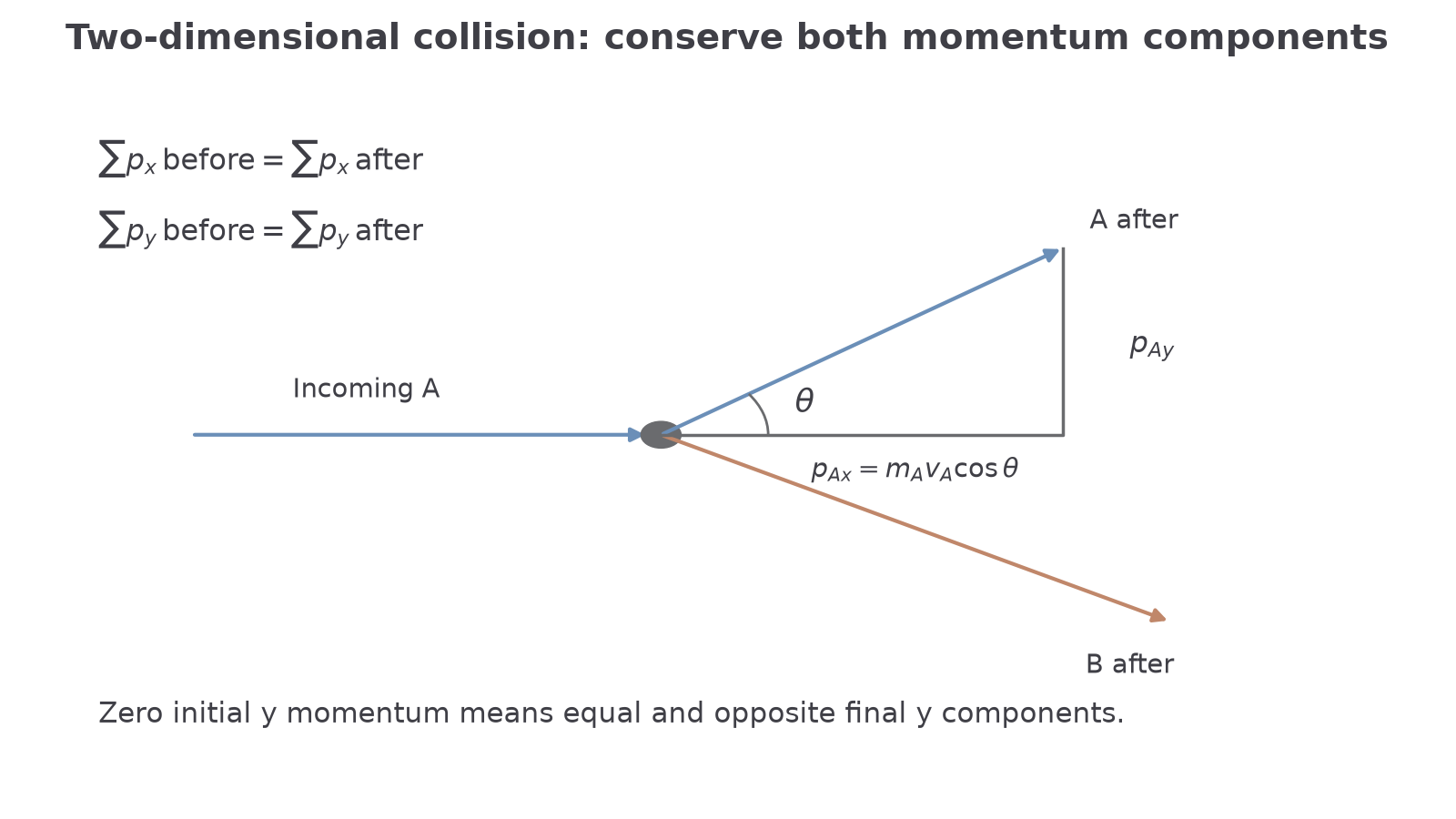
The and equations are separate because forces and momentum changes can be resolved into perpendicular directions. A sideways component cannot be hidden inside the forward component. If the total initial momentum is zero, the total final momentum must also be zero, even if each sphere individually has a non-zero momentum.
Choose the axes before substituting numbers. A common choice is:
- east or right is positive
- north or up the page is positive
- south or down the page is negative
Then resolve each momentum vector:
where is measured from the positive direction. If an object moves below the axis, its component is negative.
A tempting wrong model is: "momentum is conserved along the original direction only." That fails as soon as the spheres leave at angles. The correct model is: momentum is conserved as a vector, so both component totals must balance.
For Edexcel, an explain answer here needs the link: during the short collision the internal forces between the spheres are equal and opposite, so their effects on total momentum cancel; with negligible external impulse, the total momentum of the chosen system is conserved. A calculate or determine answer then has to show the component route, not just a final speed.
[DIAGRAM: asset_name: Collision momentum vectors and perpendicular components, with opposing transverse momenta; asset_slug: fields_collision_components; recommended_method: matplotlib; description: Collision momentum vectors and perpendicular components, with opposing transverse momenta]
Worked Two-Dimensional Collision
Here is the component method in full.
A sphere A moves east at and collides with a stationary sphere B. After the collision, A moves at at north of east. Determine the velocity of B after the collision.
Decision point 1: choose axes. Take east as positive and north as positive .
Decision point 2: momentum is conserved, not speed. Work with , then divide by mass at the end.
Initial momentum:
| Sphere | before / | before / |
|---|---|---|
| A | ||
| B | ||
| Total |
Momentum of A after collision:
Now conserve each component to find B's momentum.
For :
For :
Decision point 3: the negative sign is not an error. It says B moves south of east, so that its momentum cancels A's northward momentum.
Convert B's momentum components into velocity components by dividing by B's mass:
Find the magnitude:
Find the direction:
So B's velocity is at south of east.
Notice the representation shift:
| Verbal information | Component representation | Final vector |
|---|---|---|
| A leaves north of east | positive for A | B must have negative |
| B's velocity is unknown | solve and separately | combine components with Pythagoras and trigonometry |
For an Edexcel determine question, the final velocity needs both magnitude and direction unless the question asks only for a component. A speed alone would not fully describe the vector velocity.
Core Practical Video Data
Core Practical 10 turns the component method into measured evidence. The aim is to use ICT to analyse collisions between small spheres, such as ball bearings, on a table top.
The practical story is:
- Measure the mass of each sphere with a balance.
- Measure the diameter with callipers or a micrometer.
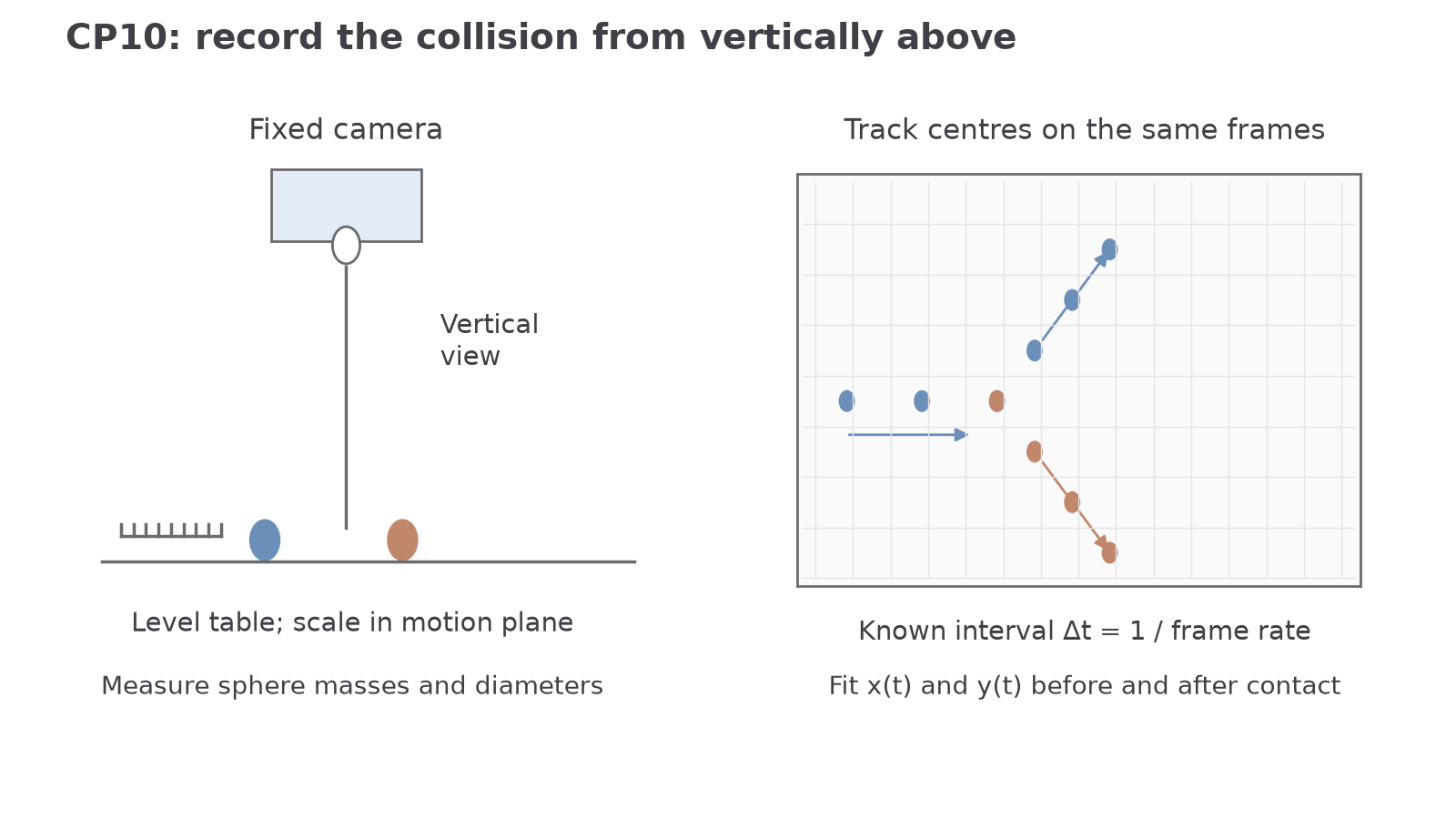
- Put a ruler or scale in the same plane as the motion so the video can be calibrated.
- Film vertically from above, so the camera sees the table as a true x-y plane.
- Roll one sphere into another and record the tracks before and after collision.
- Use video-analysis software, such as Tracker, to obtain velocities.
- Multiply each velocity component by mass to compare momentum components before and after.
- Calculate total kinetic energy before and after if deciding whether the collision is elastic.
The diameter is not inserted into . Its main practical role is to help identify/track the spheres and the geometry of contact. The mass is what converts velocity into momentum.
A good data table does not just list speeds. It keeps the vector information:
| Quantity | Sphere A before | Sphere B before | Sphere A after | Sphere B after |
|---|---|---|---|---|
| / | measured | measured | measured | measured |
| / | measured | measured | measured | measured |
| / | ||||
| / |
Decision point: a velocity overlay is not yet a momentum analysis. If two spheres have different masses, equal speeds do not mean equal momenta. Multiply by the correct mass for each sphere.
The practical only gives strong evidence if the method controls the main sources of uncertainty:
- Camera not vertical: parallax changes measured positions, a systematic effect.
- Calibration scale not in the plane of the motion: all measured distances can be scaled wrongly.
- Low frame rate or blurred frames: velocity from frame-to-frame positions becomes less precise.
- Tracking the edge instead of the centre: the measured path may shift as the sphere turns or overlaps during collision.
- Table not level during the measured run: a component of weight can provide an external force, so momentum may not be conserved for the two-sphere system.
- Too few trials: one collision angle may hide a tracking error or a poor collision.
Repeats help you judge random scatter, but they do not remove a systematic camera-alignment error. That is why an Edexcel evaluate answer must use evidence: say which limitation affects which measured quantity and how it affects the conclusion.
Calculate each velocity from the slope of a position–time graph over several clear frames just before or after contact, rather than using a single blurred collision frame. For example, a centre moving 0.036 m in 0.040 s has a velocity component of . Keep the pre- and post-collision intervals short enough that rolling resistance has little effect, but long enough to resolve displacement. Compare component totals with their uncertainties; a common distance-scale error can scale every momentum by the same factor and leave a before/after ratio deceptively unchanged.
[DIAGRAM: asset_name: Overhead fixed camera, level collision plane and calibration scale, with synchronized sphere-centre tracks and frame timing; asset_slug: fields_cp10_video_apparatus; recommended_method: matplotlib; description: Overhead fixed camera, level collision plane and calibration scale, with synchronized sphere-centre tracks and frame timing]
Continue this lesson.
You’re previewing NovaLearn without an account. Create a free account to read the rest.
Create free account