178-180 - Gravitational Potential, Field Comparisons and Orbits
This lesson completes the gravitational-fields model by adding gravitational potential, comparing it with electric fields, and using Newton's laws to model orbital motion. The common thread is that a field can be described by a force picture, an energy-per-unit-mass picture, and an orbital motion picture, but each uses a different equation and a different sign or direction convention.
Potential as a gravitational well
Imagine a satellite far from a planet. If it is allowed to fall inwards, gravity transfers energy from the gravitational potential store into kinetic energy. To move the satellite back out again, an engine must do work against gravity.
Gravitational potential
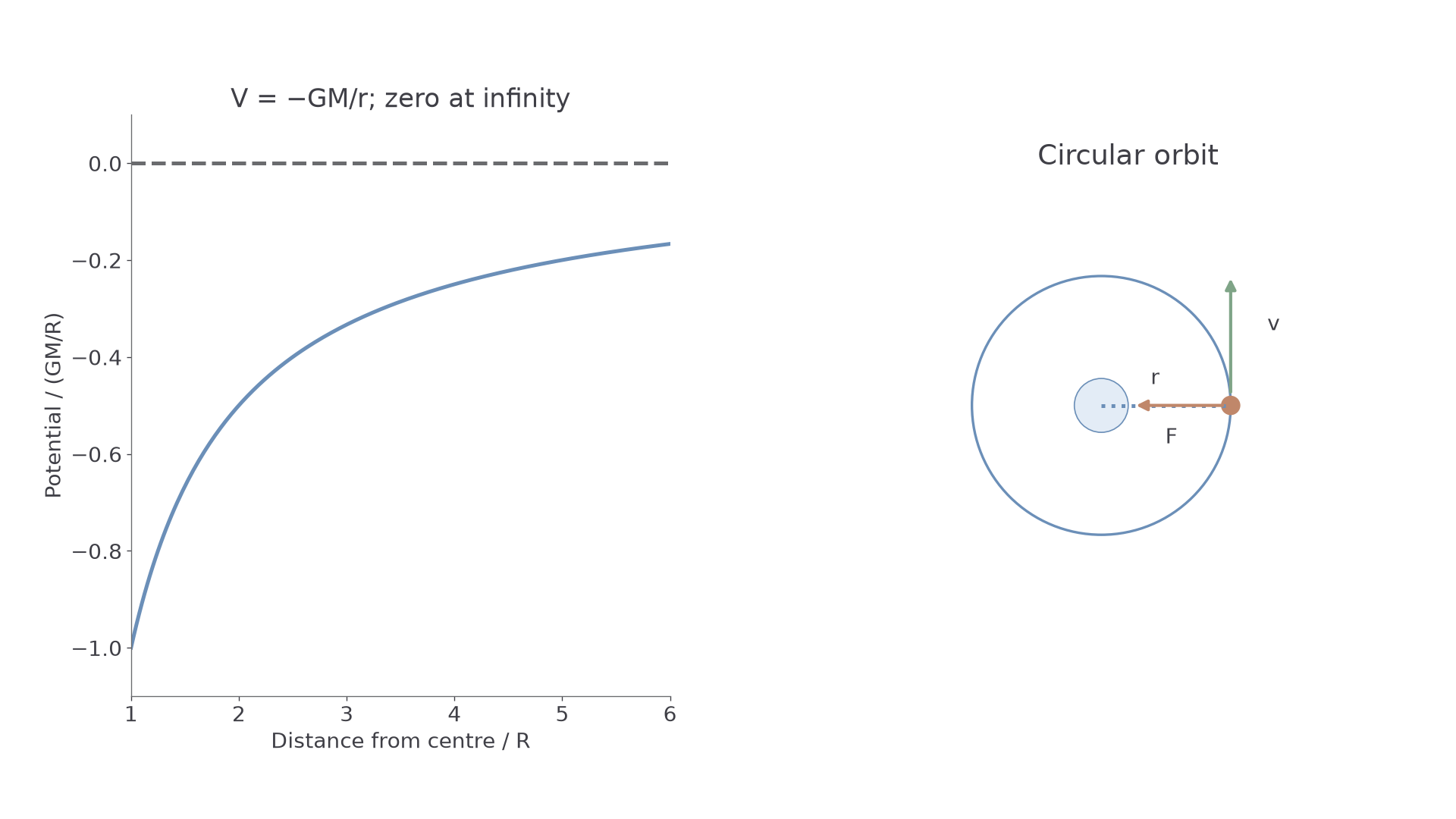
The gravitational potential energy per unit mass at a point in a field, , with zero at infinity; equivalently the work done per unit mass to bring a mass from infinity to that point.
Its unit is joules per kilogram, .
For a radial gravitational field around a spherical mass treated as a point mass,
Gravitational potential of a point mass
: potential (), zero at infinity and negative everywhere else; : source mass (kg); : distance from its centre (m).
where is the gravitational constant, is the mass producing the field, and is the distance from the centre of that mass.
The minus sign matters. We choose at infinity, where the test mass is effectively free from the planet's gravitational field. Any point closer to the planet has negative potential because energy must be supplied to move a unit mass from that point to infinity.
A tempting mistake is to say "closer means larger potential" because the field is stronger. The safer wording is: closer to the mass means the potential is more negative. Moving away makes increase towards zero.
For comparison, gravitational field strength has magnitude
This is not the same quantity. Field strength tells you force per unit mass. Potential tells you energy per unit mass. Their powers of are different, and their units are different.
The work in this definition is the signed work done by an external agent moving a small test mass slowly, with no change in kinetic energy. Moving inward from infinity gives negative external work: gravity does positive work. For a move between radii, external work is , whereas work done by gravity has the opposite sign.
Using gravitational potential
A satellite moving between two points in a radial field changes gravitational potential. The energy change for a satellite of mass is
Change in gravitational potential energy
Use at each radius (from the centre); only applies where is approximately constant.
The calculation route is:
- calculate the potential at the starting radius
- calculate the potential at the finishing radius
- subtract to find
- multiply by the satellite mass if the question asks for an energy change
Worked example: a satellite moves from to from the centre of Earth. Use and . Calculate the change in gravitational potential energy of the satellite.
Route: use potential because the field strength changes with radius. Do not use unless the question justifies that is approximately constant, and do not use altitude unless the question has already converted it to distance from the centre.
Working:
Answer: the satellite gains about of gravitational potential energy. The positive sign says energy has been supplied to move it further from Earth.
In an Edexcel "calculate" response, the credit is usually in the route as well as the final number: correct equation, radius from centre, substitution with powers of ten, unit, and a final value to sensible significant figures.
Comparing electric and gravitational fields
Electric and gravitational fields have a strong family resemblance. Both are force fields. Both can be radial around a point source. Both use an inverse-square relationship for field strength:
Both also have a radial potential proportional to :
The difference is the source. A gravitational field acts on mass. Since mass is always positive in this course, gravity is always attractive. The gravitational field direction is towards the mass producing the field.
An electric field acts on charge. Charge can be positive or negative, so electric forces can be attractive or repulsive. Electric field direction is defined as the direction of the force on a positive test charge, so the field around a positive charge points outwards and the field around a negative charge points inwards.
[DIAGRAM: asset_name: Negative gravitational potential approaching zero at infinity and circular orbit with radius r, inward force F and tangential velocity v; asset_slug: 052_gravitational_potential_field_comparisons_orbits__diagram_01; recommended_method: matplotlib; description: Negative gravitational potential approaching zero at infinity and circular orbit with radius r, inward force F and tangential velocity v.]
For a compare-and-contrast answer, do not write two separate mini-essays. Pair each similarity or difference directly:
- Similarity: both radial field strengths decrease with .
- Similarity: both radial potentials vary with .
- Difference: gravitational potential is negative for a positive mass with zero at infinity, whereas electric potential can be positive or negative depending on the sign of the source charge.
- Difference: gravitational forces between masses are always attractive, whereas electric forces can attract or repel.
Continue this lesson.
You’re previewing NovaLearn without an account. Create a free account to read the rest.
Create free account