136-139 - High-Energy Probes, Mass-Energy and Particle Lifetime
This lesson explains why particle physics needs high-energy probes, then makes that energy measurable through , MeV, GeV and mass units such as . The lesson also keeps the relativistic lifetime idea qualitative: you need to recognise when the effect matters, not calculate a time dilation factor.
Seeing inside a nucleon
A nucleon, such as a proton or neutron, is tiny. If a probe has a wavelength much larger than the thing it is trying to investigate, it cannot resolve fine structure. It is like trying to inspect a watch mechanism using a wave whose crests are wider than the whole watch.
The physics link comes from the de Broglie relationship:
where is wavelength, is the Planck constant and is momentum. A larger momentum gives a smaller wavelength. In particle accelerators, giving charged particles more energy also gives them more momentum, so their de Broglie wavelength becomes short enough to probe much smaller distances.
[DIAGRAM: asset_name: Schematic long and short de Broglie wavelengths resolving nucleon detail; asset_slug: 039_high_energy_particles_mass_energy_lifetime__diagram_01; recommended_method: matplotlib; description: Schematic long and short de Broglie wavelengths resolving nucleon detail]
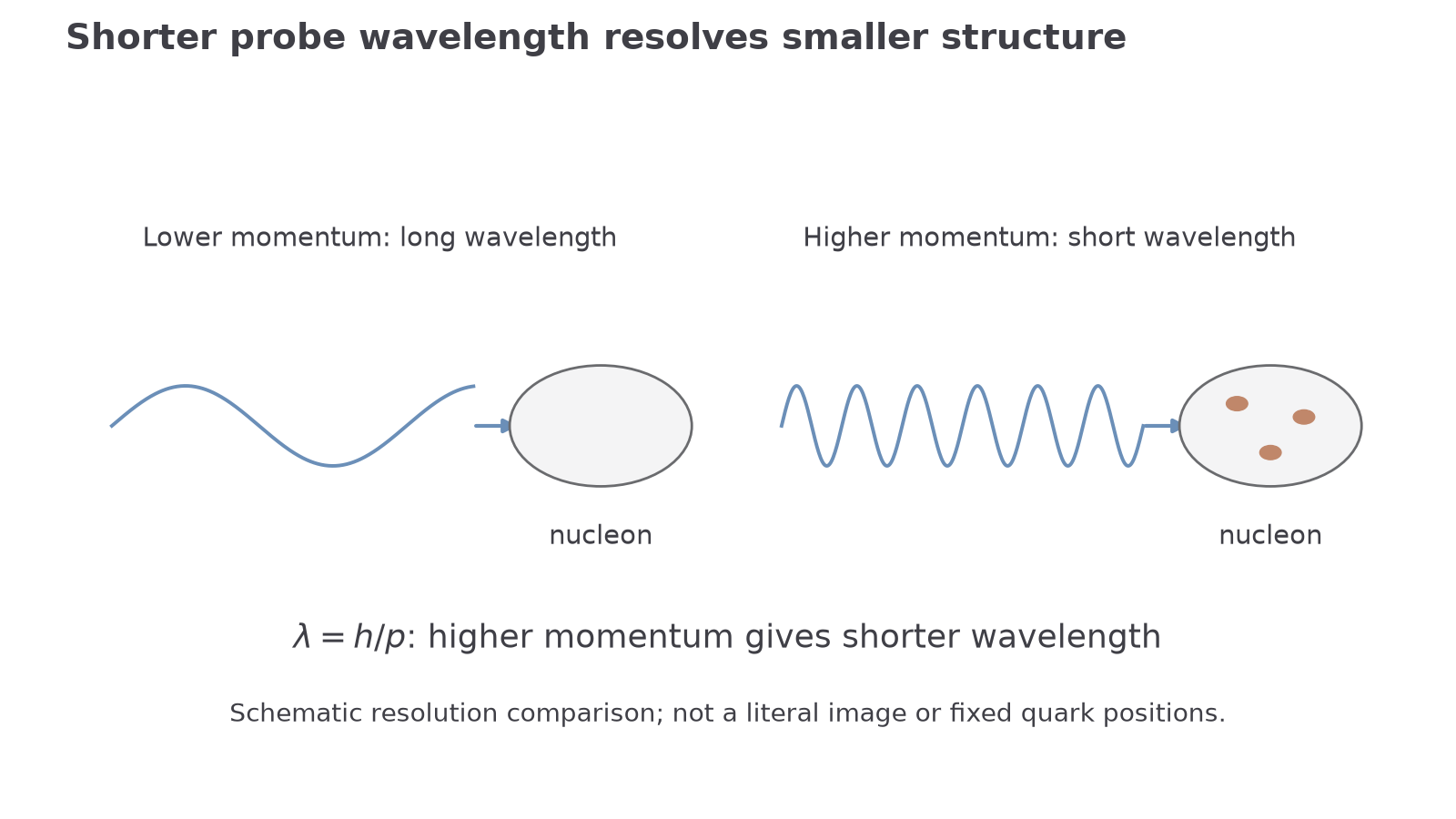
Higher energy gives higher momentum, a shorter de Broglie wavelength (), and resolution of smaller structures such as the inside of a nucleon.
Misconception contrast:
| Tempting idea | Better physics |
|---|---|
| "High energy is needed just to smash particles harder." | High energy is needed because high momentum gives a short probe wavelength, so the probe can resolve structure on the nucleon scale. |
| "A larger wave gives a clearer picture." | For resolving fine detail, a shorter wavelength is better because it can vary over smaller distances. |
For an Edexcel explain command, naming "high energy" is not enough. Link the physical reason: energy, momentum, wavelength and resolution.
Mass-energy bookkeeping
Particle interactions use energy conservation, but rest mass can be part of the energy budget. Edexcel writes this as:
Mass-energy equivalence
: energy equivalent (J); ; : change in total rest mass (kg). Used in creation (energy → rest mass) and annihilation (rest mass → photons and kinetic energy).
where:
| Symbol | Meaning | Unit |
|---|---|---|
| energy change equivalent to the mass change | J | |
| speed of light in a vacuum, | ||
| change in total rest mass | kg |
In annihilation, a matter particle and its antimatter partner can lose rest mass and produce energy in other forms, such as photons and kinetic energy of products. In creation, energy is used to increase total rest mass by producing particles. The exact products must still obey conservation laws, but here the focus is the mass-energy part of the accounting.
Worked example: an electron and a positron annihilate. Use the data-booklet electron mass to calculate the energy released if the pair is initially at rest and all its rest energy becomes photon energy. Give the answer in joules and MeV.
Decision point 1: use the total rest mass of both particles.
Decision point 2: use because the question asks for the energy equivalent of a mass change.
Decision point 3: convert joules to electronvolts, then to MeV.
The result is tiny in joules but natural in MeV. That is why particle physics uses MeV and GeV so often.
For electron–positron creation near a nucleus, the photon must supply at least the pair rest energy, approximately 1.022 MeV; any remaining energy is kinetic energy of the pair and recoiling nucleus. The nucleus can take recoil momentum. A lone photon cannot turn into a pair in empty space while conserving both energy and momentum. Conversely, an electron and positron annihilating at rest produce photons whose momenta must sum to zero: in the usual two-photon case they travel in opposite directions with equal energies of approximately 0.511 MeV each. Total energy, rather than rest mass alone, is conserved.
Particle units
The joule is often too large for single-particle energies. The electronvolt conversion in the data booklet is:
So:
| Unit | Meaning | Conversion to joules |
|---|---|---|
| same energy, different prefix |
Mass units such as and are not energy units. They are mass units chosen so that the rest energy is easy to read.
MeV/c² and GeV/c²
Units of mass: a particle of mass has rest energy 1 MeV (). To get kilograms, convert the rest energy to joules and divide by .
A mass of has rest energy . A mass of has rest energy .
If you need the mass in kilograms, convert the rest energy to joules and divide by .
Worked example: a nucleon has mass about . Convert this to and to kilograms.
Decision point 1: convert the prefix first.
Decision point 2: the rest energy is , so convert that energy to joules.
Decision point 3: use , so .
The answer is sensible because the data booklet gives a proton mass of about .
Continue this lesson.
You’re previewing NovaLearn without an account. Create a free account to read the rest.
Create free account