174-177 - Gravitational Field Strength and Universal Gravitation
This lesson builds the first gravitational-fields toolkit: what a gravitational field is, how to use , how to use Newton's law of universal gravitation, and how to derive for a point mass. The lesson stays with field strength and force; gravitational potential, electric-field comparisons and orbital motion belong to the next lesson.
A Field Is Where Mass Feels Force
Imagine an astronaut drifting near a planet. The astronaut does not need to touch the planet to be pulled. The useful model is that the planet has set up a gravitational field in the space around it, so any mass placed in that region experiences a gravitational force.
Gravitational field
A region in which a mass experiences a force.
Two masses have different roles in this story:
| Role | Meaning |
|---|---|
| source mass | the mass that creates the gravitational field, such as a planet |
| test mass | a small mass placed at a point to reveal the force the field produces there |
The source mass creates the field. The test mass reveals it. Removing the test mass does not remove the field around the source mass.
For the equations in this lesson, the force is gravitational attraction. Near a single source mass, the force on a test mass is towards the source mass. The equations usually give the magnitude of the force or field strength; if a direction is needed, state it in words.
Common misconception contrast:
| Tempting idea | Better model |
|---|---|
| "Gravity only acts when objects are touching." | A gravitational field is a region where a mass experiences force, even without contact. |
| "The field is made by the test mass." | The source mass creates the field; the test mass is used to detect the force at a point. |
For Edexcel, "state what is meant by a gravitational field" needs the force idea. "The area around a planet" is too vague unless it says that a mass experiences a force there.
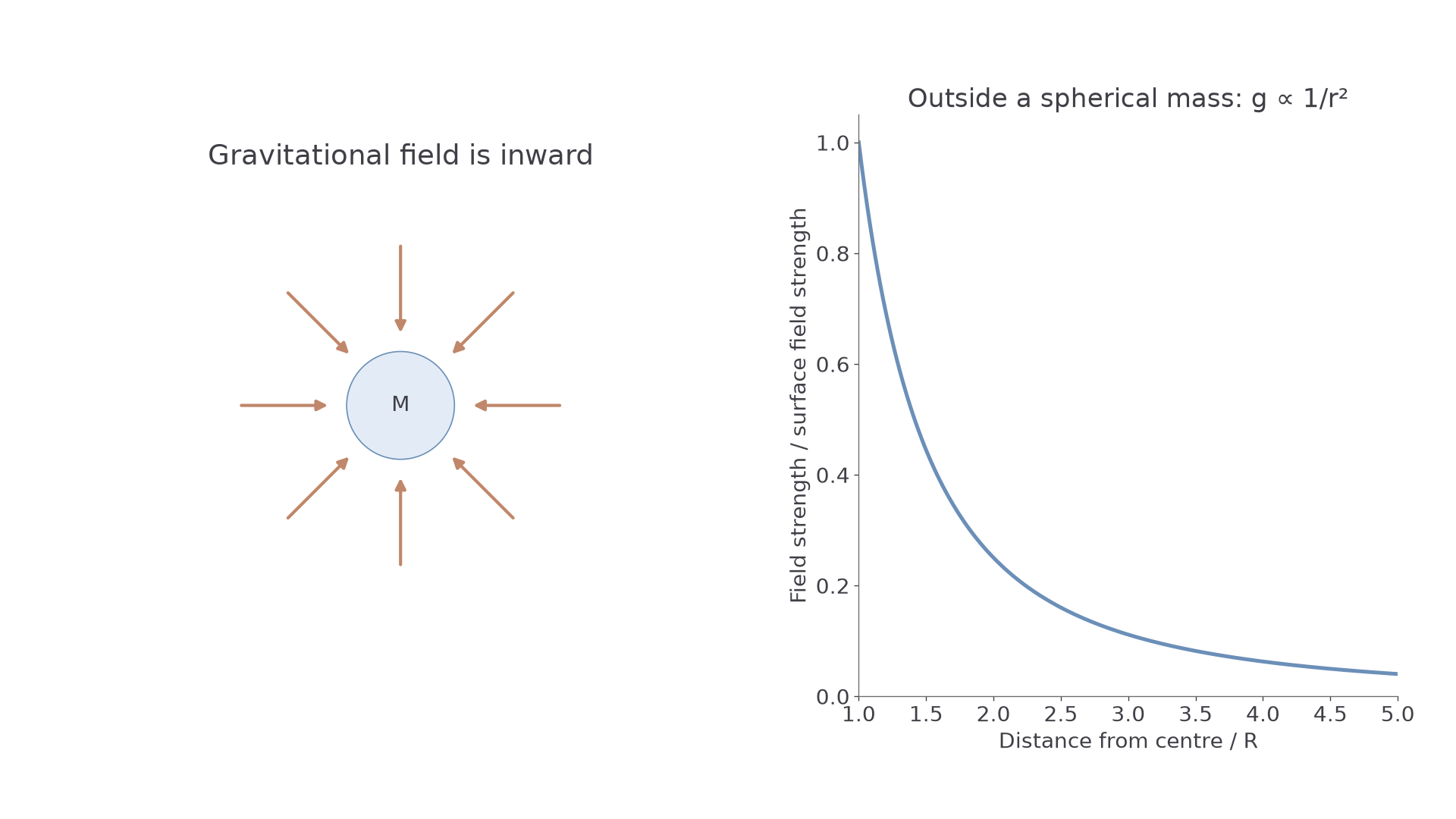
[DIAGRAM: asset_name: Inward radial gravitational field around a spherical mass; asset_slug: 051_gravitational_field__diagram_01; recommended_method: matplotlib; description: Inward radial gravitational field around a spherical mass; outside it g relative to surface value follows inverse square distance from centre.]
Field Strength Is Force Per Kilogram
Once a field can exert a force on a mass, the next question is: how strong is the field at this point?
Gravitational field strength is the gravitational force per unit mass placed at a point:
Gravitational field strength
: field strength (, equivalent to ); : gravitational force (N); : mass placed at the point (kg).
| Symbol | Meaning | Unit |
|---|---|---|
| gravitational field strength at the point | ||
| gravitational force on the mass | ||
| mass experiencing the force |
The unit follows directly from the definition: newtons per kilogram. Since , is equivalent to . In this field lesson, keeps the meaning visible: force for each kilogram.
Worked example:
An astronaut of mass has a gravitational force of on the Moon. Calculate the gravitational field strength at the astronaut's position.
Decision point 1: the question gives force on a known mass, so use the definition of field strength:
Decision point 2: both quantities are already in SI units, so substitute directly:
Answer:
The interpretation matters: each kilogram of mass at that point would experience about of gravitational force.
Now double the astronaut's mass while keeping the same place on the Moon. The gravitational force would double, but would stay the same. A bigger mass feels a bigger force; it does not mean the field strength there is bigger.
For an Edexcel “calculate” item, show the equation, substitution and unit. For an “explain” item, link bigger force and bigger mass to the ratio , not just to "gravity is the same".
Newton's Law Between Two Masses
The definition tells us how strong a field is once we know the force on a mass. Newton's law of universal gravitation tells us the force between two masses:
Newton's law of gravitation
: attractive force on each mass (N); ; , : masses (kg); : separation of centres (m). Point masses or uniform spheres.
| Symbol | Meaning | Unit |
|---|---|---|
| gravitational force between the masses | ||
| gravitational constant, | supplied constant | |
| , | the two masses | |
| separation between the centres of the masses |
The distance is not the gap between surfaces unless the question says the masses are point-like at those positions. For a planet and a spacecraft, use centre-to-centre distance. That usually means planet radius plus height above the surface.
The equation gives the magnitude of the force. The direction is attractive: each mass is pulled towards the other along the line joining their centres. The two forces are equal in size and opposite in direction.
Worked example:
A spacecraft is above the surface of Earth. Model Earth as a point mass at its centre. Use:
| Quantity | Value |
|---|---|
| mass of Earth, | |
| mean radius of Earth | |
| spacecraft mass, |
Continue this lesson.
You’re previewing NovaLearn without an account. Create a free account to read the rest.
Create free account