116-117 - Capacitance and Energy Stored
This lesson covers capacitance as charge stored per volt and the energy stored by a charged capacitor. The main idea is that a capacitor becomes harder to charge as its potential difference rises, so the stored energy comes from the area under a against graph, not from simply multiplying final by final .
Capacitance As Charge Per Volt
A capacitor is a component that stores charge by separating equal and opposite charges on two conducting plates. The whole component remains neutral overall, but one plate has charge and the other has charge . The stored charge usually means the magnitude of the charge on either plate.
When a capacitor is connected to a supply, a potential difference is built up across its plates. A capacitor with a larger capacitance stores more charge for the same potential difference. That is what capacitance measures:
Capacitance
The charge stored per unit potential difference, , where is the magnitude of the charge on either plate. Unit: farad, .
| Symbol | Meaning | Unit |
|---|---|---|
| capacitance | farad, | |
| charge stored on one plate, in magnitude | coulomb, | |
| potential difference across the capacitor | volt, |
The unit follows from the equation:
So a capacitor stores of charge for each volt across it. In school and exam circuits, capacitances are usually much smaller, such as , or .
Worked example:
A capacitor stores when the potential difference across it is . Calculate its capacitance.
The question gives charge and potential difference, and asks for charge stored per volt, so use the definition:
Substitute with units:
This is often clearer as:
Interpretation: each volt across this capacitor is associated with of stored charge.
Misconception contrast:
| Tempting idea | Better model |
|---|---|
| "A capacitor uses up charge." | A capacitor separates charge. Equal and opposite charges appear on the plates, so the component is neutral overall. |
| "Capacitance is the charge stored." | Capacitance is charge stored per potential difference: . |
For an Edexcel “calculate” item, show the formula, substitute SI units, and include the final unit. If you give the answer in , make the power-of-ten conversion visible.
Why Energy Is Half QV
Potential difference is energy transferred per unit charge. If a fixed charge moved through a fixed potential difference, the energy transfer would be .
A capacitor is different while it is being charged. At the start, the capacitor has almost no charge on its plates, so its potential difference is almost zero. Later, as more charge has already been separated, the potential difference is larger. The final bit of charge is moved through nearly the final p.d.; the first bit was not.
For a capacitor with constant capacitance:
so:
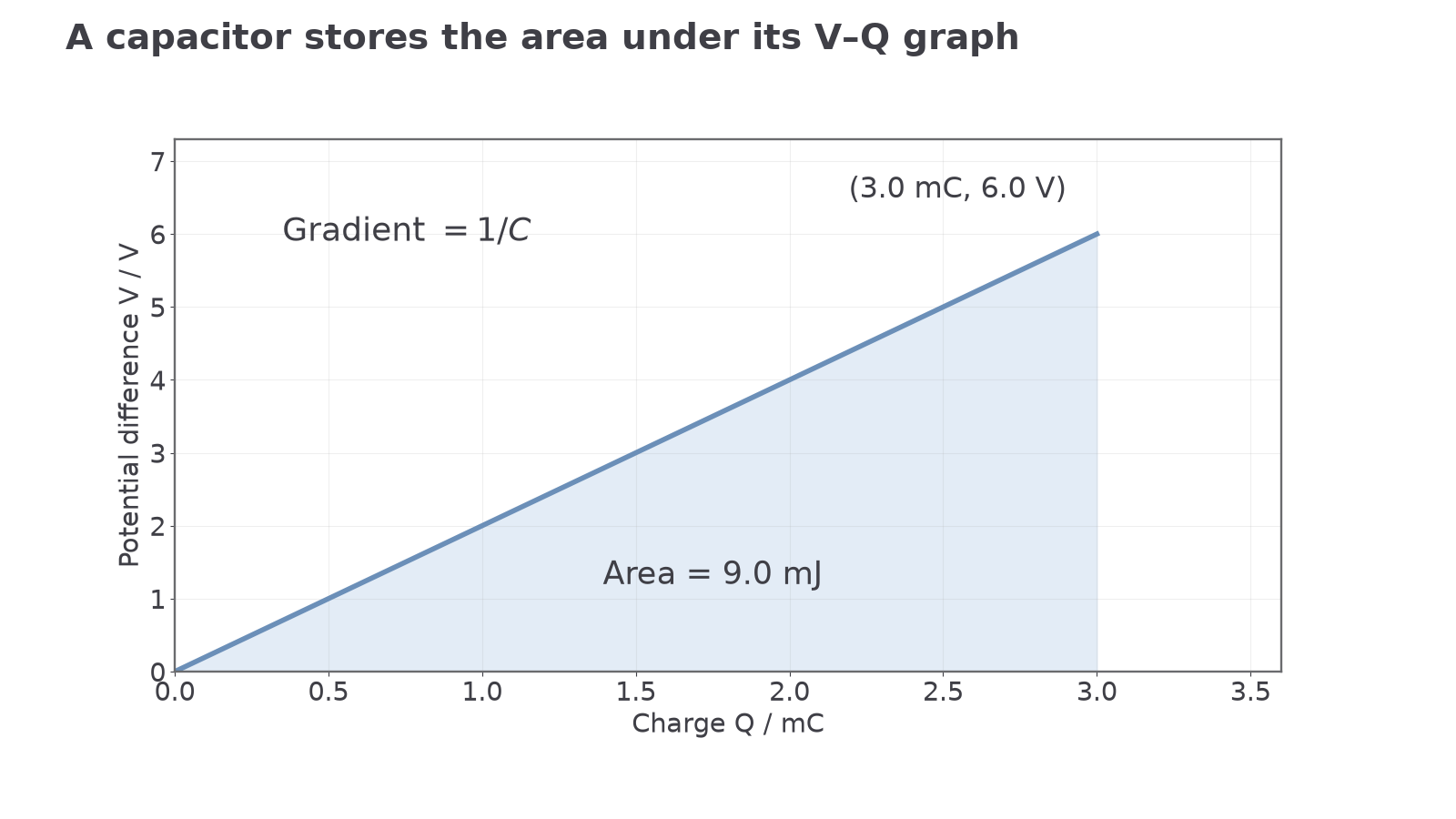
That means is directly proportional to . On a graph of potential difference on the vertical axis against charge stored on the horizontal axis, the line is straight and passes through the origin.
The work done in adding a small amount of charge is:
On a against graph, each small piece of work is a thin strip of area. Therefore:
For a straight line from to final charge and final p.d. , the area is a triangle:
The unit check is useful:
So the graph area has the correct unit for energy.
This is why the answer is not . Multiplying final by final treats every bit of charge as if it crossed the final p.d. In the linear capacitor model, the average p.d. during charging is , so the stored energy is .
[DIAGRAM: asset_name: Linear capacitor voltage-charge graph with triangular stored-energy area and reciprocal-capacitance gradient; asset_slug: fields_capacitor_energy_graph; recommended_method: matplotlib; description: Linear capacitor voltage-charge graph with triangular stored-energy area and reciprocal-capacitance gradient]
Three Energy Forms
Edexcel gives the energy stored in a capacitor in three equivalent forms:
Energy stored by a capacitor
: energy stored (J); : charge on either plate (C); : p.d. across the capacitor (V); : capacitance (F). Equal to the area under the against graph for a capacitor of constant capacitance.
They are not three separate ideas. They are the same graph-area result written for different information.
Start with:
If the question gives and , use :
If the question gives and , use :
Worked example:
A capacitor is charged to a potential difference of . Calculate the charge stored and the energy stored.
Decision point 1: convert the capacitance into farads.
Decision point 2: charge comes from .
Decision point 3: for energy, and are already known, so is the direct route.
The result is small in joules, but it is not small because charge has disappeared. It is small because the capacitance and p.d. are modest. The energy is stored in the electric field associated with the separated charge.
Continue this lesson.
You’re previewing NovaLearn without an account. Create a free account to read the rest.
Create free account