112-115 - Electric Potential, Equipotentials and Uniform Fields
This lesson connects electric field strength to electric potential, uses for parallel plates, uses for a radial field, and interprets field-line and equipotential diagrams for uniform and radial fields.
Potential as an Energy Landscape
Imagine a small positive test charge released in an electric field. It moves because the field can transfer energy to it. Electric potential, , is electric potential energy per unit charge relative to a chosen zero, measured in volts, where .
Electric potential
The electric potential energy per unit charge at a point, relative to zero at infinity. Unit: volt ().
Electric field strength, , is not the same thing as potential. Potential is an energy-per-charge value at a place; field strength tells you how quickly that potential changes with distance and in which direction a positive charge would be pushed.
For a distance interval along a field, gives an average gradient. It is the local gradient as the interval becomes very small, and is exact over a finite interval in a uniform field:
If the coordinate increases in the direction of the field, potential falls as increases, so the sign-aware relationship is:
That minus sign is a direction clue: electric field lines point from higher potential towards lower potential for a positive test charge. In Edexcel calculation questions, the magnitude is often enough, but in interpretation questions the direction is the physics.
A common trap is to say "a high potential means a large field". Not necessarily. A high plateau can be flat. The field is large where the potential changes rapidly with distance.
For a charge moving from A to B, the change in electric potential energy is ; the work done by the field is . A positive charge released from rest tends towards lower potential, whereas a negative charge tends towards higher potential. Both can lose electric potential energy. Across a 200 V fall, a charge loses . Potential is a scalar: add source potentials algebraically, while electric fields must be added as vectors.
Uniform Fields Between Plates
Between two large parallel plates, away from the edges, the electric field is close to uniform. That means the field lines are parallel, equally spaced, and all point from the positive plate to the negative plate. The equipotentials are lines or surfaces of constant potential, so they sit at right angles to the field lines.
[DIAGRAM: asset_name: Uniform and radial fields with perpendicular equipotentials; radial radii follow inverse potential; asset_slug: 031_electric_potential_equipotentials_uniform_fields__diagram_01; recommended_method: matplotlib; description: Uniform and radial fields with perpendicular equipotentials; radial radii follow inverse potential]
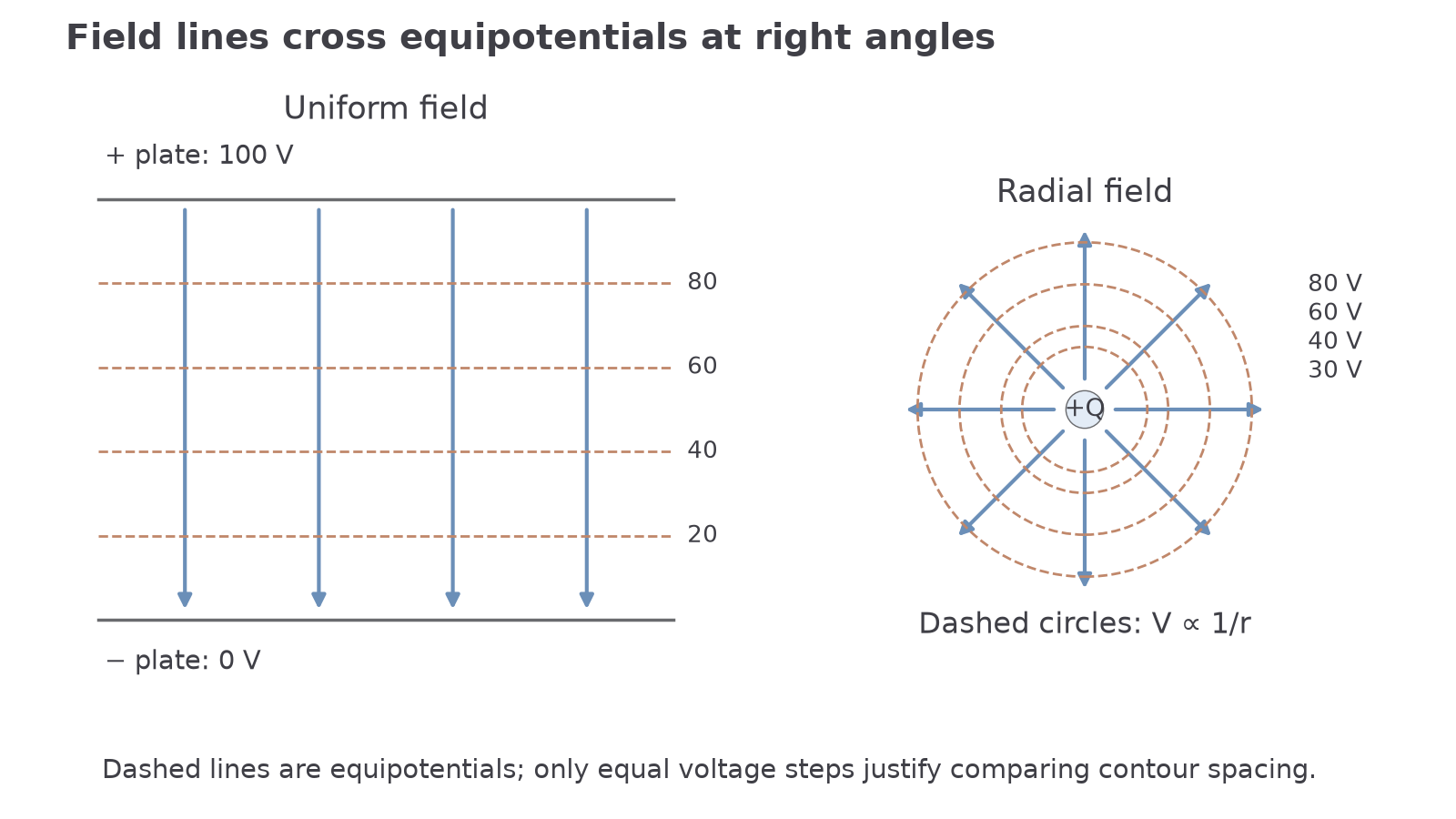
For parallel plates, the potential falls steadily across the gap. If the potential difference between the plates is and their separation is , then:
Uniform field between parallel plates
: field strength (, equivalent to ); : potential difference between the plates (V); : plate separation (m). Applies away from the plate edges, where the field is uniform.
Worked example: a 1.20 kV potential difference is applied across two parallel plates separated by 4.0 cm. Find the uniform electric field strength between the plates.
The field is between parallel plates, so the steady potential gradient model fits. Convert the quantities before substituting:
The answer can also be written as . If the top plate is positive and the bottom plate is negative, the direction is downwards. For an Edexcel "calculate" response, the substitution, unit conversion, final unit and sensible significant figures are all doing credit-bearing work.
Potential Around a Point Charge
A radial field is different. Around a single positive point charge, field lines spread outwards, so the field is strongest close to the charge and weaker farther away. The potential also changes most rapidly close to the charge.
For a point charge or spherical charge treated from outside as a point source, the electric potential at distance from the charge is:
Potential of a point charge
: potential relative to zero at infinity (V); : source charge with its sign (C); : distance from the centre (m); .
is electric potential in volts, is the source charge in coulombs, is the distance from the centre of the source charge in metres, and is the permittivity of free space. The zero of potential is taken to be at infinity. For a positive source charge, is positive; for a negative source charge, is negative.
Continue this lesson.
You’re previewing NovaLearn without an account. Create a free account to read the rest.
Create free account