21-22 - Momentum and Conservation in One Dimension
Momentum as a vector quantity and conservation of momentum in one-dimensional interactions. The route is to keep direction and system boundaries clear before using the conservation equation.
Momentum as Signed Motion
A supermarket trolley is harder to stop when it is loaded than when it is empty. A slow heavy trolley can be as awkward to stop as a fast light one. That everyday idea is the start of momentum: it measures how much moving object there is, including which way it is moving.
For an object of mass moving with velocity :
Momentum
: momentum (kg m s⁻¹, equivalent to N s); : mass (kg); : velocity (m s⁻¹). Momentum is a vector in the direction of the velocity.
Momentum is a vector quantity because velocity is a vector. In one-dimensional problems we do not need arrows in the calculation. We choose one direction as positive and let the sign of and carry the direction.
For example, choose right as positive:
| object | mass / kg | velocity / | momentum / |
|---|---|---|---|
| light trolley moving right | 0.50 | +2.0 | +1.0 |
| heavy trolley moving left | 2.0 | -0.50 | -1.0 |
These two trolleys have equal-sized momenta but in opposite directions. They do not have the same speed, and they do not have the same kinetic energy. Momentum is not "speed with a more impressive name"; it is mass multiplied by velocity.
A useful unit check is:
You may also see momentum measured in , because , so . In this lesson the main unit to write is .
Command-word transfer: if Edexcel asks state what is meant by momentum, a full answer should not only say . It should identify momentum as mass times velocity, and, where relevant, that it is a vector quantity with unit .
Misconception contrast:
- Tempting but wrong: "The object with the bigger speed always has the bigger momentum."
- Correct: momentum depends on both mass and velocity. A more massive object can have a larger momentum even at a lower speed.
Conservation as a System Claim
Momentum conservation is not a claim that each object keeps its own momentum. In a collision, each object usually changes speed or direction. The claim is about the total momentum of a chosen system.
Take two low-friction trolleys on a straight track. During the collision:
- trolley A exerts a force on trolley B
- trolley B exerts an equal and opposite force on trolley A
- those forces are internal to the two-trolley system
Newton's third law gives the equal and opposite force pair. Newton's second law links force to changing motion. Put those together and the internal interaction makes one trolley gain momentum while the other loses the same amount of momentum in the opposite direction. The total for the two-trolley system is unchanged, provided there is no resultant external force along the track.
So the principle is:
Principle of conservation of momentum
For a system with no resultant external force, the total momentum before an interaction equals the total momentum after it.
For two objects moving in one dimension:
Conservation of momentum in one dimension
: masses (kg); : velocities before and : velocities after the interaction (m s⁻¹), all signed with the same positive direction. Valid when the resultant external force on the system along the line of motion is zero.
The words "chosen system" matter. If you choose only one trolley as the system, its momentum is not conserved because the other trolley exerts an external force on it. If you choose both trolleys as the system, the collision forces are internal and cancel in the total momentum account.
The condition also matters. Weight and normal contact forces can act vertically on the trolleys, but for a horizontal track they do not change horizontal momentum. Friction, air resistance, a hand pushing, or a sloping track would be external influences along the line of motion, so they can change the horizontal momentum of the two-trolley system.
Misconception contrast:
- Tempting but wrong: "Momentum is conserved in every collision no matter what."
- Correct: total momentum is conserved for the chosen system when the resultant external force is zero in the direction considered. In a school collision experiment this usually means low friction and a short collision time.
For constant masses, Newton’s second law gives . The interaction lasts the same time for both objects and Newton’s third law gives , so . Hence . This is the link between the two laws and conservation, not a separate conservation assumption about each trolley. When small external forces are present, the approximation is good if their momentum change over the collision is negligible compared with the momentum changes being measured.
Worked Example: Trolleys That Stick
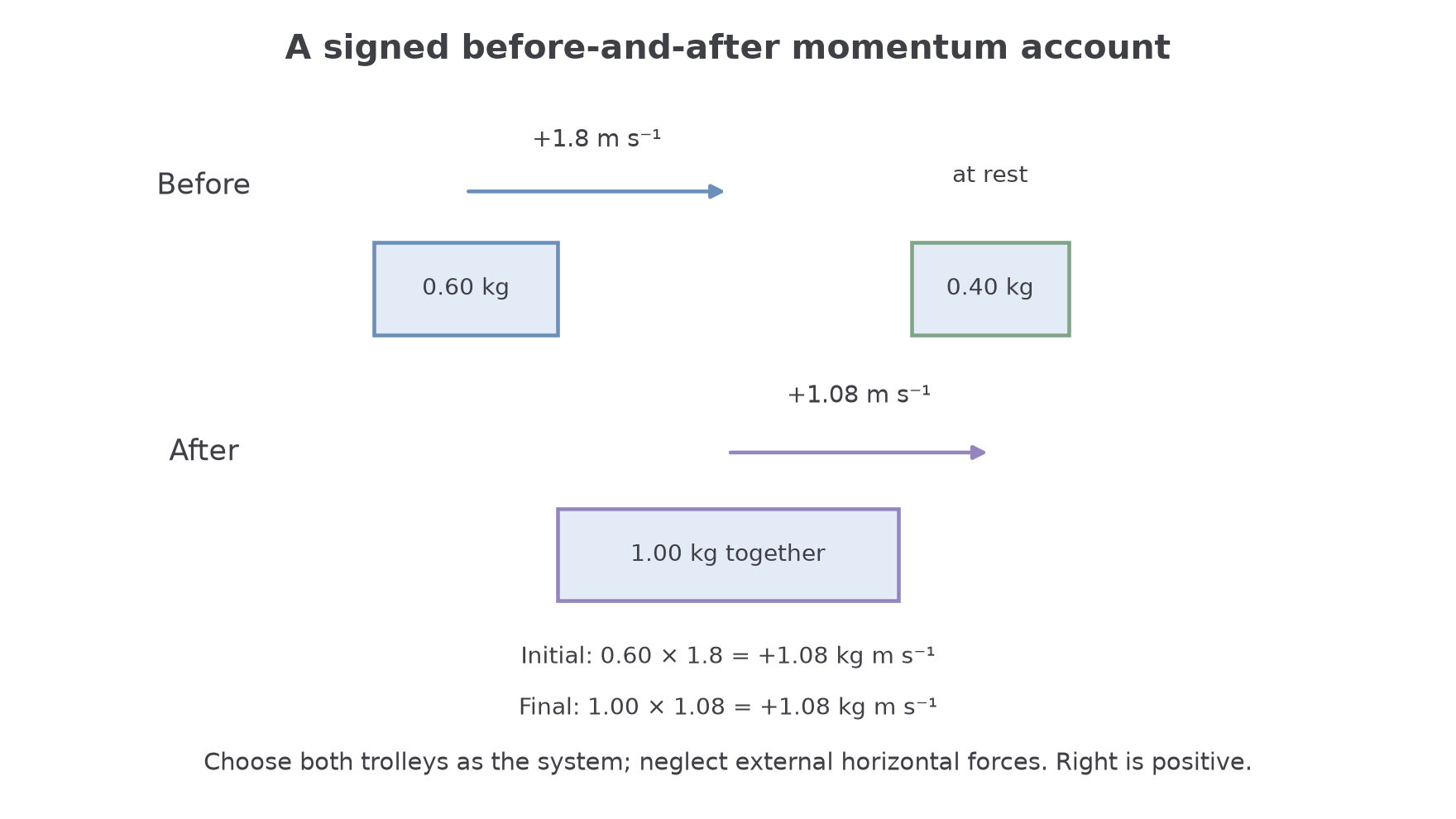
A common one-dimensional collision is a moving trolley hitting a stationary trolley and sticking to it. "Sticking together" is the clue that both trolleys have the same final velocity.
[DIAGRAM: asset_name: Signed momentum before and after coupling; asset_slug: 9ph0_momentum_trolleys; recommended_method: deterministic; description: Before a collision a 0.60 kg trolley at 1.8 m s⁻¹ right approaches a stationary 0.40 kg trolley. After coupling their common speed is 1.08 m s⁻¹ right; both signed totals are 1.08 kg m s⁻¹.]
Worked example:
A 0.60 kg trolley moves right at and collides with a stationary 0.40 kg trolley. The trolleys couple together. Calculate their common velocity immediately after the collision.
Decision point 1: choose the system.
Use both trolleys as the system. The contact forces during the collision are then internal.
Decision point 2: choose a sign convention.
Take right as positive. The first trolley has . The second trolley is stationary, so .
Decision point 3: choose the conservation equation, not a kinetic-energy shortcut.
Because the trolleys stick together, kinetic energy is not generally conserved. Momentum is the conserved quantity for this system.
Set up the before-and-after account:
| stage | trolley A momentum / | trolley B momentum / | total / |
|---|---|---|---|
| before | |||
| after |
Use conservation of momentum:
So the joined trolleys move right at .
Notice what happened physically. The moving trolley slowed down, the stationary trolley started moving, and the total momentum stayed at . The final speed is less than the first trolley's initial speed because the same total momentum is now carried by a larger combined mass.
Command-word transfer: “calculate” means show the equation route, substitution and final unit. A bare is not enough in a mark scheme if the unit or direction is expected.
Opposite Directions and Rebounds
Momentum calculations become much safer when you treat direction with signs from the start. Do not wait until the end and then try to decide whether to add or subtract speeds.
Worked example:
Two gliders move along the same straight air track. Glider A has mass 0.20 kg and moves right at . Glider B has mass 0.30 kg and moves left at . After they collide, glider A moves left at . Determine the velocity of glider B after the collision.
Decision point 1: positive direction.
Choose right as positive. Left is negative.
| glider | mass / kg | velocity before / | velocity after / |
|---|---|---|---|
| A | 0.20 | +0.80 | -0.10 |
| B | 0.30 | -0.40 |
Decision point 2: calculate total momentum with signs.
Decision point 3: use the known final velocity of A, not its initial velocity.
Conservation of momentum gives:
The positive sign means glider B moves right after the collision.
Misconception contrast:
- Tempting but wrong: "Because the gliders approach each other, subtract the final answer from the initial answer."
- Correct: assign a positive direction first, then let the signs do the adding and subtracting. Momentum is a signed quantity in one-dimensional problems.
Command-word transfer: “determine” is often used when the route is not just one direct substitution. Here it means set up the conservation equation with signed velocities and solve for the unknown.
Separating From Rest
Momentum conservation also explains explosions and separations. An "explosion" in physics does not have to mean fire or damage. It can be a spring-loaded trolley pushing two parts apart.
Suppose a system is initially at rest. Its total momentum is zero:
If there is no resultant external force along the track, the total momentum after separation must also be zero:
That does not mean nothing moves. It means the moving parts have equal and opposite momenta.
Worked example:
A stationary spring-loaded cart separates into two parts on a horizontal track. The left part has mass 0.80 kg and moves left at . The right part has mass 1.20 kg. Calculate the velocity of the right part immediately after the separation.
Decision point 1: "at rest" means initial total momentum is zero.
Choose right as positive:
Decision point 2: give the left-moving part a negative velocity.
Use conservation of momentum:
The right part moves right at .
The two parts have momenta:
Their momenta cancel. Their speeds are not equal because their masses are not equal. The less massive part moves faster.
A system that starts at rest still has zero total momentum after it separates: the parts move off with equal and opposite momenta.
Misconception contrast:
- Tempting but wrong: "If the total momentum is zero, every object must have zero momentum."
- Correct: the vector sum can be zero even when individual objects have non-zero momenta in opposite directions.
Testing Momentum Conservation with Measurements
A momentum question can arrive as a clean calculation, a written explanation, or a data comparison. The physics is the same, but the command word changes what earns credit.
For a practical-style data context, the reliable routine is:
- Choose the system.
- Choose the positive direction.
- Calculate each object's momentum before and after.
- Add signed momenta to find total momentum before and after.
- Compare the totals, allowing for uncertainty and possible external forces.
Suppose a video analysis gives:
| quantity | value / |
|---|---|
| total momentum before collision | +0.840 |
| total momentum after collision | +0.805 |
| uncertainty in each total | ± 0.030 |
The totals are close but not identical. The difference is:
When comparing two measured totals, the uncertainty in their difference can be estimated by adding absolute uncertainties:
The observed difference, , is smaller than this comparison uncertainty. A careful conclusion is:
The data are consistent with conservation of momentum within the measurement uncertainty.
That is stronger physics than saying "human error". If the totals differed by much more than the uncertainty, you would look for a resultant external force along the track, such as friction, a slight slope, or a push from the release mechanism. You would also check for systematic measurement issues, such as calibration error in the video scale.
Command-word transfer:
- “Explain” needs linked reasoning: no resultant external force, internal forces are equal and opposite, so the total momentum of the chosen system is unchanged.
- “Comment on” or “evaluate” needs evidence: compare numerical totals, compare with uncertainty, then make a supported judgement.
- “Show that” needs a value reached with enough working and precision before rounding to the stated value.
The exam habit to build is simple: do not write conservation as a slogan. Show the before-and-after account.
To obtain the momentum data, measure each trolley’s total moving mass, including its interrupt card, on a balance. Level the track and use low friction or an air track. Place light gates close to either side of the collision region; measure the card lengths and use immediately before and after contact. A light gate gives a speed magnitude: record the observed travel direction separately before assigning signs. Ensure the software associates each interruption with the correct trolley, especially after a rebound. Use stops or a catch zone so trolleys cannot fall from the bench.
Repeat the collision under comparable conditions and compare the signed totals with their combined uncertainties. Measuring far from the collision gives friction more time to change the momenta. A video alternative needs a known length in the plane of motion and a verified frame interval; a common scale-factor error changes all measured momenta together, so it does not by itself explain unequal before/after totals when applied identically.