103-107 - Angular Speed, Circular Motion and Centripetal Force
This lesson covers angular displacement, angular velocity, circular motion, centripetal acceleration and centripetal force. The goal is to keep tangential motion and inward acceleration separate before combining them in calculations.
Angles as fractions of a turn
Imagine two dots painted on the same turntable: one close to the centre and one near the edge. After one complete turn, both dots have turned through the same angle, even though the outer dot has travelled a much longer distance. This is why circular motion begins with angular quantities, not distance along the path.
Angular displacement, , is the angle turned through. It can be measured in degrees or radians.
A radian is built from the circle itself:
So one complete revolution has arc length equal to the circumference, .
That gives the key conversion:
Use these as conversion factors:
Radians are the natural angle unit for circular-motion equations because makes the radius cancel cleanly. A calculator in degree mode may still give correct arithmetic for ordinary degree conversions, but when an equation uses inside a sine or cosine later in the course, the angle must be in radians. Build the habit here: angular equations use radians unless a question is explicitly only asking for degrees.
Angular velocity, , is the instantaneous rate of change of angular displacement. For uniform rotation, or for the average angular velocity over an interval:
Its unit is . The radian is dimensionless, but writing is useful because it reminds you that the quantity is angular, not linear.
Radian
The angle subtended at the centre of a circle by an arc equal in length to the radius; , so one revolution is .
Angular velocity
The rate of change of angular displacement, , in . Every point on a rigid rotating object has the same .
Misconception contrast: saying "the edge of the turntable has a bigger angular velocity" is tempting because the edge moves faster along the path. It is not correct for a rigid turntable. Every point completes the same angle in the same time, so every point has the same . The difference is the linear distance travelled at different radii.
From angular speed to linear speed
Return to the turntable. The outer dot covers a longer arc than the inner dot in the same time. That longer arc is why the outer dot has a greater linear speed.
The arc length relation is:
Divide by time:
is the linear speed , and is the angular velocity , so:
This equation links two different descriptions of the same motion:
- tells you how quickly the object turns, in .
- tells you how far the object is from the centre, in .
- tells you the tangential speed along the circular path, in .
For one complete revolution, the angular displacement is . If the time for one complete revolution is the period , then . Rearranging gives the data-booklet form:
Angular and linear speed
: linear (tangential) speed (); : angular velocity (); : radius (m); : period of one revolution (s). Angles must be in radians.
Worked example: a turntable makes 15.0 revolutions in 12.0 s. One mark is from the centre and a second mark is from the centre. Determine the angular velocity and the linear speed of each mark.
Decision point 1: convert revolutions to radians before finding angular velocity.
Decision point 2: the two marks share the same because they are on the same rigid turntable.
Decision point 3: do not give the linear speed in . Linear speed is distance per time, so its unit is .
The result also passes a proportional check: the outer radius is four times the inner radius, so the outer linear speed is four times larger for the same angular velocity.
Show the physical route and keep units consistent: revolutions must become radians before you use .
Why constant speed can accelerate
Uniform circular motion can feel odd at first: the speed can be constant, but the object is still accelerating. The reason is that velocity is a vector. It has a magnitude and a direction. In circular motion the magnitude of velocity may stay the same, but the direction changes continuously.
At any instant, the velocity is tangential to the circle. A short time later, the object has moved to a new point, and the velocity is tangential there instead. The two velocity arrows have equal length if the speed is constant, but they point in different directions.
[DIAGRAM: asset_name: Equal tangential velocity vectors and head-to-head change directed inward; small-angle centripetal derivation; asset_slug: 029_angular_quantities_circular_motion_centripetal_force__diagram_01--3c3b1bde; recommended_method: matplotlib; description: Equal tangential velocity vectors and head-to-head change directed inward; small-angle centripetal derivation]
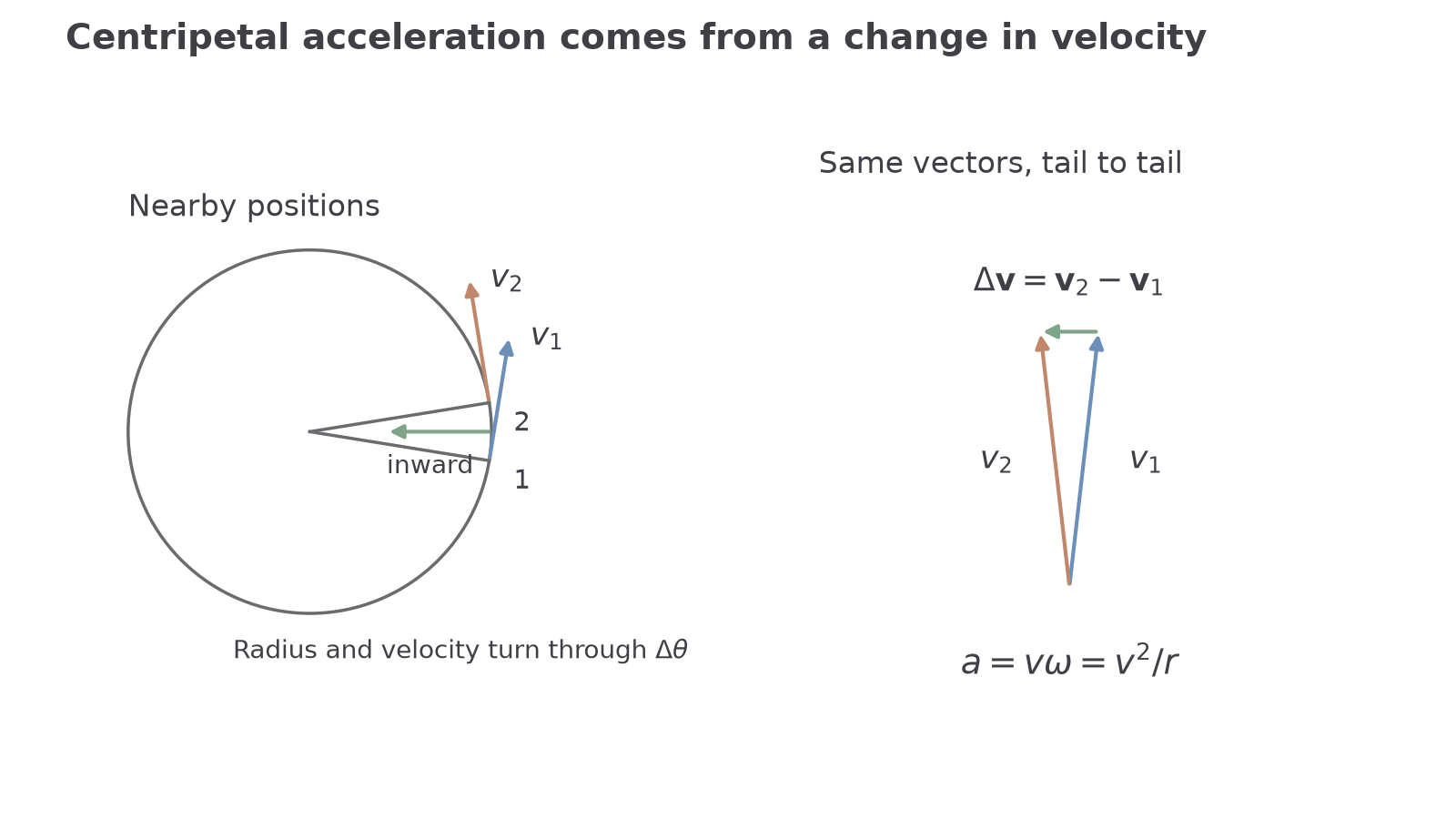
The derivation is a small-angle vector argument.
- Choose two instants separated by a very small time .
- The radius turns through a small angle .
- The velocity direction also turns through the same angle , because the velocity is always perpendicular to the radius.
- In the velocity-change triangle, the change in velocity is .
- For a small angle in radians:
So:
Divide by the time interval:
The left side becomes acceleration as the time interval becomes very small. The right side contains , which is angular velocity.
Now use , or equivalently .
So the centripetal acceleration is:
Centripetal acceleration
: acceleration towards the centre (); : speed (); : radius (m); : angular velocity (). Applies to uniform circular motion.
The direction is towards the centre of the circle. That direction comes from the arrow in the velocity triangle, not from the direction the object is travelling.
Misconception contrast: "constant speed means zero acceleration" is true only if the velocity vector is constant. In circular motion, the direction of velocity keeps changing, so the acceleration is not zero even when the speed is constant.
For the command word “derive”, do not just quote . A derivation needs a chain: velocity changes direction, the velocity triangle has the same small angle, in the small-angle limit, divide by , then substitute .
Continue this lesson.
You’re previewing NovaLearn without an account. Create a free account to read the rest.
Create free account