153-155 - Black Body Radiation and Thermal Laws
This lesson is about what a black body radiator means, how to interpret its radiation curves, and how two supplied equations describe those curves. The curve tells you where the radiation is concentrated in wavelength and how much total power is emitted. This lesson stays with black-body radiation itself; luminosity-intensity-distance methods and HR diagrams belong to later lessons.
A hot surface emits a whole curve
Imagine increasing the current through a tungsten filament. It first glows dull red, then orange-white, and eventually dangerously bright. The surface is not choosing one wavelength; it emits a continuous spread of electromagnetic radiation because its thermal energy is being shared among many possible wavelengths.
Black body radiator
An ideal surface that absorbs all the electromagnetic radiation incident on it and is the best possible emitter at a given absolute temperature.
Real objects are not perfect black bodies, but dense hot objects such as stars, furnace walls and lamp filaments can be good enough approximations for this model.
A black-body radiation curve usually has wavelength on the horizontal axis and emitted power per unit wavelength on the vertical axis. Three features matter:
- the curve is continuous, not a set of spectral lines
- the peak wavelength, , moves to shorter wavelength as temperature increases
- the total area under the curve increases strongly as temperature increases
[DIAGRAM: asset_name: Exact Planck spectra for 3000, 4500 and 6000 K, spectral power per unit area against wavelength in micrometres; asset_slug: 044_black_body_radiation_stefan_boltzmann_wien__diagram_01; recommended_method: matplotlib; description: Exact Planck spectra for 3000, 4500 and 6000 K, spectral power per unit area against wavelength in micrometres; dashed peak wavelengths.]
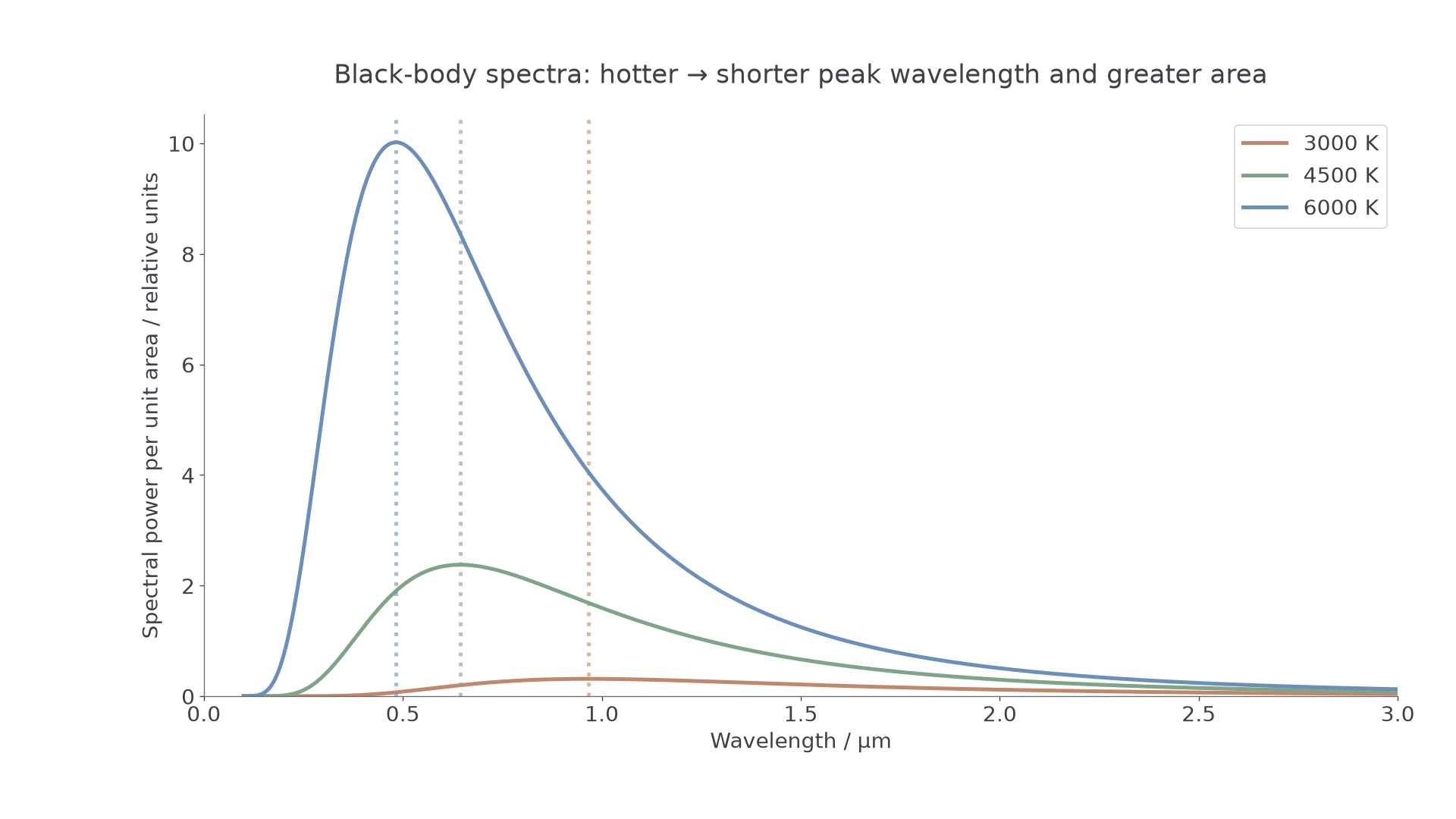
The common mistake is to treat colour as if the object emits only one wavelength. A 6000 K black body peaks near visible light, but it still emits infrared and ultraviolet too. The peak is the largest contribution per unit wavelength, not the whole output.
Wien's law reads the peak
The graph gives a visual rule: hotter black bodies peak at shorter wavelengths. Wien's law turns that into an equation:
Wien's law
: wavelength at the peak of the curve (m); : absolute temperature (K). For a black body.
is the wavelength at the peak of the black-body curve, measured in metres. is the absolute temperature in kelvin. The constant has units , so the product of wavelength and temperature is constant for a black body.
Worked route: a star approximates a black body with surface temperature . Estimate the peak wavelength.
The decision point is equation choice. We want the wavelength of the peak, so use Wien's law, not the Stefan-Boltzmann law. Temperature is already in kelvin, and the equation gives wavelength in metres.
is , which is in the visible region. That does not mean the star emits only green-blue visible light; it means the maximum of its continuous black-body curve is around that wavelength.
For a cooler black body at :
The peak has moved towards the infrared, so a larger fraction of the visible output is towards the red end.
In an Edexcel "calculate" response, make the rearrangement visible, substitute with powers of ten, and finish with a unit. In an "explain" response, link the shorter peak wavelength to higher absolute temperature through the inverse relationship in Wien's law.
Stefan-Boltzmann counts the total output
Wien's law reads the peak position. The Stefan-Boltzmann law describes the total power emitted by a black body:
Stefan-Boltzmann law
: luminosity, the total power emitted (W); ; : surface area (), for a sphere; : absolute temperature (K).
is luminosity: the total power emitted by the radiator, in watts. is the Stefan-Boltzmann constant, supplied by Edexcel as . is the surface area in , and is absolute temperature in kelvin.
For a spherical star, the emitting surface area is , so the supplied form becomes:
Worked route: estimate the luminosity of a Sun-sized black-body star with radius and surface temperature .
The decision point is surface area. The star is spherical, so use , not . The fourth power also matters: calculate , not .
Continue this lesson.
You’re previewing NovaLearn without an account. Create a free account to read the rest.
Create free account