124-127 - Electromagnetic Induction, Lenz's Law and Faraday's Law
This lesson covers how an e.m.f. is induced by changing magnetic flux linkage, how linked coils can induce an e.m.f. without visible motion, and how Lenz's law and Faraday's law work together. The thread through the lesson is simple but easy to misuse: change produces the induced e.m.f.; Lenz's law gives its direction; Faraday's law gives its magnitude.
Change, Not Presence
Imagine a coil connected to a centre-zero voltmeter. A bar magnet is pushed into the coil, held still, then pulled out. The meter needle flicks while the magnet is moving, returns to zero when the magnet is held still, and flicks the other way when the magnet is pulled out.
That observation is the heart of electromagnetic induction.
Electromagnetic induction
An e.m.f. is induced in a circuit whenever the magnetic flux linkage through it changes; a steady flux linkage, however large, induces no e.m.f.
From the previous magnetic-flux lesson:
- is the magnetic flux through one turn of a coil.
- is the flux linkage for a coil with turns.
- has no unit; flux linkage is measured in weber-turns.
The magnet can be near the coil without producing a sustained induced e.m.f. If the flux linkage is steady, the induced e.m.f. is zero. The important phrase is rate of change.
For a coil and permanent magnet, the induced e.m.f. is larger when the flux linkage changes more rapidly. That can happen if:
- the magnet and coil move faster relative to each other
- the magnet is stronger, so the flux change is larger
- the coil has more turns, so the same flux change per turn gives a larger flux linkage change
- the magnet and coil are better aligned, so more of the magnet's field links the turns
Common misconception contrast:
| Tempting idea | Better model |
|---|---|
| "A magnet inside a coil makes electricity." | A changing flux linkage through the coil induces an e.m.f. |
| "The e.m.f. depends only on how strong the magnet is." | Magnet strength matters, but the rate of change of flux linkage matters too. A weaker magnet moved quickly can produce a larger e.m.f. than a stronger magnet held still. |
In an Edexcel “explain” answer, do not stop at "the magnet moves". Link the motion to changing flux linkage, and then to induced e.m.f.
Changing Current in a Linked Coil
Motion is one way to change flux linkage, but it is not the only way.
Place two coils close together on an iron core. Connect the first coil, the primary coil, to a cell and switch. Connect the second coil, the secondary coil, to a centre-zero voltmeter. When the switch in the primary circuit is closed, the current in the primary rises from zero to a steady value. That changing current produces a changing magnetic field in the core, so the flux linkage through the secondary coil changes and an e.m.f. is induced in the secondary.
Once the primary current is steady, the secondary voltmeter returns to zero. The magnetic field may still be present, but it is no longer changing.
The induced e.m.f. in the secondary is larger when:
- the primary current changes more rapidly
- the change in primary current is larger
- the coils have more turns
- the coils are more tightly linked, for example by using a soft iron core
- the coils are closer together or better aligned
This is the same physics as the moving magnet: the secondary coil responds to a changing flux linkage. The cause of the change is different.
This also explains why a steady direct current in the primary does not keep inducing a steady e.m.f. in the secondary. A current that has stopped changing gives a magnetic field that has stopped changing. Alternating-current details belong to the next lesson, but the useful preview is that a continuously changing current can keep inducing an e.m.f. in a linked coil.
Worked example: a primary coil is switched on near a secondary coil. A student says, "The secondary coil has an induced e.m.f. because current flows in the primary." Improve the explanation.
Decision point 1: current in the primary is not enough. A steady current gives a steady magnetic field.
Decision point 2: the secondary needs a changing flux linkage.
A stronger answer is: "When the primary current changes, the magnetic field produced by the primary changes. This changes the flux linkage through the secondary coil, so an e.m.f. is induced in the secondary. When the primary current is steady, the flux linkage through the secondary is steady and the induced e.m.f. is zero."
Lenz's Law as an Opposition Rule
Lenz's law predicts the direction of the induced e.m.f.:
Lenz's law
The induced e.m.f. (and any induced current) acts in the direction that opposes the change producing it.
The word change is the careful word. The induced effect does not always oppose the magnetic field itself. It opposes the increase or decrease in flux linkage that caused the induction.
Use this routine:
- Identify the change in flux linkage.
- Decide what magnetic effect would oppose that change.
- Use the right-hand grip rule to convert the induced magnetic effect into current direction if the circuit is complete.
For a coil viewed from one end:
- anticlockwise conventional current makes that end a north pole
- clockwise conventional current makes that end a south pole
Now apply that to a magnet and coil.
| Situation | What the coil must do | Direction consequence |
|---|---|---|
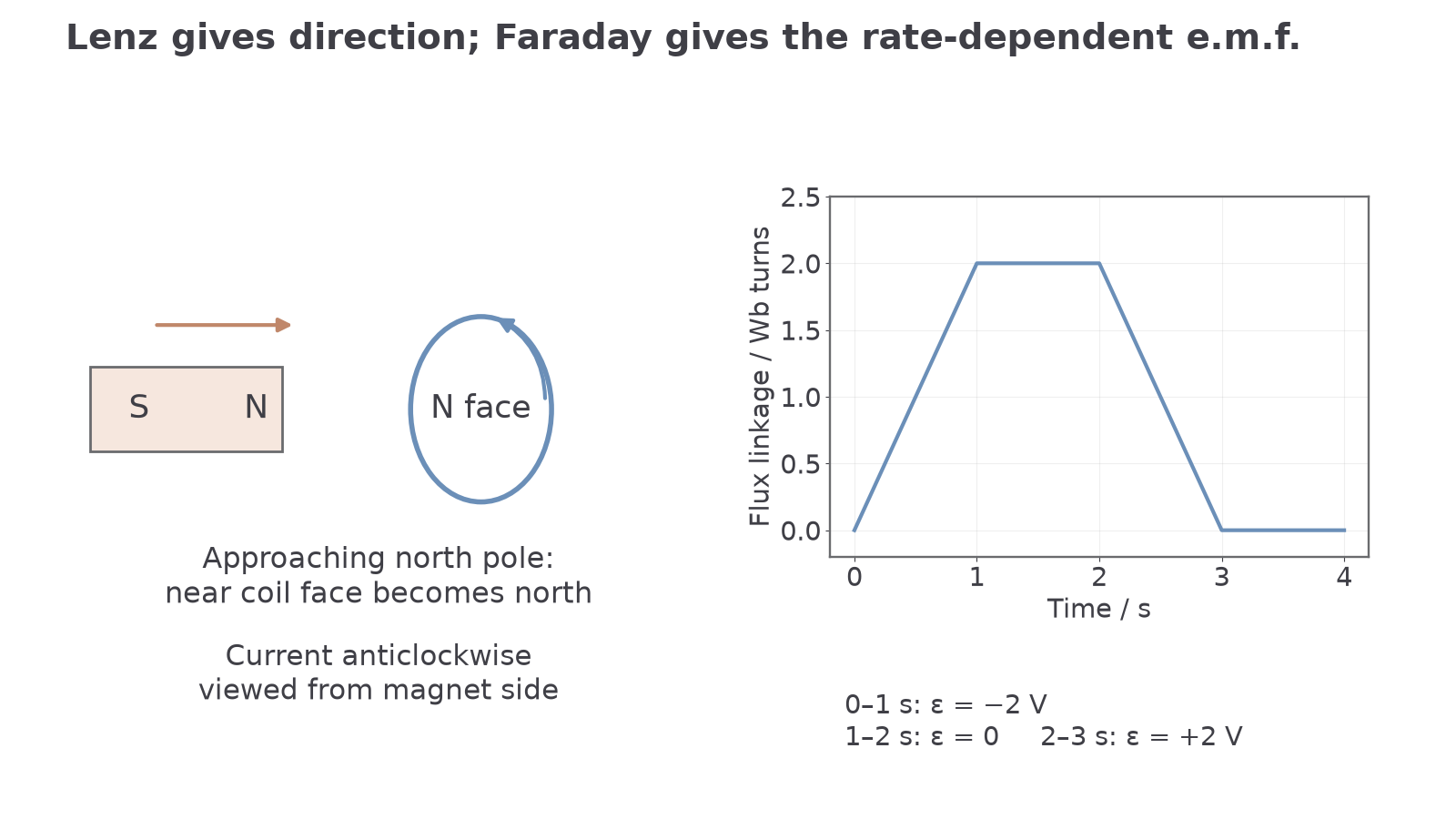
| North pole approaches the coil | make the near face north to repel the approaching north pole | current is anticlockwise when viewed from the magnet side |
| North pole moves away from the coil | make the near face south to attract the north pole back | current is clockwise when viewed from the magnet side |
This is not a trick about magnets. It is energy conservation. If the induced current helped the magnet move, the magnet would gain kinetic energy while electrical energy was also produced. Energy would appear from nowhere. Instead, you must do work against the magnetic effect; that work is the source of the electrical energy and any thermal energy dissipated in the circuit.
The same logic works for linked coils. If the primary current is rising, the induced effect in the secondary opposes the increasing linked field. If the primary current is falling, the induced effect acts to reduce the decrease. In both cases, the induced e.m.f. resists the change rather than supplying free energy.
[DIAGRAM: asset_name: Approaching north magnet induces opposing north coil face; flux-linkage slopes give signed induced emf; asset_slug: fields_induction_lenz_faraday; recommended_method: matplotlib; description: Approaching north magnet induces opposing north coil face; flux-linkage slopes give signed induced emf]
Continue this lesson.
You’re previewing NovaLearn without an account. Create a free account to read the rest.
Create free account