17-20 - Newton’s Laws, Weight and Free Fall (CP1)
Newton's laws, weight, free fall and Core Practical 1 (determining the acceleration of free fall). You will link forces to changes in motion, then use practical evidence to test the relationship between resultant force, mass and acceleration.
Resultant Force Changes Motion
Imagine a dynamics trolley on a very smooth track. A short push gets it moving. Once the push has stopped, a tempting everyday idea says, "there is no force, so it should stop." Physics asks a sharper question: is there a resultant force?
The resultant force is the vector sum of all forces on the chosen body. Along one line, choose a positive direction and add the signed forces; in two dimensions, resolve and sum each perpendicular component separately. Newton's second law, for constant mass, is
Newton's second law
: resultant force (N); : mass (kg); : acceleration (m s⁻²), in the direction of the resultant force. Applies to a body of constant mass.
This equation is not saying "force makes velocity." It is saying resultant force makes acceleration. Acceleration means the velocity changes: the object may speed up, slow down, or change direction.
Newton's first law is the zero-resultant-force case inside the same idea:
So an object at rest stays at rest, and an object already moving continues at constant velocity, unless there is a non-zero resultant force.
The phrase "constant velocity" includes both constant speed and constant direction. If an object is moving steadily in a straight line, the resultant force is zero even though it is moving.
Misconception contrast:
| Tempting idea | Better Physics model |
|---|---|
| A force is needed to keep an object moving. | A resultant force is needed to change velocity. |
| If the object is moving, the forward force must be bigger. | If it is moving at constant velocity, forward and backward forces are balanced. |
| Zero resultant force means the object must be stationary. | Zero resultant force means zero acceleration: stationary or constant velocity are both possible. |
Edexcel often uses “explain” here. A good explanation links the force balance to acceleration, then links acceleration to motion. For example: "The forward and resistive forces are equal, so the resultant force is zero. Since , the acceleration is zero, so the trolley continues at constant velocity."
Weight and Gravitational Field Strength
Mass and weight are easy to blur because everyday language uses "weight" for both. In mechanics they are different quantities.
Mass is a measure of how much matter an object has and how difficult it is to accelerate. It is measured in kilograms. Weight is the gravitational force on the object. It is measured in newtons.
Close to Earth's surface, the gravitational field exerts about of force on each kilogram of mass.
Gravitational field strength
The gravitational force per unit mass at a point: , in N kg⁻¹.
For weight, the gravitational force is usually written as
Weight
: weight (N); : mass (kg); : gravitational field strength (N kg⁻¹), close to Earth's surface.
The same value of is also the acceleration of free fall, , close to Earth's surface.
Those two units are consistent:
Worked example: choosing the right quantity
A laboratory mass is hanging from a newton meter. Calculate its weight close to Earth's surface.
Decision point 1: the mass is already in kilograms, so do not multiply by or divide by .
Decision point 2: the question asks for a force, so the answer must be in newtons.
The mass is ; its weight is . The mass has not "become" . The number changed because weight is a different physical quantity.
If Edexcel says “calculate”, show the relationship, substitution, answer and unit. If it says state what is meant by gravitational field strength, use the force-per-unit-mass idea: gravitational field strength is the gravitational force per unit mass placed at that point.
Falling, Air Resistance and Terminal Velocity
A falling object close to Earth has weight acting downward. If air resistance is negligible, the resultant force is just its weight, so
This is why objects in free fall have the same acceleration when air resistance is negligible. The mass cancels because a larger mass has a larger weight, but it also needs a larger force to produce the same acceleration.
Real falling objects usually move through air. Air resistance acts upward on a downward-moving object, so the resultant force is
if downward is chosen as positive and is air resistance.
As speed increases, air resistance increases. The resultant downward force gets smaller, so the downward acceleration gets smaller. At terminal velocity, air resistance equals weight:
Terminal velocity
The constant velocity reached when the resistive force on a moving object equals the driving force (for a falling object, its weight), so the resultant force and acceleration are zero.
Terminal velocity does not mean no forces act. It means the forces balance, so the object continues at constant velocity.
Worked example: a falling skydiver before and after the parachute opens
A skydiver has mass . At one instant before the parachute opens, the upward air resistance is . Take downward as positive.
Decision point 1: calculate weight first because weight is one of the forces.
Decision point 2: use resultant force in , not weight alone.
Decision point 3: acceleration has a direction.
Later, the parachute opens and the upward air resistance is while the skydiver is still moving downward.
The negative sign means the acceleration is upward, opposite to the chosen positive direction. Because the skydiver is still moving downward, an upward acceleration means they slow down.
For an Edexcel “explain” question about terminal velocity, link the sequence: speed increases, air resistance increases, resultant force decreases, acceleration decreases, then air resistance equals weight, so resultant force and acceleration are zero.
Core Practical 1: Finding g from a Graph
Core Practical 1 is not just "drop something and time it." The aim is to determine the acceleration of a freely falling object, so the method must connect measured quantities to .
[DIAGRAM: asset_name: CP1 free-fall timing and gradient; asset_slug: 9ph0_cp1_freefall; recommended_method: deterministic; description: Electromagnet releases a sphere to a contact timer plate; height measured bottom of sphere to plate. A t-squared versus height graph has gradient 2/g.]
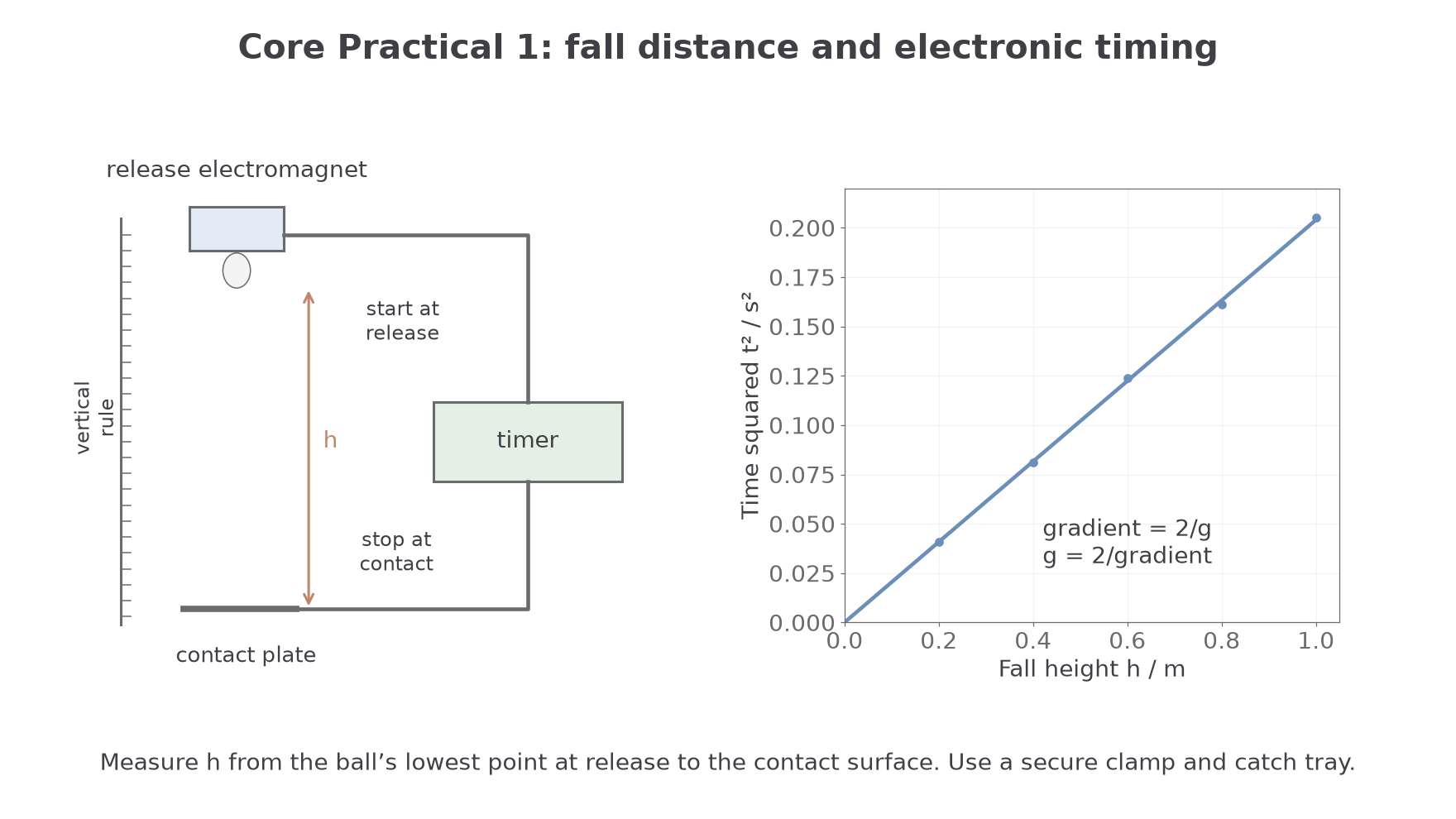
Two common routes are used.
Route A: measure height and time of fall
- Hold a steel sphere with an electromagnet or release mechanism.
- Let it fall from rest through a measured height .
- Use a trap door/electronic timer or similar timing system to measure .
- Repeat timings for the same height and take a mean.
- Vary and take at least several sets of readings.
For motion from rest with constant acceleration:
Rearrange this into a graph-friendly form:
If you plot on the y-axis against on the x-axis, the gradient is
so
Route B: measure height and final speed
- Drop a card or dowel through a light gate after it has fallen a measured height.
- The light gate calculates an average speed from the interrupting length divided by the beam-blocking time. Use a short interrupting length so that this is a good approximation to the speed at the gate, and measure the fall distance consistently to the object’s reference point near the middle of that interruption.
- Repeat, vary , and process the graph.
For motion from rest:
If you plot on the y-axis against on the x-axis, the gradient is
so
Worked example: determining g from a best-fit gradient
A student uses the time-of-fall route. Their graph of against has a best-fit gradient of
Decision point 1: identify which graph was plotted. This is against , so the gradient is , not .
Decision point 2: use the gradient of the best-fit line, not just two raw table values unless those points are on the line.
The unit works because .
Free-fall graphs (Core Practical 1)
For an object released from rest with negligible air resistance; : height fallen (m), : time of fall (s), : speed after falling (m s⁻¹).
If Edexcel says “determine” in this practical, it usually expects a quantitative route: identify the graph relationship, use a gradient, calculate , and give a unit. If it says “show that”, carry more figures in the working than the rounded value you are trying to show.
For the sphere-and-trapdoor method, measure the vertical gap from the sphere’s lowest point at release to the contact surface that stops the timer. Start the electronic timer when the sphere is actually released and stop it at first contact; a delay between switching off an electromagnet and release must be investigated. Keep the rule vertical next to the fall path and read square-on. Clamp the release securely, use a catch tray, and keep feet and hands out of the falling mass’s path. These controls protect both the measurement reference and the experimenter.
A second valid light-gate route measures speeds at two gates and the time between them, using . The speed readings and the elapsed time must refer to consistent midpoints of the interruptions; the beam-blocking time of one gate is not the time taken to travel between gates.
Keep a dated practical record with a labelled apparatus sketch, the height reference, instrument ranges and resolutions, raw repeated times and any rejected readings with reasons. Put units in table headings; record raw readings consistently to the instrument resolution. A spreadsheet can calculate mean times and squared means and plot the graph, but check its axes, units and fitted equation against the physical model. Use a plumb line to check the rule is vertical and a set square to transfer the sphere’s lowest point to the rule without parallax.
Uncertainty and Evaluating Free-Fall Data
The practical is only convincing if the value of is supported by the quality of the measurements. In this experiment, the two main measurement stories are distance and time.
Distance is usually measured with a metre rule or tape measure. Record it to the instrument resolution. If the ruler has millimetre divisions, a single reading is commonly uncertain by about , though the actual setup may introduce a larger uncertainty if the release point or detection point is hard to locate.
Time is often the bigger problem. Human stopwatch reaction time is usually too large for short falls, so electronic timing, light gates or a data logger are much better choices. A light gate does not make the experiment perfect, but it removes a large reaction-time uncertainty and can measure short time intervals more consistently.
Repeated readings help with random variation. If repeated times differ, an Edexcel-friendly estimate of the uncertainty in a representative timing can be estimated as half the range:
Then
For the graph route, the percentage uncertainty in is twice the percentage uncertainty in , because the measured quantity has been squared.
Worked example: timing uncertainty in the practical
For one height, a student records these repeated times:
| Reading | Time / s |
|---|---|
| 1 | 0.449 |
| 2 | 0.453 |
| 3 | 0.457 |
Mean time:
Half-range uncertainty:
Percentage uncertainty in :
Percentage uncertainty in :
Decision point: do not use the percentage uncertainty in unchanged once the graph uses . Squaring the measurement doubles its percentage uncertainty.
Evaluation is evidence-led. Useful comments include:
- Large scatter about the best-fit line suggests random uncertainty in timing, distance measurement or release conditions.
- If a straight line through the origin is expected but the best-fit line has a clear intercept, that can suggest a height zero offset. A constant timing delay can also distort the trend, but squaring a delayed time generally introduces curvature as well as an apparent intercept; it is not simply a constant offset in squared time.
- Air resistance would make the measured acceleration smaller than the ideal value, especially for light objects, large surface areas or larger speeds.
- Repeats and means reduce the effect of random error, but they do not remove systematic error.
- A value such as is not automatically "wrong"; compare it with its uncertainty range and the accepted value .
For an Edexcel “evaluate” or “criticise” prompt, avoid a loose list such as "use better equipment." Tie each improvement to the measurement problem: "Use a light gate and data logger to reduce reaction-time uncertainty in the time measurement" is creditworthy because the reason is physical and specific.
Draw uncertainty bars where the measurement uncertainties are known. Find the steepest and shallowest straight lines consistent with the error bars, using widely separated points on each line to calculate gradients. If their gradients are and , use as a simple gradient uncertainty. For the time-squared route, and : the order reverses because the gradient is in the denominator. For example, gradients 0.200–0.208 imply from 9.62 to 10.0 . Do not force the fitted line through the origin before testing the zero-offset assumption.
Newton's Third-Law Force Pairs
Newton's third law is about interactions between two bodies. If body A exerts a force on body B, then body B exerts a force on body A.
The two forces in a Newton's third-law pair have these properties:
- equal magnitude
- opposite direction
- same type of force
- act on different bodies
- occur at the same time
The "different bodies" point is the one that stops many mistakes.
A third-law pair acts on two different bodies, so the two forces do not cancel in the force balance for either individual body. If both bodies form one system, the pair is internal and cancels from the system’s total external-force account. Forces that balance on one body are a first/second-law balance, not a third-law pair.
For a book resting on a table:
- The Earth pulls the book downward. This is the book's weight.
- The book pulls the Earth upward with an equal gravitational force. That is the third-law partner of the book's weight.
- The table pushes the book upward. This is the normal contact force on the book.
- The book pushes the table downward with an equal contact force. That is the third-law partner of the normal contact force.
The book's weight and the table's normal contact force are not a third-law pair. They both act on the book, and they are different types of force. They may be equal in size when the book is at rest, but that is a Newton's first/second-law balance on one object, not a third-law interaction pair.
This also explains falling objects. The Earth pulls the ball downward; the ball pulls the Earth upward with an equal gravitational force. The forces are equal, but the accelerations are not equal because and Earth's mass is enormous compared with the ball's mass.
Edexcel “explain” answers about third-law pairs need the body labels. Write "force of Earth on ball" and "force of ball on Earth", not just "weight and reaction." Body labels make it clear the forces act on different objects.