121-123 - Magnetic Flux Density, Flux and Magnetic Forces
This lesson introduces the language of magnetic fields: magnetic flux density , magnetic flux , and flux linkage . You then use that field language to calculate the magnetic force on a moving charged particle and on a current-carrying conductor. This lesson stays with magnetic-field force and direction; changing flux, induced e.m.f., Faraday's law and Lenz's law follow in the next lesson.
Sideways force from a field
Picture two arrangements between the poles of a strong magnet:
| Arrangement | What is moving through the magnetic field? | What the field can do |
|---|---|---|
| a beam of charged particles | individual charges with velocity | exert a force on each moving charge |
| a straight wire carrying current | many charges drifting through the wire | exert a force on the wire as a whole |
The shared idea is not "the field pulls the object along". A magnetic field gives a force sideways to the motion of charge. The force is greatest when the charge motion cuts across the field at right angles, and zero when the charge motion is parallel to the field.
Magnetic flux density, , is the quantity that tells us how strong the magnetic field is. Its unit is the tesla, T.
For a wire at right angles to the field:
so:
For a single moving charge at right angles to the field:
so the same tesla can also be written as:
The angle matters because only the part of the motion that cuts across the field produces the magnetic force. In the force equations later, is the angle between the velocity or current direction and the magnetic field direction:
| Angle between motion/current and field | Force size | |
|---|---|---|
| zero | ||
| half the perpendicular value | ||
| maximum |
Misconception contrast:
| Tempting idea | Better model |
|---|---|
| "A magnetic field pushes any charge." | In this lesson's equations, a magnetic force acts on moving charge and depends on the motion across the field. |
| "The magnetic force is along the field lines." | The force is at right angles to the field and to the charge motion or current direction. |
When Edexcel asks you to state what is meant by magnetic flux density, a useful answer links to force, not just to "how strong the magnet is". For example:
Magnetic flux density
The force per unit current per unit length on a conductor placed at right angles to the magnetic field, . Unit: tesla, .
Flux and linkage
Magnetic flux density is about field strength at a place. Magnetic flux, , adds another idea: how much magnetic field passes through an area.
For a uniform magnetic field passing through a flat area:
Magnetic flux
: flux through one turn (Wb); : flux density (T); : area (); : angle between the field and the normal to the area. Uniform field, flat area.
where:
| Symbol | Meaning | Unit |
|---|---|---|
| magnetic flux through the area | weber, | |
| magnetic flux density | tesla, or | |
| area being pierced by the field | ||
| angle between the field and the normal to the area | degrees or radians |
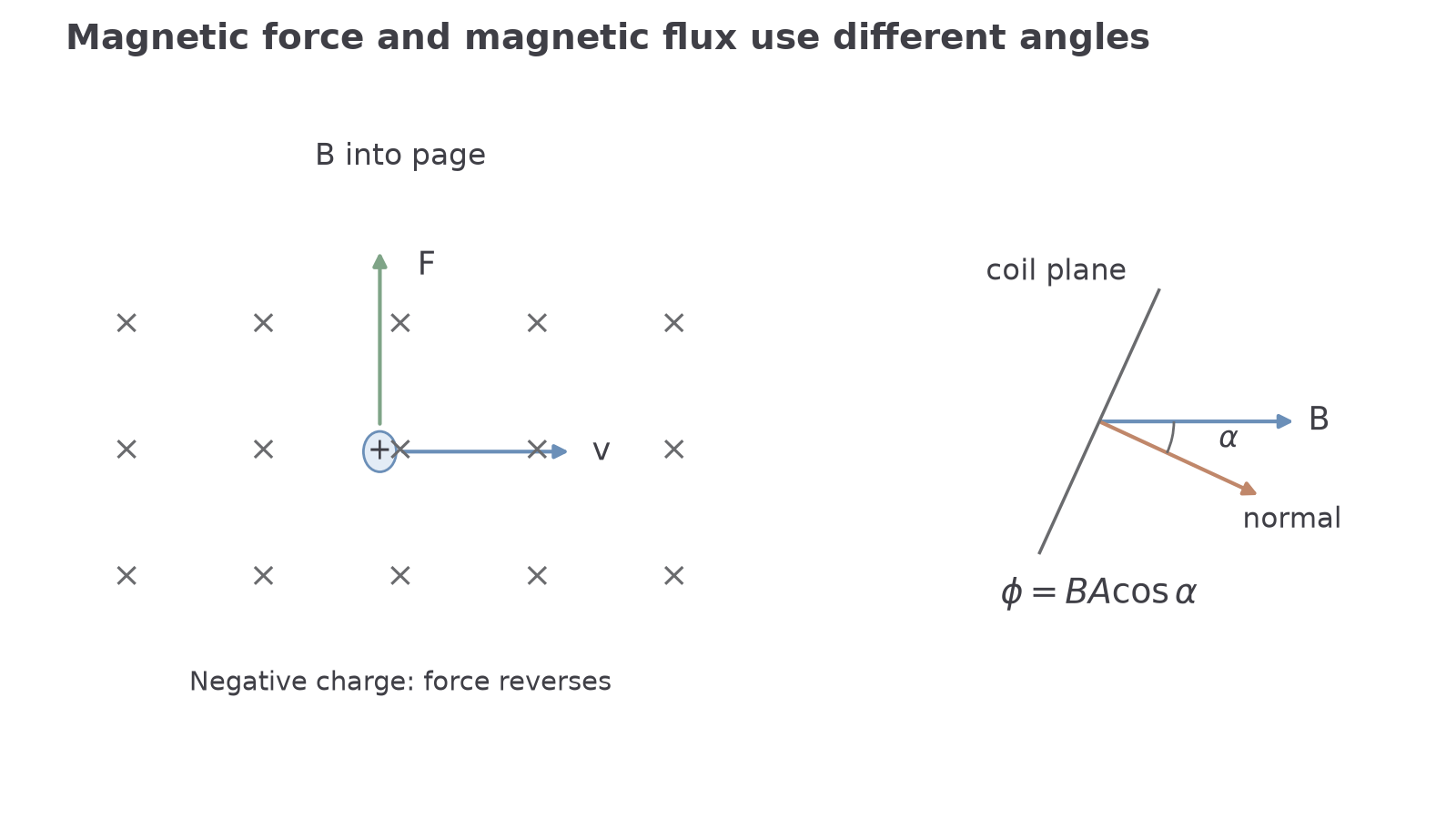
The normal is an imaginary line at right angles to the surface. This angle convention prevents a common error:
| Situation | Flux | |
|---|---|---|
| field straight through the face of the coil | maximum, | |
| field along the plane of the coil | zero |
Flux linkage
The flux through one turn multiplied by the number of turns linked by it, . Unit: Wb turns.
Here is the number of turns. Flux linkage is not a different kind of flux; it is the single-turn flux multiplied by the number of turns linked by that flux.
Worked example:
A rectangular coil has turns. Each turn is by . The coil is in a uniform magnetic field of flux density . The normal to the coil makes an angle of with the magnetic field. Calculate the magnetic flux through one turn and the flux linkage.
Decision point 1: flux uses area in square metres, not square centimetres.
Decision point 2: the angle is measured between the field and the normal, so use .
Decision point 3: flux linkage comes after the flux through one turn.
The answer makes physical sense: the angle is not zero, so the flux is a little less than , but it is not zero because the field still passes through the coil face.
[DIAGRAM: asset_name: Magnetic force perpendicular to positive-particle motion and into-page field; flux angle is measured to coil normal; asset_slug: fields_magnetic_force_flux; recommended_method: matplotlib; description: Magnetic force perpendicular to positive-particle motion and into-page field; flux angle is measured to coil normal]
Charged particles in fields
For one charged particle moving through a magnetic field, Edexcel gives:
Force on a moving charge
: force (N); : flux density (T); : charge (C); : speed (); : angle between velocity and field. Force is perpendicular to both and .
where:
| Symbol | Meaning | Unit |
|---|---|---|
| magnetic force on the particle | ||
| magnetic flux density | ||
| charge on the particle | ||
| speed of the particle | ||
| angle between velocity and magnetic field | degrees or radians |
For force magnitude, use the magnitude of the charge. The sign of the charge is then used for the direction.
Fleming's left-hand rule gives the direction:
| Left-hand part | Meaning |
|---|---|
| First finger | magnetic Field direction |
| seCond finger | conventional Current direction |
| Thumb | force or thrust direction |
For a positive particle, conventional current is in the same direction as its velocity. For a negative particle, conventional current is opposite to its velocity. This is the trap in many electron questions.
Worked example:
An electron travels to the right at through a uniform magnetic field of flux density . The field is into the page. Calculate the force on the electron and state its direction. Use .
Decision point 1: this is a single charged particle, not a wire, so use:
Decision point 2: the velocity is perpendicular to the field, so and .
Continue this lesson.
You’re previewing NovaLearn without an account. Create a free account to read the rest.
Create free account