140-143 - Standard Model, Antiparticles and Conservation Laws
This lesson is about turning the "particle zoo" into a system. First classify the particles you are given, then use antiparticle properties and conservation of charge, baryon number and lepton number to decide whether an interaction is possible. The same accounting lets you write and interpret particle equations when the symbols are supplied.
Classifying Particles
Imagine a detector has recorded several short-lived particles. A list of names is not very useful by itself, so physicists sort particles into families. The standard quark-lepton model gives Edexcel four categories to know here.
| Category | What it means in this lesson | Examples |
|---|---|---|
| baryon | made from three quarks | proton , neutron |
| meson | made from a quark and an antiquark | pion |
| lepton | fundamental particle in this model | electron , neutrino |
| photon | electromagnetic force carrier, not a baryon, meson or lepton |
Baryon
A particle made from three quarks, e.g. proton, neutron. Baryon number (antibaryons ).
Meson
A particle made from a quark and an antiquark, e.g. pion. Baryon number 0.
Lepton
A fundamental particle not made from quarks, e.g. electron, neutrino. Lepton number (antileptons ).
Baryons and mesons are both hadrons because they are made from quarks. The difference is their quark structure: three quarks for a baryon, quark plus antiquark for a meson. Leptons are treated as fundamental in this course, so an electron is not made from quarks.
The word "model" matters. A good model is not just a filing cabinet for particles already found; it makes predictions. In the standard quark-lepton model, the pattern of quarks came in a symmetry that predicted the top quark before it was observed experimentally. This is the kind of evidence that makes a classification scheme more powerful than a vocabulary list.
Misconception contrast: a photon is not a tiny charged particle moving between matter particles. In this lesson it is listed separately from baryons, mesons and leptons. It has no baryon number or lepton number, and it is neutral.
For Edexcel know or state marks, be precise about the structure. "A baryon is heavy" or "a meson is smaller" is not the model. The credit-bearing idea is the quark content.
The six quarks form three paired generations: up/down, charm/strange, top/bottom. Finding bottom without its partner left a gap in this pattern, so the symmetry predicted top. This illustrates a testable model prediction, rather than a new conservation law.
When quark charges are supplied, add them to check a composition. With and , has charge and has zero charge. Both are baryons because each contains three quarks. An antiquark reverses the quark's charge: has charge , but is a meson because it contains a quark and an antiquark. Equal charge alone does not imply the same particle family.
Antiparticles
Antiparticles have the same rest mass as their partners and reversed additive quantum numbers.
Antiparticle
A particle with the same mass as its partner but opposite charge, baryon number and lepton number.
Every particle has a corresponding antiparticle. The easiest way to deduce antiparticle properties is to ask which additive properties must reverse sign.
| Property | Particle and antiparticle relationship |
|---|---|
| mass or rest energy | same |
| magnitude of charge | same magnitude |
| sign of charge | opposite sign |
| baryon number | opposite sign for baryon and antibaryon |
| lepton number | opposite sign for lepton and antilepton |
An electron has charge in units of the elementary charge , so its antiparticle, the positron, has charge . The electron has lepton number , so the positron has lepton number .
A proton has charge and baryon number , so an antiproton has charge and baryon number . A neutron has charge , but the antineutron is still a different particle: its baryon number is , not .
This is a useful place to be careful. "Opposite particle" does not mean every property changes sign. Mass does not become negative. A neutral particle can still have a distinct antiparticle if another property, such as baryon number, changes sign. Some neutral particles, such as photons, are their own antiparticles, but exam questions on this topic usually give the relevant symbols and properties.
For an Edexcel deduce response, write the property you are changing. A bare answer such as "opposite" is too vague if the particle is neutral.
The Conservation Ledger
Particle equations are judged like a ledger. Add the relevant quantity before the arrow, add it after the arrow, and compare the totals. Here the three checks are:
| Quantity | Symbol | Rule |
|---|---|---|
| charge | total charge before = total charge after | |
| baryon number | total baryon number before = total baryon number after | |
| lepton number | total lepton number before = total lepton number after |
[DIAGRAM: asset_name: Four particle categories and neutron beta-minus charge baryon lepton totals with correct antineutrino notation; asset_slug: 040_standard_model_antiparticles_conservation_laws__diagram_01; recommended_method: matplotlib; description: Four particle categories and neutron beta-minus charge baryon lepton totals with correct antineutrino notation]
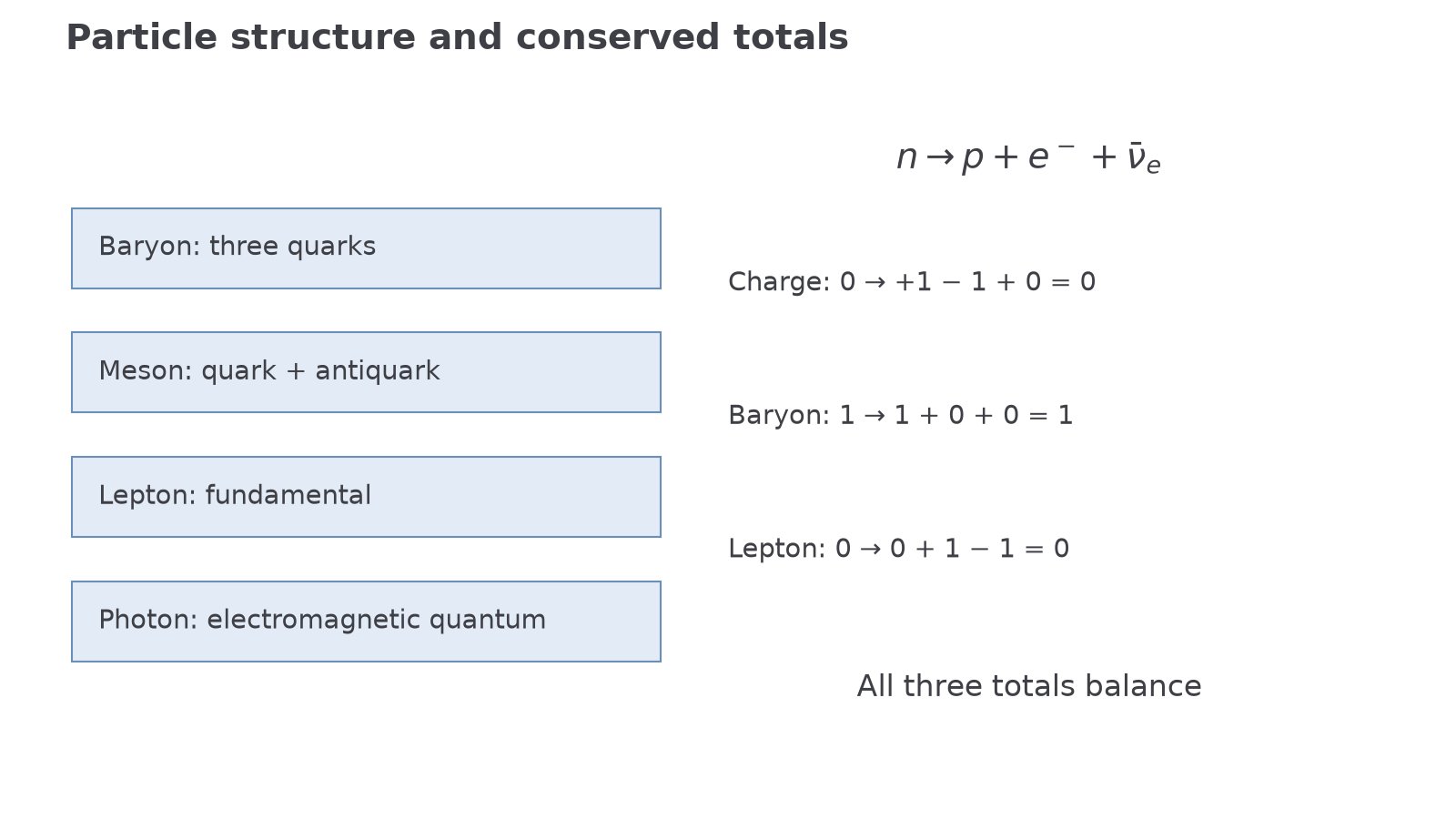
Worked route:
Consider -minus decay written as
Continue this lesson.
You’re previewing NovaLearn without an account. Create a free account to read the rest.
Create free account