49-52 - Density, Upthrust and Viscosity (CP4)
Modelling what happens when an object is in a fluid: how much matter is packed into a volume, how the displaced fluid pushes back, and how a viscous liquid resists motion. The core practical uses a falling sphere to turn those ideas into a measurement of viscosity. The lesson covers density, upthrust, Stokes' law and the falling-ball method (Core Practical 4).
Density as mass per volume
Imagine two spheres with the same radius: one is glass, one is steel. They displace the same volume of liquid, but the steel one has more mass packed into that volume. Density is the quantity that captures that difference:
Density
: density (kg m⁻³); : mass (kg); : volume (m³). For a sphere .
The most common trap is mixing units. If a diameter is measured in mm, convert to metres before finding the volume. If a mass is measured in g, convert to kilograms before using SI density.
For a sphere,
Worked example: a small sphere has diameter and mass .
The radius is half the diameter:
The volume is:
The mass is:
So:
The decision point was not the algebra; it was noticing that density compares mass with the actual volume occupied, so the sphere's radius had to be cubed after converting to metres.
Upthrust as displaced fluid
When an object is submerged, the pressure on its lower surface is greater than the pressure on its upper surface because pressure increases with depth. The sideways forces cancel, but the vertical forces do not. The result is an upward force called upthrust.
Upthrust
The upward force a fluid exerts on an object in it, equal to the weight of fluid displaced by the object.
For a fully submerged object, the displaced volume is the object's volume. If the fluid has density , then:
Upthrust
: upthrust (N); : density of the fluid, not the object (kg m⁻³); : volume of fluid displaced (m³); : 9.81 N kg⁻¹.
A useful misconception to catch early: upthrust is not a reward for floating. It acts on a sinking object too. A ball bearing sinks because its weight is larger than the upthrust, not because upthrust is absent.
Worked example: a ball of mass and volume is fully submerged in washing-up liquid of density .
The ball's weight is:
The upthrust uses the density of the liquid, not the density of the ball:
Before viscous drag is considered, the downward force left over is:
That result tells the physical story: the liquid does push upward, but not enough to balance the ball's weight.
Viscous drag and terminal speed
A liquid such as glycerol or washing-up liquid does not simply let a ball pass through it. Layers of liquid have to move around the ball, and the liquid's internal resistance produces viscous drag.
Viscosity
Dynamic viscosity measures how strongly a fluid resists flow (internal friction between its layers); unit Pa s, equivalent to N s m⁻².
For a small sphere moving slowly through a fluid with laminar flow, Edexcel require Stokes' law:
Stokes' law
: viscous drag (N); : viscosity (Pa s); : sphere radius (m); : speed (m s⁻¹). Only for a small sphere moving slowly with laminar (non-turbulent) flow.
The direction matters even though the equation gives a magnitude. If the sphere is falling downward, viscous drag acts upward, opposite to the motion.
Worked example: a sphere of radius falls through a liquid of viscosity at .
Convert the radius:
Then:
The choice of equation is conditional. Stokes' law is not a general drag law for every falling object. It applies here only because the object is a small sphere, the speed is low, and the flow is laminar rather than turbulent.
As the ball starts falling, its speed is small, so viscous drag is small. As speed increases, Stokes' drag increases. Eventually the upward forces, upthrust plus viscous drag, balance the downward weight:
The resultant force is then zero, so the ball moves at constant terminal velocity.
At terminal velocity weight = upthrust + viscous drag: the forces are balanced, not absent.
Falling-ball viscosity method
Core Practical 4 uses the terminal velocity of a sphere to determine the viscosity of a liquid. The apparatus is deliberately simple: a tall transparent tube of liquid, small spheres, rubber bands or marks on the tube, a metre ruler, a timer, and a micrometer or vernier callipers for the sphere diameter.
[DIAGRAM: asset_name: falling ball apparatus; asset_slug: 9ph0_falling_ball; recommended_method: matplotlib; description: Wide liquid column, central sphere, timing marks below release, and terminal force diagram showing upward upthrust and drag balanced by weight.]
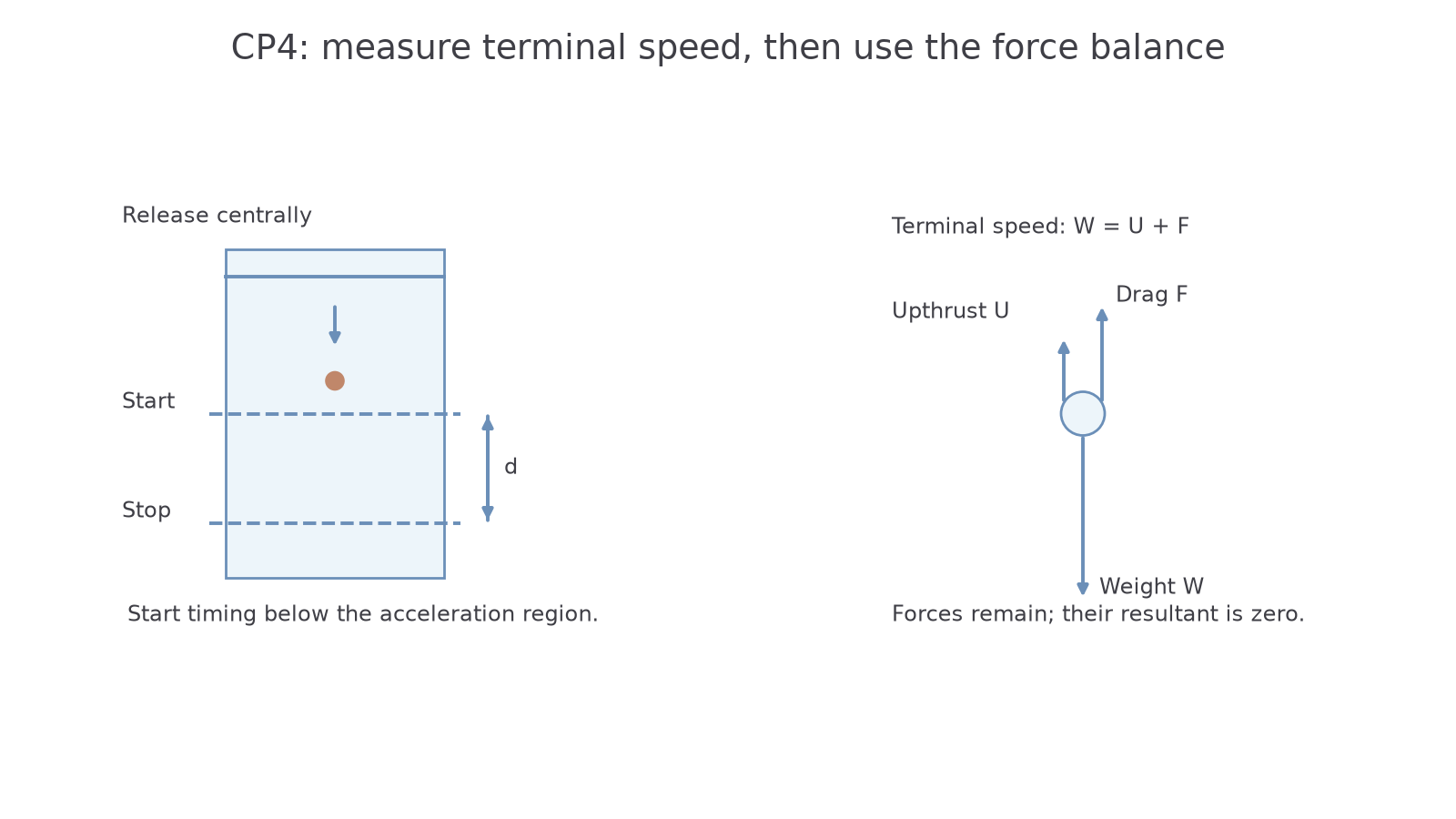
The timing marks are not placed right at the surface. The top timing mark must be far enough below the liquid surface that the sphere has already reached terminal velocity by the time it gets there. Check this by comparing transit times over successive equal vertical distances. Then the measured speed between marks is a terminal speed, not an average speed from release.
A practical route:
Continue this lesson.
You’re previewing NovaLearn without an account. Create a free account to read the rest.
Create free account