130-131 - Nucleon Number, Proton Number and Alpha Scattering
This lesson connects two ideas: how to count the particles in a nucleus, and how -particle scattering showed that atoms contain a tiny, dense nuclear centre. The lesson stops before thermionic emission, accelerators, detectors and particle tracks; here the focus is nuclear notation and the evidence for changing the model of the atom.
Counting the nucleus
An atom is mostly empty space, but nearly all of its mass is in the nucleus. To describe a nucleus, physicists count two things very carefully.
| Quantity | Symbol | Meaning |
|---|---|---|
| proton number or atomic number | number of protons in the nucleus | |
| nucleon number or mass number | total number of protons and neutrons in the nucleus |
The word nucleon means a particle in the nucleus. At this level, the nucleons are protons and neutrons.
Proton number, Z
The number of protons in the nucleus; it identifies the element.
Nucleon number, A
The total number of protons and neutrons (nucleons) in the nucleus. Number of neutrons .
So:
Nuclear notation usually places the nucleon number at the upper left and the proton number at the lower left:
is the chemical symbol. The lower number, , decides the element because the element is identified by its number of protons.
Worked example:
An atom is written as . Find the numbers of protons, neutrons and nucleons.
Decision point 1: the lower number is not the neutron number. It is the proton number.
Decision point 2: the upper number is the total number of nucleons, not the total number of particles in the whole atom.
Decision point 3: neutrons are found by subtracting the proton number from the nucleon number.
So has 13 protons, 14 neutrons and 27 nucleons.
For an Edexcel state what is meant by item, be precise. "Mass number is the mass" is too vague. The expected idea is that nucleon number is the total number of protons and neutrons in the nucleus.
Same element, different neutrons
Proton number is the identity label of an element. If two nuclei have the same , they are the same element even if their neutron numbers differ.
For carbon:
| Nuclear notation | Protons | Neutrons | Nucleon number |
|---|---|---|---|
| 6 | 6 | 12 | |
| 6 | 7 | 13 | |
| 6 | 8 | 14 |
All three are carbon because all three have . They are different isotopes because they have different neutron numbers.
Isotopes
Nuclei of the same element (same proton number) with different numbers of neutrons, and so different nucleon numbers.
Misconception contrast: changing the neutron number changes the nucleon number, but it does not change the element. Changing the proton number would change the element because the nucleus would no longer have the same .
This matters in scattering too. An particle is the nucleus of a helium atom, so it can be represented as : two protons and two neutrons. Its positive charge is why it is repelled by a positive nucleus, and its relatively large mass compared with an electron is why electron interactions cannot explain large-angle scattering.
Guided check:
Compare and .
- The proton number is the same: both have 17 protons.
- The nucleon number is different: 35 and 37.
- The neutron numbers are different:
So they are isotopes of the same element.
Alpha particles as probes
The -scattering experiment is a probing experiment. A narrow beam of particles is fired at very thin gold foil, and observers record where the particles go afterwards.
The key is not one particle. The evidence comes from the pattern after many particles:
- most pass through with little or no deflection
- some are deflected through small angles
- a very small fraction are turned through very large angles, sometimes back towards the source
[DIAGRAM: asset_name: Alpha-source foil-screen apparatus and non-contact close-approach repulsion causing backscatter; asset_slug: 037_nucleon_proton_number_alpha_scattering__diagram_01; recommended_method: matplotlib; description: Alpha-source foil-screen apparatus and non-contact close-approach repulsion causing backscatter]
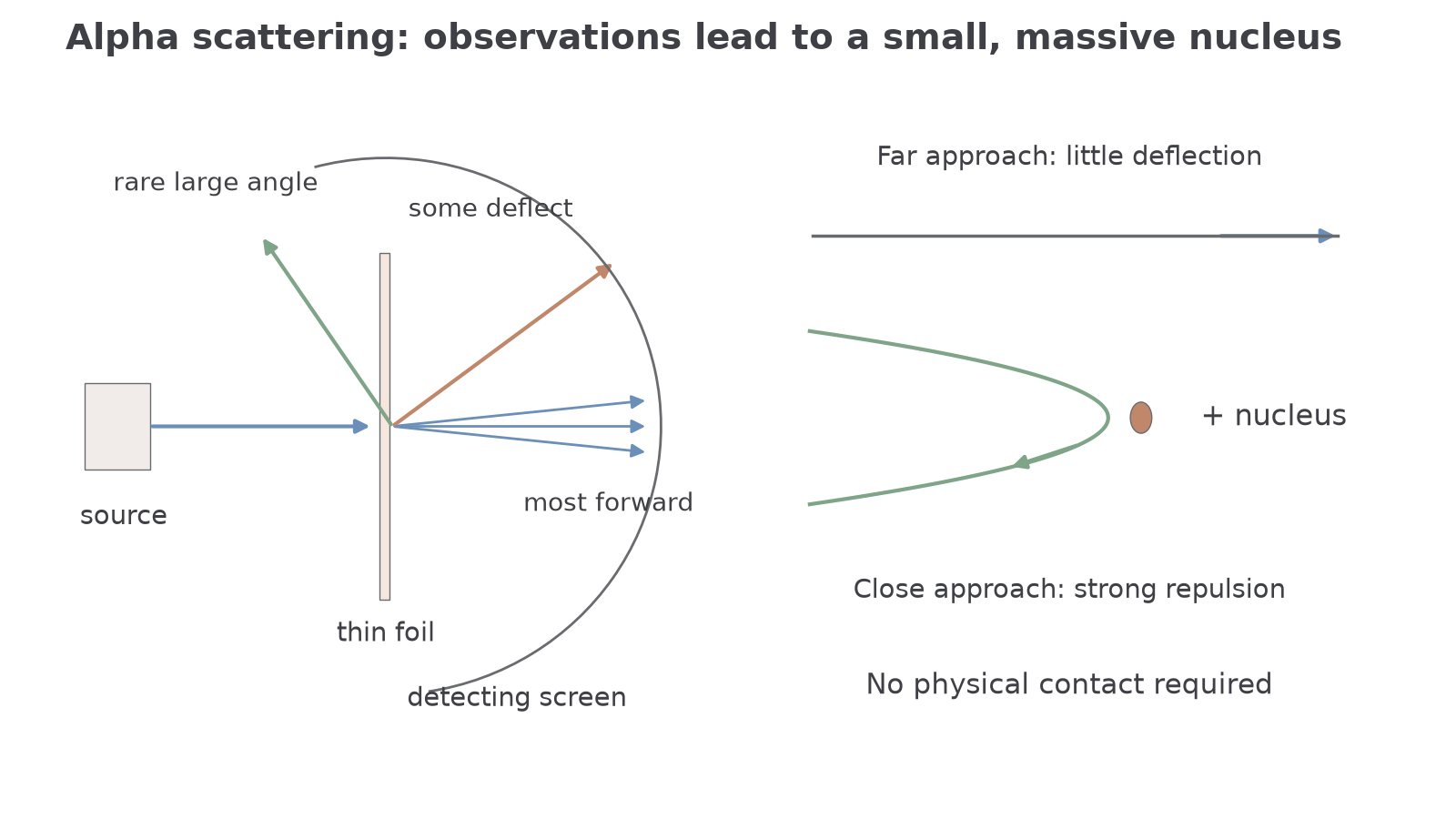
Before Rutherford's nuclear model, a tempting picture was that positive charge was spread through the atom, with electrons embedded within it. If the positive charge were spread out like that, each particle would feel only weak sideways pushes as it passed through. Large-angle scattering would be extremely difficult to explain.
The observations point in a different direction:
| Observation | Inference |
|---|---|
| Most particles pass straight through | most of the atom is empty space |
| Some particles are deflected | particles interact with positive charge in the atom |
| Very rare particles scatter through large angles | positive charge and most mass are concentrated in a tiny central nucleus |
Misconception contrast: "the particles bounced off electrons" sounds plausible because atoms contain electrons. It does not work. Electrons are much less massive than particles, and their negative charge would attract particles rather than strongly repel them. Large-angle deflection points to a concentrated positive centre.
Most pass straight through → atom mostly empty space. Some deflected → charged matter inside. Very few turned through large angles → positive charge and most of the mass concentrated in a tiny nucleus.
Continue this lesson.
You’re previewing NovaLearn without an account. Create a free account to read the rest.
Create free account