65-69 - Superposition and Standing Waves (CP7)
Superposition, phase, stationary (standing) waves and Core Practical 7 on vibrating strings. You will build from overlapping waves to stationary patterns, then use the pattern to measure and reason quantitatively.
When Waves Meet
Imagine two small ripples crossing on the surface of water. At the instant they overlap, the water at each point has only one displacement. It cannot be separately "the displacement from ripple A" and "the displacement from ripple B". The actual displacement is the algebraic sum of the displacements the two waves would have produced there.
Principle of superposition
When two or more waves meet, the resultant displacement at any point is the (vector) sum of the displacements each wave would produce there.
If two crests meet, the displacements have the same sign and the resultant amplitude is larger. If a crest and a trough of equal size meet, the displacements have opposite signs and can cancel. This pattern of reinforcement and cancellation is interference.
Useful language for this lesson:
| Term | Meaning in this topic |
|---|---|
| Wavefront | A line or surface joining points on a wave that are at the same stage of the cycle, such as all the points on the same crest. |
| Phase | The stage of an oscillation cycle. It is usually measured as an angle, such as , , or . |
| Phase difference | How far out of step two oscillations are. A phase difference of means in phase; or means exactly out of phase. |
| Coherence | A constant phase difference between waves of the same frequency. |
| Path difference | The difference between the distances travelled by two waves to reach the same point. |
| Superposition | The addition of displacements where waves overlap. |
| Interference | The observable reinforcement or cancellation caused by superposition. |
The misconception to avoid is "the waves bounce off each other". They do not. While overlapping, their displacements add. After overlapping, each wave continues travelling as before.
For sources initially in phase, path difference produces the phase difference below because one wavelength is one complete cycle. If the sources have an initial phase offset, include that offset when finding the phase at the meeting point:
Phase difference from path difference
For two coherent sources emitting in phase. A path difference of gives constructive interference; gives destructive interference (equal amplitudes).
So:
- path difference , , , ... gives phase difference , , , ... and constructive interference
- path difference , , ... gives phase difference , , ... and destructive interference for equal-amplitude waves
- other path differences give partial reinforcement or partial cancellation
Worked example: two coherent waves emitted in phase, of wavelength reach a point with path difference . Calculate the phase difference and decide whether the interference is fully constructive, fully destructive, or neither.
Decision point 1: compare the path difference with the wavelength, not with either whole path length.
Decision point 2: choose one phase unit and stay with it.
In radians:
In degrees:
Decision point 3: classify the result. is not , , or a repeat of either, so the interference is neither fully constructive nor fully destructive.
For an Edexcel Calculate response, show the ratio, the phase calculation and the unit. For State what is meant by coherence, do not say only "same wavelength"; the fixed phase relationship is the point that makes a stable interference pattern possible.
How a Standing Wave Forms
A standing wave on a string begins as a travelling wave. The driver sends a wave along the string. At a fixed end or pulley end, the wave is reflected back. The reflected wave travels through the incoming wave in the opposite direction.
[DIAGRAM: asset_name: stationary modes; asset_slug: 9ph0_stationary_modes; recommended_method: matplotlib; description: First three string modes with correctly alternating loops, fixed nodes and opposite snapshots separated by half a period.]
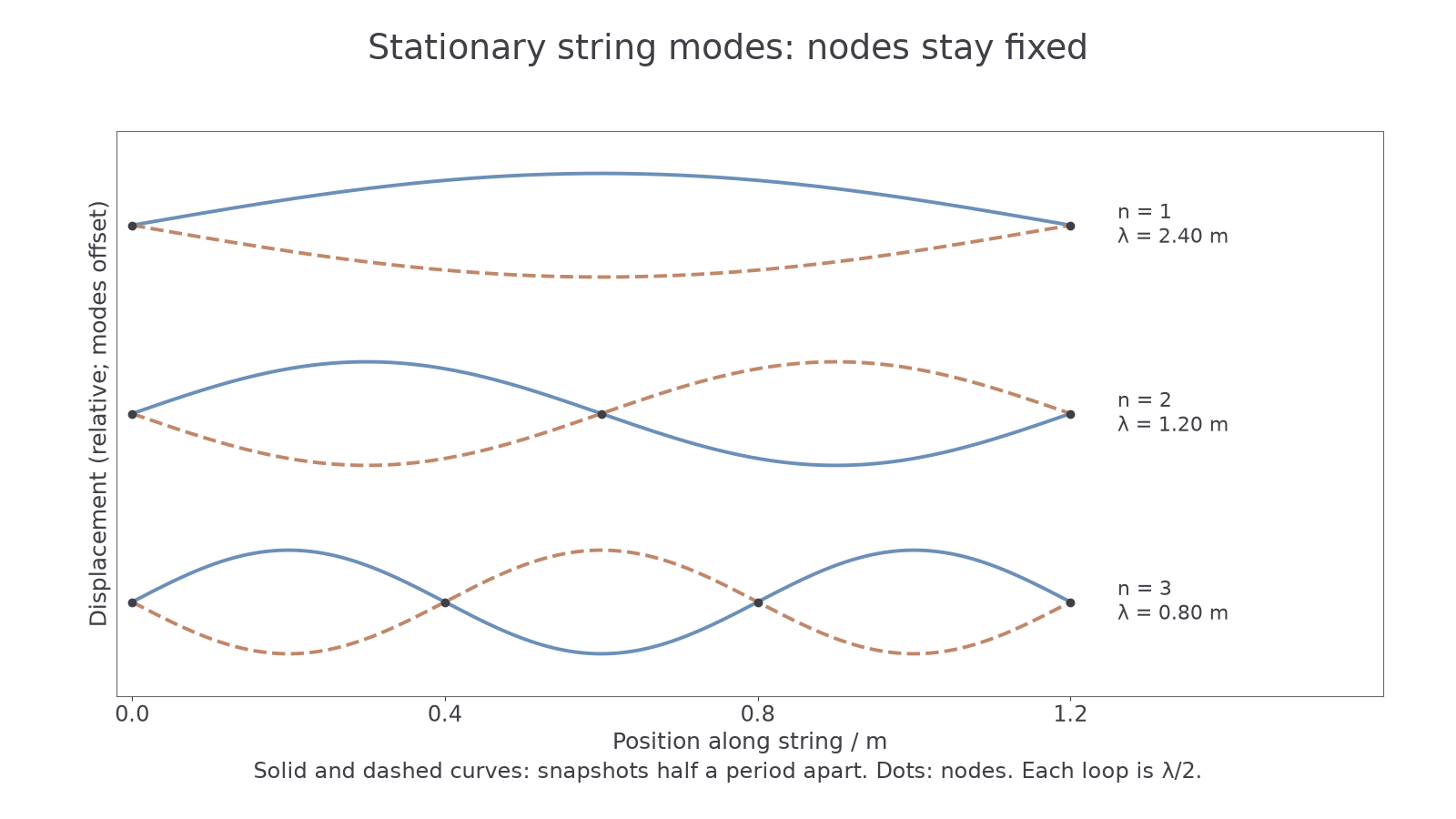
Incident and reflected waves of the same frequency can interfere at fixed positions. A large, stable resonant pattern occurs when the wavelength fits the boundary conditions and repeated reflections reinforce the driven motion. On a string fixed at both ends this requires a whole number of half-wavelengths along its length.
That fixed pattern is a standing wave, also called a stationary wave.
The word "stationary" can mislead. The pattern is stationary; the string itself is not frozen. Except at the nodes, the particles of the string still oscillate up and down.
Key points on the pattern:
Node and antinode
A node is a point on a stationary wave with zero displacement at all times; an antinode is a point of maximum amplitude.
- adjacent nodes are separated by
- adjacent antinodes are separated by
- a node and the nearest antinode are separated by
Nodes are not places where "no wave arrives". Two waves arrive there, but their displacements always cancel. Antinodes are places where the waves repeatedly reinforce.
A stationary wave forms when a wave and its reflection, with the same frequency, travel in opposite directions and superpose: fixed nodes (cancellation) alternate with antinodes (reinforcement).
For a string with a node at each end, each loop is half a wavelength. If the vibrating length is and there are loops:
Stationary waves on a string
: vibrating length between fixed ends (m); : number of loops (harmonic number); : wavelength (m). Adjacent nodes are apart.
The number is the number of loops, or antinodes, in the standing-wave pattern. The first harmonic has one loop, so . The second harmonic has two loops, so .
Worked example: a string has vibrating length and shows three clear loops. Determine the wavelength and the node spacing.
Decision point 1: three loops does not mean three wavelengths. Each loop is half a wavelength.
Decision point 2: adjacent nodes are half a wavelength apart.
Decision point 3: do not use the amplitude to identify wavelength. The wavelength is set by the spacing of repeated phase positions, such as node-to-next-alternate-node or antinode-to-next-alternate-antinode.
For an Edexcel Explain question about formation, link the causes in order: reflection produces a wave travelling the opposite way; waves of the same frequency superpose; at resonance, fixed positions of cancellation and reinforcement form nodes and antinodes.
For ideal fixed nodes the counter-propagating waves have equal amplitudes as well as the same frequency and wavelength. Points within one loop oscillate in phase; points in adjacent loops oscillate in antiphase. At an instant when the whole string passes through equilibrium, antinodes also have zero displacement, but they still have the largest amplitude. An instantaneous zero therefore does not by itself identify a node.
String Speed and Frequency
The standing-wave pattern tells you the wavelength. The string itself tells you the wave speed.
For a transverse wave on a string:
Speed of a wave on a string
: wave speed (m s⁻¹); : tension (N); : mass per unit length (kg m⁻¹).
The relationship has a physical story. Tension is the restoring effect: a tighter string pulls a displaced section back more strongly, so a disturbance travels faster. Mass per unit length is inertia: a heavier string per metre is harder to accelerate, so a disturbance travels more slowly.
The formula is supplied in the Edexcel data booklet. The skill is choosing and using it, then connecting it to .
For a standing wave on a string:
and because ,
This derived equation is useful for seeing patterns, but do not treat it as a new formula to memorise. It is just standing-wave geometry plus the two wave-speed relationships.
Worked example: a string has vibrating length , tension and mass per unit length . It is driven at resonance with two loops. Calculate the frequency.
Decision point 1: use because the question gives tension and mass per unit length.
Decision point 2: two loops means , so the vibrating length contains two half-wavelengths.
Decision point 3: now use , because frequency is linked to speed and wavelength.
Continue this lesson.
You’re previewing NovaLearn without an account. Create a free account to read the rest.
Create free account