132-135 - Thermionic Emission, Accelerators, Detectors and Tracks
This lesson covers how electrons are released, how fields accelerate or deflect charged particles, how linacs and cyclotrons use those fields, and how detector tracks are interpreted. The main idea is that invisible charged particles become readable when fields and conservation laws leave clues in their paths.
Making an electron beam
Start with a small electron gun rather than a huge accelerator. A metal cathode is heated until some electrons near the surface have enough energy to leave the metal. That release of electrons from a hot surface is thermionic emission.
Thermionic emission
The release of electrons from the surface of a heated metal.
The heater does not push the electrons across the tube. Its job is to make electrons available. Once they have left the hot cathode, an electric field between the cathode and a positive anode accelerates them. Because an electron has negative charge, the force on it is towards the positive anode.
Energy transfer is the useful way to picture the acceleration. A potential difference transfers energy to a particle of charge magnitude . For an electron, , so accelerating through gives an energy gain of .
Once the beam is moving, a magnetic field can bend it. The magnetic force is sideways when the particle velocity is perpendicular to the magnetic field, so it changes the direction of the velocity without increasing the speed. That distinction matters all the way through this lesson:
- electric fields can do work on charged particles and increase their kinetic energy
- magnetic fields can steer, bend or focus charged particles
- the sign of the charge affects the direction of deflection
Misconception contrast: "the heating current accelerates the beam" mixes two jobs together. Heating releases electrons from the metal; the electric field accelerates the released electrons.
Field roles in accelerators
An accelerator is an electron gun's big cousin: it makes a beam, gives charged particles more kinetic energy, and controls where they go.
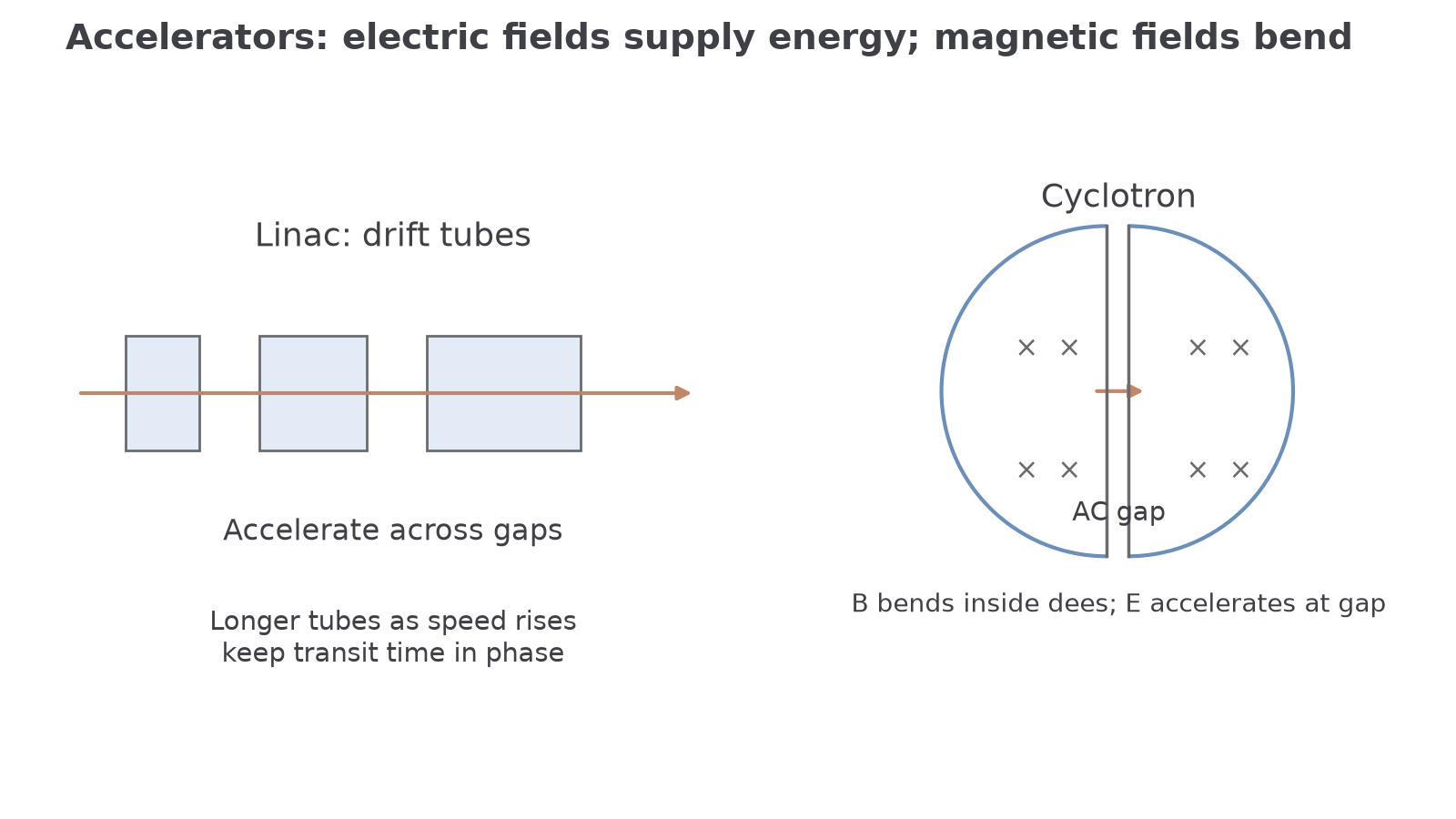
In a linear accelerator, or linac, particles pass along a straight line through a sequence of accelerating gaps. The electric field across each gap is timed so that the particle is pulled or pushed in the forward direction as it crosses. Drift tubes can shield the particle while the field reverses, so the particle meets the next gap at the right phase. The repeated idea is simple: each useful gap transfers more energy to the charged particle.
Magnetic fields in linacs are mainly used to steer and focus beams. The magnetic force does no work on the particles. It keeps the beam narrow and correctly aimed.
A cyclotron folds the journey into a circle. It has two hollow D-shaped electrodes, often called dees, with an alternating electric field across the gap between them. A charged particle is accelerated each time it crosses the gap. Inside a dee the electric field is shielded, and a magnetic field bends the particle into a semicircle so it comes back to the gap again.
As the particle gains momentum, its circular path gets larger. That growing radius is not a decorative feature: it is the same physics that later lets detector tracks reveal momentum.
So keep the roles separate:
- Linac: electric fields accelerate across repeated straight-line gaps.
- Cyclotron: electric fields accelerate at the gap; magnetic fields curve the path.
- Detectors: ionisation produces tracks; magnetic curvature provides charge and momentum clues.
Electric fields change kinetic energy; magnetic fields only change direction.
Misconception contrast: a magnetic field is not a hidden engine that keeps making the particle faster. In the cyclotron, the electric field at the gap increases kinetic energy; the magnetic field bends the path so the particle returns to the gap.
In a non-relativistic drift-tube linac the particle spends half an AC cycle inside each successive tube. As its speed increases, the tubes must become longer so that the electric field has time to reverse while the particle is shielded. The gap fields then accelerate it at every crossing. Near the speed of light the speed changes much less, so equal-length structures can be used.
For a non-relativistic cyclotron, combining with gives . The period is independent of speed, so a fixed alternating frequency can reverse the gap field every half-turn as the radius grows. At relativistic speeds this simple synchronisation fails; the elementary fixed-frequency cyclotron model has a limit. The required field-role understanding does not require a relativistic calculation.
[DIAGRAM: asset_name: Drift-tube linac with increasing tube lengths and cyclotron dees with alternating electric gap and perpendicular magnetic field; asset_slug: fields_accelerators; recommended_method: matplotlib; description: Drift-tube linac with increasing tube lengths and cyclotron dees with alternating electric gap and perpendicular magnetic field]
Deriving the track-radius equation
A charged particle moving through a uniform magnetic field can follow a circular path if its velocity is perpendicular to the field. The magnetic force is always sideways to the velocity, so it acts as the centripetal force.
For a particle of charge magnitude , speed , and magnetic flux density , the magnetic force is:
This is the perpendicular case of , with .
For circular motion, the required centripetal force is:
Decision point: these are not two separate forces to add. They are two descriptions of the same force. The magnetic force is providing the inward resultant force needed for circular motion.
Equate them:
Cancel one :
Rearrange for :
In this classical derivation, momentum is , so:
Radius of a charged particle's path
: radius of curvature (m); : momentum (); : magnetic flux density (T); : charge magnitude (C). Velocity perpendicular to a uniform field.
The radius-momentum relation also applies at high speeds when is the actual relativistic momentum; the classical substitution is then inappropriate. No relativistic momentum calculation is required here. It says the radius is larger when momentum is larger, but smaller when the magnetic field strength or charge magnitude is larger.
Worked example: a singly charged positive particle has momentum and enters a region where at right angles to the field. Calculate the radius of its path.
Decision point 1: "singly charged" means use the charge magnitude .
Decision point 2: the question asks for radius, and it gives momentum directly, so use .
The radius is . A stronger magnetic field would give a smaller radius for the same particle momentum.
For derive, Edexcel-style credit comes from the chain: magnetic force provides centripetal force, substitute the two expressions, rearrange, and replace with . Quoting alone is not a derivation.
Continue this lesson.
You’re previewing NovaLearn without an account. Create a free account to read the rest.
Create free account