168-171 - Nuclear Radiation and Gamma Absorption (CP15)
The thread running through this lesson is measurement: a detector counts radiation from the source and from the room around it, so good physics means separating the wanted signal from background, understanding what , and can do in matter, and using lead-absorber data carefully. Radioactive decay laws and isotope half-life calculations belong to the next lesson; here, half-thickness means the thickness of lead that halves a count rate.
Background Counts
Put a Geiger-Muller tube on a bench, connect it to a counter, and leave the radioactive source in its store. The counter still clicks. That is not a broken detector: it is detecting background radiation.
Background radiation
Ionising radiation present in the surroundings from natural and artificial sources, detected whether or not a laboratory source is present.
Background radiation is ionising radiation already present in the surroundings. In a UK classroom it can come from natural sources such as radon from rocks and soil, radiation from the ground and building materials, cosmic radiation from space, and small amounts of radionuclides in food and drink. Artificial sources, especially diagnostic medical exposure, also contribute to population exposure, but the key laboratory point is simpler: the detector counts background whether or not your intended source is present.
A count is the number of detections in a time interval. A count rate is:
The unit is or . In school radiation experiments, the useful source signal is usually the corrected count rate:
Corrected count rate
Count rate = count ÷ counting time (). Subtract rates, not raw counts taken over different times.
Decision point: subtract rates, not raw counts measured over different times. If the background was counted for and the source reading for , the raw counts are not directly comparable until each is converted to a count rate.
Worked example:
The background count is counts in .
With a source present, the detector records counts in .
So:
For Edexcel, a “calculate” answer should show the conversion to rates, the subtraction and the unit. A common wrong route is to subtract from first; that mixes a five-minute count with a one-minute count and over-corrects the source reading.
Alpha, Beta And Gamma
Alpha, and are all ionising radiations, but they interact with matter in different ways.
| Radiation | Nature | Typical charge | Ionising ability | Penetration and range |
|---|---|---|---|---|
| helium nucleus, protons and neutrons | high | stopped by paper or skin; range of only a few cm in air | ||
| -minus | fast electron emitted from the nucleus | medium | typically travels up to metres in air; passes through paper, but is stopped by a few mm of aluminium or plastic | |
| high-energy electromagnetic photon from the nucleus | low per unit path | travels long distances in air; reduced by thick lead or concrete, with no single sharp maximum range |
The useful physical contrast is not "dangerous" against "safe". It is how often the radiation interacts while it travels. Alpha particles are massive and charged, so they interact strongly with nearby atoms. They cause many ionisations in a short distance, lose energy quickly, and therefore have low penetration. Gamma photons have no charge and no rest mass, so each photon has a lower chance of interacting over a small distance. That makes radiation weakly ionising per unit path but highly penetrating.
This contrast explains why radiation can be serious if an -emitting material is inside the body, even though particles are easily stopped outside the body. It also explains why lead is used in the core practical: lead does not make radiation vanish at one magic thickness, but each extra thickness gives more chance for photons to interact and be removed from the beam.
Misconception contrast: more penetrating does not mean more strongly ionising. Here, is the most penetrating of the three but the least ionising per unit path; is the least penetrating but the most ionising.
The more strongly a radiation ionises, the faster it loses energy and the less it penetrates: (stopped by paper) > (stopped by a few mm of aluminium) > (reduced gradually by lead).
For an “explain” response, Edexcel credit usually depends on linked reasoning. "Gamma is penetrating" is a statement. "Gamma has no charge, so it is less likely to interact with atoms over a short distance and can pass through more material" is an explanation.
Nuclear Equations
Nuclear equations track two conserved counts:
is the nucleon number, the total number of protons and neutrons. is the proton number, the number of protons. In a nuclear equation, the total values must balance and the total values must balance.
Useful particle symbols are:
| Particle/radiation | Symbol in equations | Meaning for and |
|---|---|---|
| particle | or | , |
| -minus particle | or | , |
| radiation | , |
Worked example 1: emission.
Check the nucleon numbers:
Check the proton numbers:
Worked example 2: -minus emission.
The nucleon number stays . The proton number of the nucleus increases from to , because the emitted electron has charge number and the totals must still balance:
Gamma emission is different in this bookkeeping. It carries energy away from the nucleus but has and , so it does not change the element:
The superscript just signals an excited nuclear state in this example; the key skill is that does not change or .
Decision point: do not balance nuclear equations by chemical valency. These are not electron-shell equations. Balance the top numbers and the bottom numbers.
In beta-minus decay a neutron changes into a proton, an electron and an electron antineutrino: . The antineutrino has zero nucleon and charge numbers, so including it leaves the top and bottom number sums unchanged. The bottom number means proton number for a nucleus and charge in units of for an emitted particle; an electron does not contain minus one proton. When positron emission is specified, , so nuclear stays constant and decreases by one. Use the supplied particle symbols and include the neutrino where the full decay equation is requested.
Gamma Absorption Setup
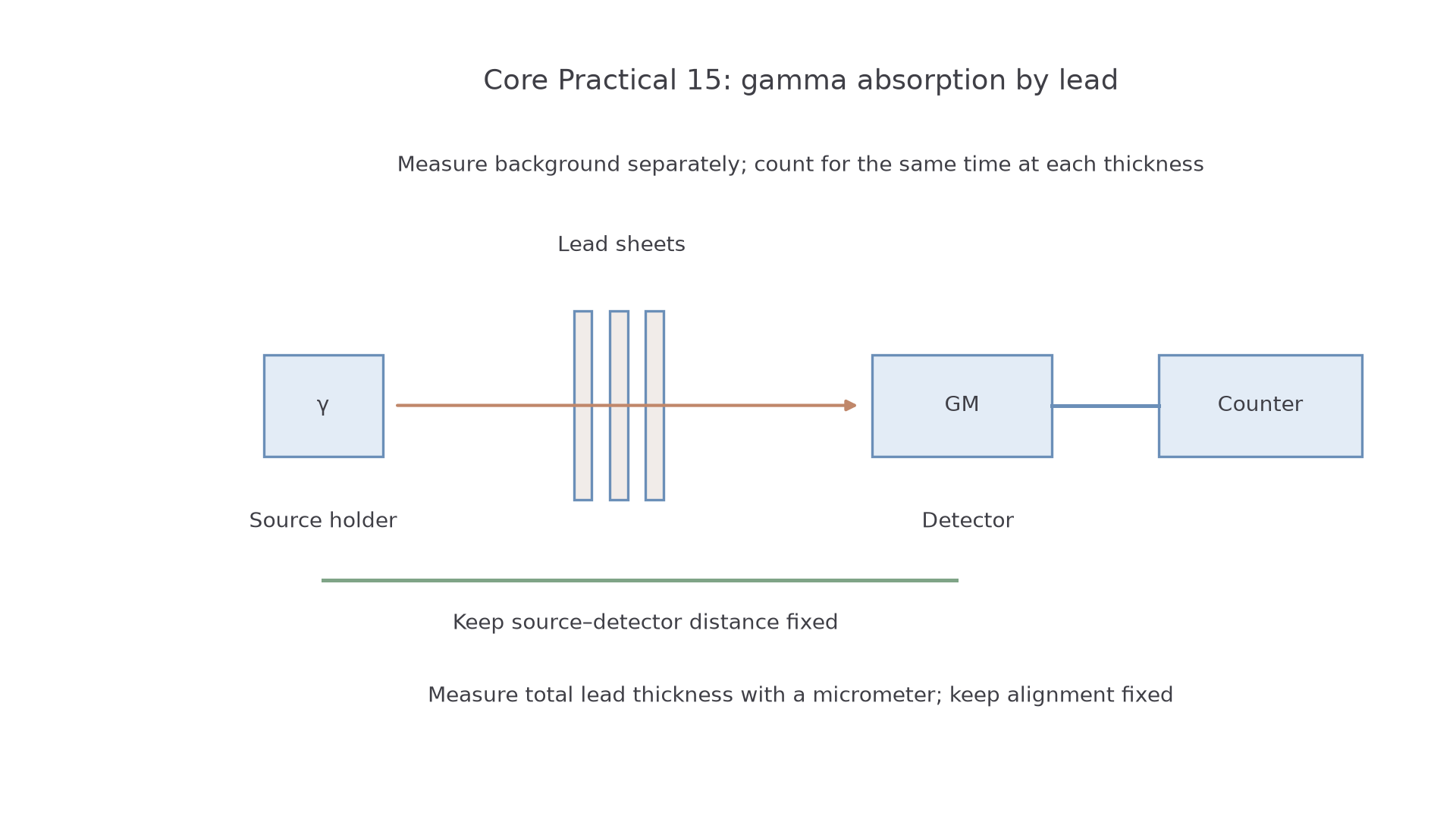
Core Practical 15 investigates how lead reduces the count rate from a source. The apparatus needs a fixed geometry because count rate depends on more than the lead: it also depends on distance, alignment and detector position.
[DIAGRAM: asset_name: Gamma source, lead sheets, GM detector and counter at fixed distance with background and thickness controls; asset_slug: 049_background_radiation_gamma_absorption_core_practical__diagram_01; recommended_method: matplotlib; description: Gamma source, lead sheets, GM detector and counter at fixed distance with background and thickness controls.]
Continue this lesson.
You’re previewing NovaLearn without an account. Create a free account to read the rest.
Create free account