97-98 - Impulse and Momentum Change (CP9)
Momentum is not changed by force alone. It is changed by a force acting for a time. A brief hard hit and a gentler push over longer time can produce the same change in momentum if the force-time product is the same. Core Practical 9 turns that idea into evidence: measure the force-time effect on a moving trolley system, measure its change in momentum, then test whether the two match.
Impulse As Force-Time
Impulse is the product of force and the time for which it acts.
Impulse
For a constant force, the product of the force and the time for which it acts; for a varying force, use its time-average, ; equal to the area under a force-time graph and to the change in momentum. Unit N s (= kg m s⁻¹).
Newton's second law can also be written as:
Impulse and change of momentum
: resultant (or average resultant) force (N); : time it acts (s); : change in momentum (kg m s⁻¹), a vector in the direction of the force.
| Symbol | Meaning | Unit |
|---|---|---|
| force in the chosen direction, or average force over the interval | newton, N | |
| time interval for which the force acts | second, s | |
| momentum | ||
| change in momentum, |
The unit of impulse is N s. Since , then:
That unit match is not a coincidence. Impulse and change in momentum are the same physical quantity seen from two sides: one side describes the force acting over time; the other describes what changed in the object's motion.
The direction matters. Momentum is a vector, so change in momentum is a vector too. If you choose "to the right" as positive, then a leftward impulse is negative. Do not drop the sign just because the calculation has numbers in it.
Misconception contrast: a larger force does not automatically mean a larger change in momentum. A force acting for gives an impulse of . A force acting for also gives . The force-time product is what matters.
For Edexcel, a calculate response involving impulse should show the equation, substitution, numerical answer and unit. If direction is part of the situation, state the direction or keep a clear sign convention.
From Impulse To Velocity
Impulse becomes useful when it is linked to momentum:
For an object of constant mass moving in one straight line:
so
where is initial velocity and is final velocity in the chosen direction.
Worked example:
A trolley starts from rest. A constant resultant force of acts to the right for . Calculate the final velocity.
Decision point 1: this is not a displacement question. The useful information is force and time, so start with impulse.
Decision point 2: impulse equals change in momentum.
Decision point 3: the trolley starts from rest, so its initial momentum is zero. Its final momentum is therefore to the right.
The final velocity is to the right, to two significant figures.
If the trolley had already been moving, you would not set the initial momentum to zero. The change in momentum must be added to the initial momentum using signs. This is a common source of wrong answers: students calculate and report it as the final velocity, even when the object already had momentum.
Guided check:
A trolley has initial velocity to the right. Its initial momentum is:
If it receives a leftward impulse of , and right is positive, then:
So:
The trolley is still moving to the right, but more slowly.
Force-Time Area
Real forces often change during a contact. A bat hitting a ball, a crash mat slowing a jumper, or a trolley being pulled by a slightly uneven string will not always have one perfectly constant force.
The idea survives if you read as the average force over the interval:
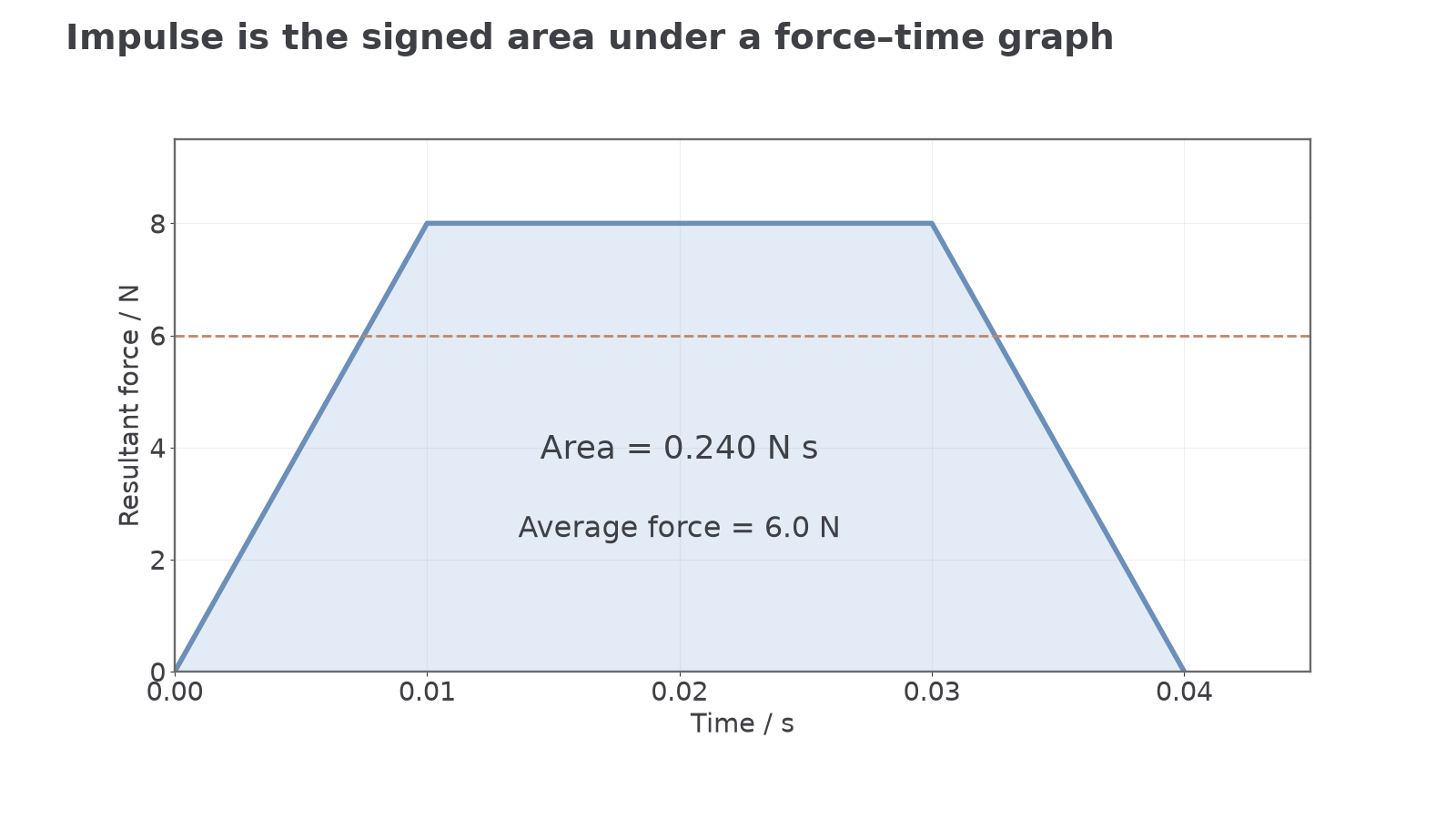
On a force-time graph, impulse is the area under the graph.
Why area? The vertical axis is force in N; the horizontal axis is time in s. Area has units:
which is the unit of impulse and change in momentum.
Decision point: impulse is not the gradient of a force-time graph. The gradient would tell you how quickly the force is changing. The area tells you the force-time product.
Worked example:
A force on a ball rises linearly from to in , stays at for , then falls linearly to in .
Break the force-time graph into simple areas:
First triangle:
Rectangle:
Second triangle:
Total impulse:
So the change in momentum is in the direction of the force.
The contact lasts , so the average force is:
Notice that the average force is not the peak force. It is the constant force that would give the same impulse over the same time.
Impulse = area under the force-time graph = change in momentum. The average force is that area divided by the contact time.
[DIAGRAM: asset_name: Impulse from a trapezoidal force-time pulse; shaded area 0.240 N s and average force 6.0 N; asset_slug: fields_impulse_area; recommended_method: matplotlib; description: Impulse from a trapezoidal force-time pulse; shaded area 0.240 N s and average force 6.0 N]
Core Practical Method
Core Practical 9 tests the relationship between force and change of momentum using a moving trolley system.
One standard route uses:
| Apparatus | Purpose |
|---|---|
| dynamics trolley or air-track vehicle | moving object/system |
| runway or air track | low-friction straight path |
| pulley, string, mass hanger and slotted masses | provides a controllable driving force |
| interrupt card and light gate | measures final speed |
| stop clock or timing system | measures the time for which the force acts |
| balance and metre ruler | measures mass, card length and distance |
The setup is arranged so a hanging mass pulls the trolley along the runway. The hanging mass falls until it reaches the floor, and the trolley's card passes through the light gate at that end point. That makes the light-gate speed the speed at the end of the force-time interval.
Define the quantities carefully:
| Symbol | Meaning |
|---|---|
| m | hanging mass |
| total moving mass: trolley, string, hanger and slotted masses | |
| time during which the hanging mass is pulling | |
| length of the interrupt card | |
| time for the card to pass through the light gate | |
| final speed of the moving system, |
If friction is compensated and the system starts from rest, the driving term in the coupled shared-coordinate model is approximately the weight of the hanging mass:
Impulse is therefore:
Continue this lesson.
You’re previewing NovaLearn without an account. Create a free account to read the rest.
Create free account