149-152 - Kinetic Theory and Ideal Gases (CP14)
This lesson covers the kinetic-theory model of gas pressure, the ideal gas equation, Core Practical 14, and the link between absolute temperature and mean molecular kinetic energy. The story is a trapped gas sample: microscopic molecule-wall collisions produce a measurable pressure, then the Boyle's-law apparatus lets us test the pressure-volume relationship for a fixed mass of gas at fixed temperature.
Collisions make pressure
Picture a sealed tube containing air. The gas looks still, but the molecules are moving randomly in every direction. Each time a molecule hits the wall and rebounds, its momentum changes. The wall must exert a force on the molecule to reverse its motion, so the molecule exerts an equal and opposite force on the wall. Pressure is this force spread over the wall area.
The kinetic-theory model simplifies the gas so the mathematics is possible:
- molecules move randomly and rapidly
- molecule volume is negligible compared with the container volume
- collisions with the walls are elastic
- the time spent colliding is negligible compared with the time between collisions
- there are no intermolecular forces except during collisions
Take a cube of side length and volume . A molecule of mass has velocity component towards one pair of opposite walls.
In one collision with a wall, the molecule's component of velocity changes from to , so the magnitude of its momentum change is:
The time before it hits the same wall again is the time to travel across the cube and back:
Force is rate of change of momentum, so the average force from this one molecule on that wall is:
Pressure is force divided by area. The wall area is , so:
For many molecules, add all the terms:
The gas is random and isotropic: no direction is special. On average, one third of the molecular speed-squared is in the direction, one third in , and one third in .
With molecules, the final relationship is:
Kinetic theory of gases
: pressure (Pa); : volume (); : number of molecules; : mass of one molecule (kg); : mean square molecular speed (). Ideal gas: random motion, negligible molecular volume, elastic collisions, no forces except in collisions.
Decision point: is not the square of the average speed. Fast molecules contribute disproportionately because the collision force depends on speed squared. Also, this means molecular speed, not the speed of light.
For the Edexcel command word “derive”, quoting the final equation is not enough. The credit-bearing chain is: momentum change at a wall, time between collisions, pressure from force per area, summing over molecules, then the one-third factor from random three-dimensional motion.
Consider slow compression at constant temperature. The mean molecular speed and the momentum change in a collision remain unchanged. Molecules travel a shorter distance between collisions with the moving wall, so the collision rate increases. A larger rate of momentum transfer means a larger force; divided by the wall area, this gives a larger pressure. This microscopic chain explains Boyle's law rather than merely restating .
Using the ideal gas equation
The kinetic-theory equation explains pressure from molecule collisions. The ideal gas equation connects the measurable gas state to temperature:
Ideal gas equation
: number of molecules; (Boltzmann constant); : absolute temperature (K); in Pa and in .
Use SI units:
- in pascals,
- in cubic metres,
- in kelvin,
Temperature must be absolute temperature in kelvin because is proportional to molecular energy. Celsius values are intervals on a shifted scale, so they cannot be put straight into .
Worked example: a sealed gas sample in a rigid container has volume , pressure , and temperature . Determine the number of molecules. Then predict the pressure if the same sealed container is warmed to .
Decision point 1: use because , , , and are linked for an ideal gas sample.
Decision point 2: the container is sealed and rigid, so and stay constant. That makes constant.
The result is physically sensible: higher temperature means larger average molecular kinetic energy, so collisions with the walls are more forceful on average and the pressure rises.
Misconception contrast: a warmer gas in a rigid sealed container does not have more molecules. It has the same molecules with greater average kinetic energy. The pressure change comes from the collision model, not from new gas being made.
For “determine”, make the condition visible: fixed , fixed , or fixed tells you which ratio is constant.
Core Practical 14: Boyle's law
Core Practical 14 investigates how pressure changes with volume for a fixed mass of gas at fixed temperature. The practical is not just "take some readings". The point is to keep everything except pressure and volume under control so the relationship is valid.
[DIAGRAM: asset_name: Trapped gas above oil in a closed uniform-bore tube, with pressure gauge and pump; asset_slug: 043_kinetic_theory_ideal_gas_core_practical__diagram_01; recommended_method: matplotlib; description: Trapped gas above oil in a closed uniform-bore tube, with pressure gauge and pump; gas length measured from closed end to oil.]
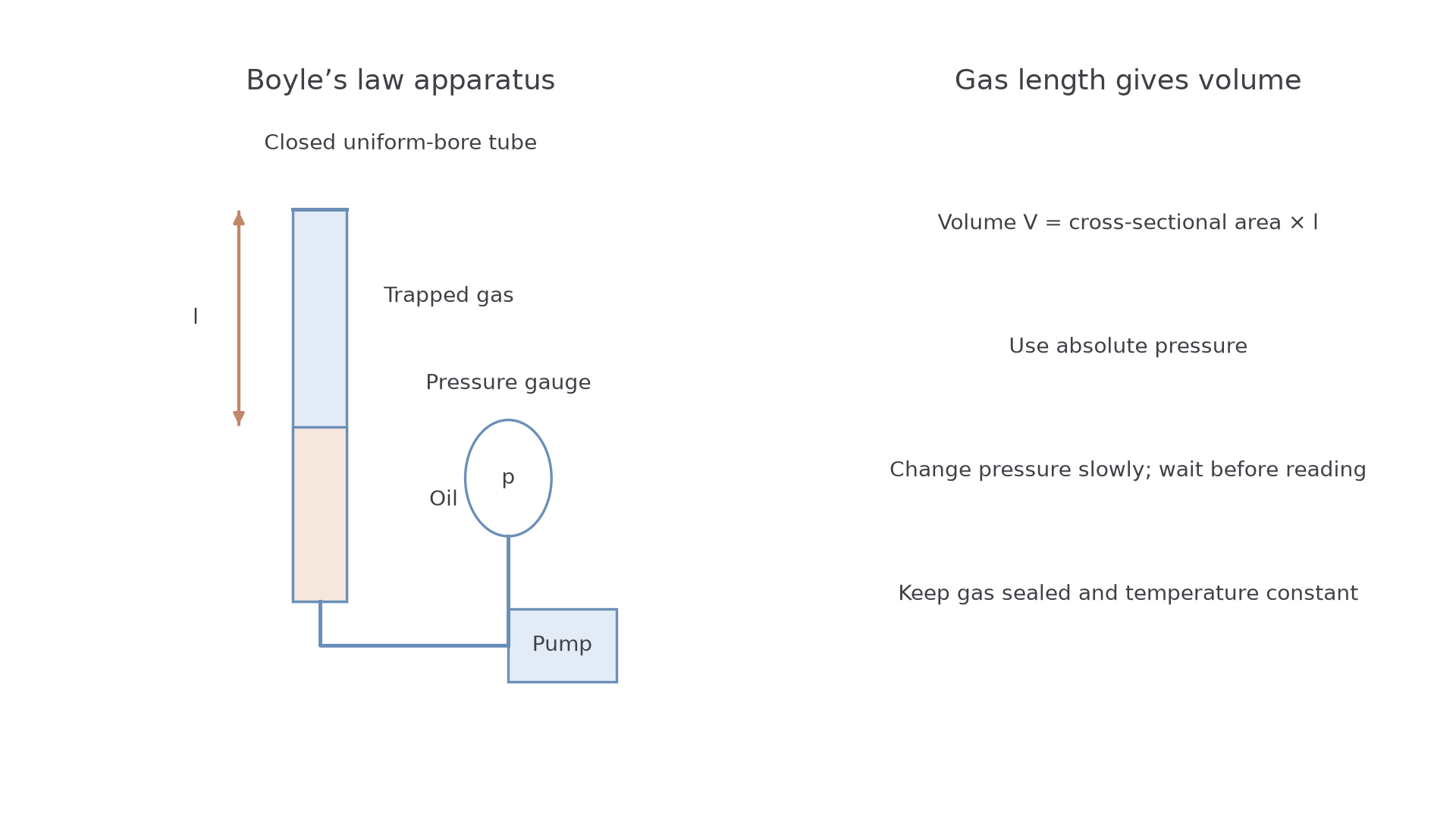
In a common Boyle's-law apparatus, a trapped gas sample sits in a tube of constant cross-sectional area. The oil column seals the gas and transmits pressure. A pump changes the pressure, and a pressure gauge gives the gas pressure. The gas volume is proportional to the trapped gas length because:
where is the constant cross-sectional area of the tube. If is constant, testing against is equivalent to testing against .
A sensible method is:
- Set up the apparatus behind a safety screen and check that the gas is trapped with no leaks.
- Record the initial pressure and trapped gas length.
- Use the pump to change the pressure in small steps.
- After each pressure change, wait for the gas to return to room temperature before reading and .
- Repeat readings where possible and calculate means.
- Plot against , or against if length is being used as the volume proxy.
If Boyle's law holds at fixed temperature:
So:
A graph of against should be a straight line through the origin. If using instead of , a graph of against should also be straight because .
Continue this lesson.
You’re previewing NovaLearn without an account. Create a free account to read the rest.
Create free account