188, 191 - Oscillation Energy and Damping
An oscillator exchanges kinetic and potential energy. This lesson explains that exchange, how resistive forces reduce mechanical energy, and how permanent deformation can dissipate energy.
Energy in an undamped oscillator
Picture a mass on a spring moving horizontally on a low-friction track. It is pulled to one side and released. The motion looks like a repeated back-and-forth journey, but the energy story is a repeated exchange between two stores.
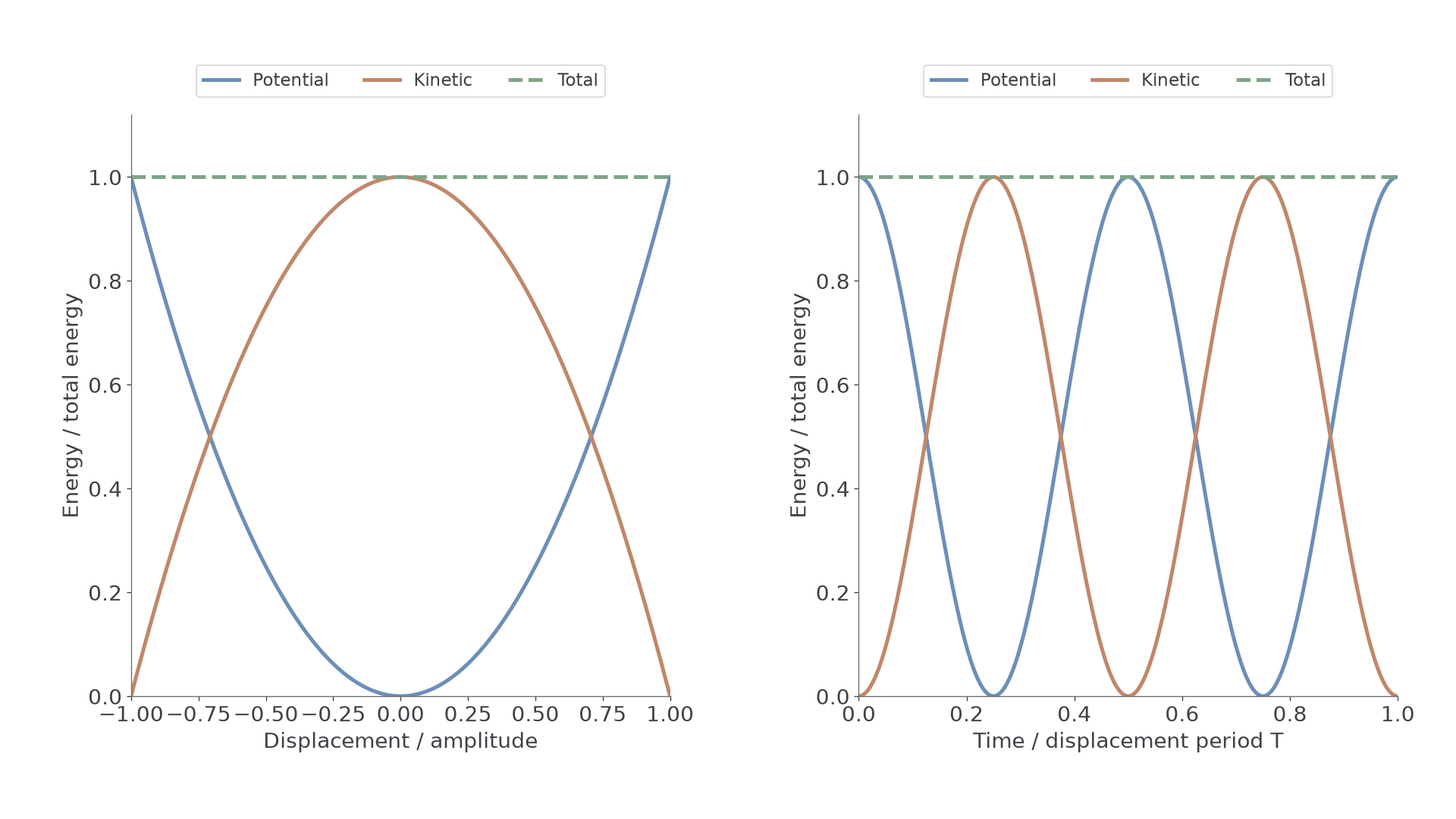
At the turning points, or , the mass is momentarily stationary. Its kinetic energy is zero and the energy is stored as elastic potential energy in the spring. At equilibrium, , the spring has no extra extension relative to equilibrium, so the mass has its greatest speed and its kinetic energy is maximum.
For an ideal undamped oscillator, no mechanical energy is transferred away from the oscillator. The total mechanical energy stays constant:
For a spring oscillator of amplitude :
Energy of a spring oscillator
: spring constant; : amplitude; at all the energy is elastic potential, at it is all kinetic (). Constant only if undamped.
That equation is most useful when you choose the easiest point in the cycle. At maximum displacement the speed is zero, so all the mechanical energy is elastic potential energy. At equilibrium the elastic potential energy is minimum, so the mechanical energy is kinetic.
[DIAGRAM: asset_name: Complementary kinetic and potential energies against displacement and time, with constant total; asset_slug: 055_energy_damping_forced_oscillations_resonance__diagram_01; recommended_method: matplotlib; description: Complementary kinetic and potential energies against displacement and time, with constant total; energy-time curves repeat twice per displacement period.]
Worked route: a mass is attached to a spring of spring constant . The oscillator has amplitude . Determine the maximum speed.
Decision point: maximum speed occurs at equilibrium, but the easiest energy value is found at maximum displacement.
At equilibrium, treat this as kinetic energy:
The answer is a maximum speed, not the speed everywhere. The mass slows to zero at each turning point.
For the horizontal spring shown, equilibrium is the unstretched position. For a vertical oscillator the same expression describes the change in combined gravitational and elastic potential energy relative to equilibrium, not elastic energy alone.
With , potential energy is and kinetic energy is . Both repeat every : there are two turning points and two passages through equilibrium in each displacement cycle. Their sum remains constant. For a lightly damped oscillator the exchange continues while the total mechanical energy and amplitude decrease.
Continue this lesson.
You’re previewing NovaLearn without an account. Create a free account to read the rest.
Create free account