128-129 - Alternating Currents and RMS Values
In this lesson you will describe an alternating current or potential difference using frequency, period, peak value and root-mean-square value, then use the Edexcel relationships and for sinusoidal AC.
Reading an AC Waveform
A direct current has one direction through a component. An alternating current repeatedly reverses direction. In a simple sinusoidal AC supply, the potential difference and current rise, fall, pass through zero, reverse, and repeat.
That reversing story is why a time graph matters. At one instant the potential difference may be positive; half a cycle later it may have the same size but the opposite sign. The sign tells you the direction of the potential difference or current, not whether the supply is "stronger" or "weaker".
[DIAGRAM: asset_name: Sinusoidal AC example with 10 volt peak, 20 millisecond period and positive rms value 7.07 volts; asset_slug: 036_alternating_currents_rms_values__diagram_01; recommended_method: matplotlib; description: Sinusoidal AC example with 10 volt peak, 20 millisecond period and positive rms value 7.07 volts]
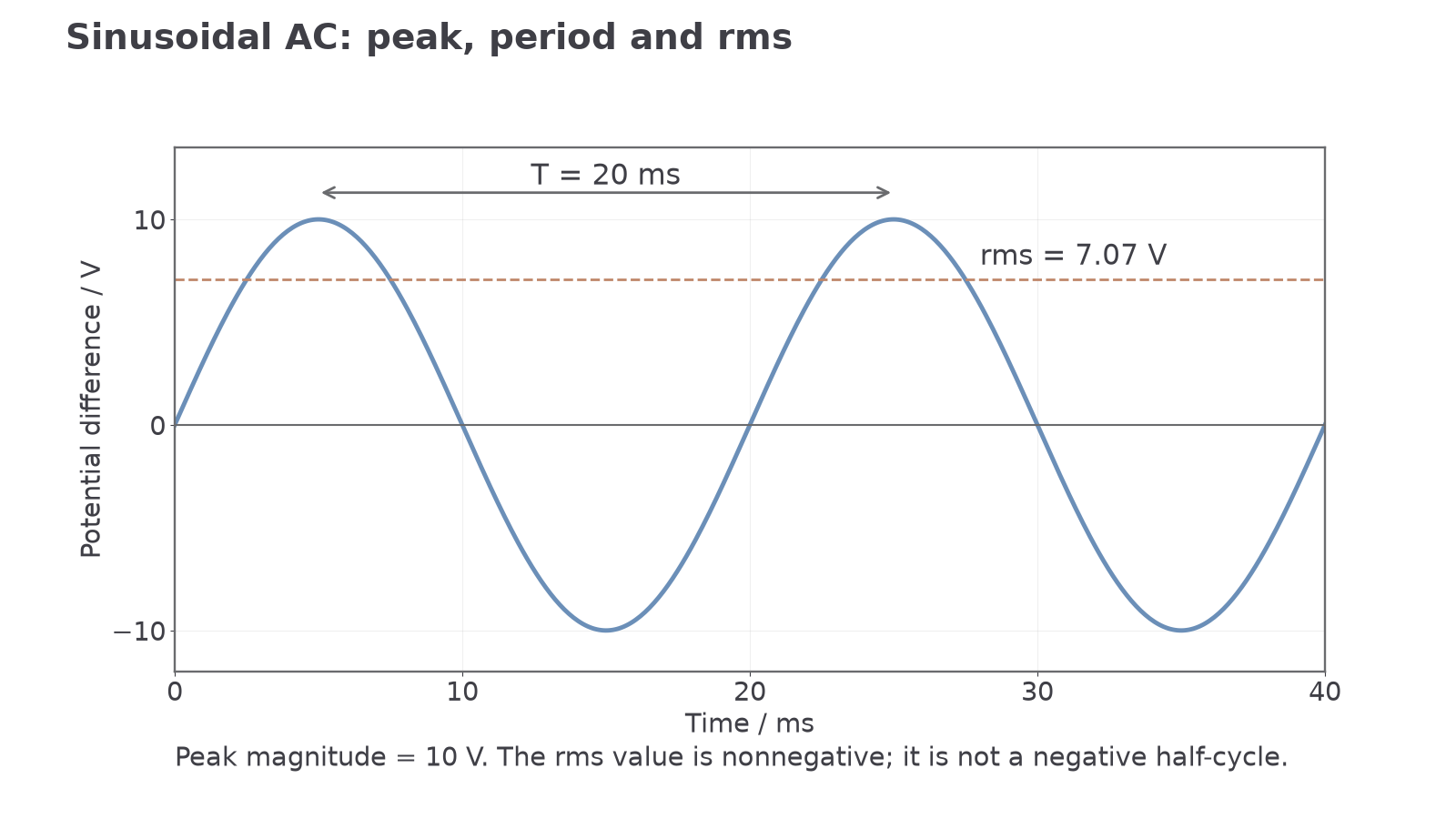
Four quantities describe the waveform:
| Quantity | Symbol | Unit | Meaning |
|---|---|---|---|
| Period | Time for one complete cycle. | ||
| Frequency | Number of complete cycles per second. | ||
| Peak value | or | or | Maximum magnitude reached from zero to a crest or trough. |
| Root-mean-square value | or | or | The effective DC value that would produce the same heating effect in a resistor. |
Frequency and period are linked by:
So a supply with has:
The peak value is not the same as the peak-to-peak value. Peak is measured from the zero line to one crest. Peak-to-peak is measured from the positive crest to the negative crest, so for a symmetric sine wave:
For Edexcel “determine” questions using a graph or oscilloscope trace, show where the reading came from: one complete cycle for , zero-to-crest for peak, and sensible unit conversion such as to .
Why RMS Is Needed
If you average a perfectly symmetric AC current over one complete cycle, the signed average is zero. The positive half-cycle and negative half-cycle cancel.
That does not mean the AC supply transfers no energy. A lamp filament or heater still gets hot. In a resistor, the rate of heating depends on , and squaring the current makes both halves of the cycle contribute positively:
- positive current gives positive heating
- negative current gives positive heating too, because
This is the physical reason for root-mean-square values.
Root-mean-square (rms) value
The rms current (or p.d.) is the steady direct current (or p.d.) that would produce the same mean heating effect in the same resistor.
The name describes the operation:
- Square the instantaneous values so negative parts do not cancel.
- Find the mean of those squared values over a cycle.
- Take the square root to return to the original unit, such as volts or amps.
You do not need calculus for this topic. The important model is that rms is an effective value, not an ordinary signed average.
Common mistake: saying "the average value of AC is zero, so the rms value is zero." The signed average can be zero, but rms is based on the average of squared values, so it is positive for a non-zero alternating waveform.
Using Peak and RMS Values
For sinusoidal alternating currents and potential differences:
Peak and rms values
, : peak p.d. (V) and peak current (A), measured from zero to a crest; , : root-mean-square values. Sinusoidal waveforms only.
The rms value is about of the peak value because .
Worked example: a signal generator produces a sinusoidal alternating p.d. with peak value . The peak current in a connected resistor is . Calculate the rms p.d. and rms current.
The fork in the road is whether the numbers are peak or rms. The question says peak, so divide by .
The answers are smaller than the peak values, which makes sense because a sine wave is below its peak for most of the cycle.
You may also need the reverse route. If a mains supply is quoted as , its peak value is:
That does not mean a "230 V" AC supply is harmless below 230 V or only sometimes 230 V. It means its effective heating value is ; its instantaneous value varies between about and for a sinusoidal supply.
The link is for sinusoidal waveforms. Do not assume every possible alternating waveform has the same rms-to-peak ratio.
Continue this lesson.
You’re previewing NovaLearn without an account. Create a free account to read the rest.
Create free account