31-33 - Charge, Current, Potential Difference and Resistance
Electric circuits become much easier when the first three quantities do three separate jobs. Current tells you how quickly charge is passing a point. Potential difference tells you how much energy is transferred for each coulomb of charge. Resistance tells you how much potential difference is needed for each ampere of current. Keep those roles separate and the equations stop feeling like a pile of letters.
Current As A Rate
Imagine choosing one fixed point in a wire and counting the charge that crosses it. If crosses in one second, the current is . If the same takes ten seconds, the current is much smaller. The physics idea is a rate, not a store of charge.
Electric current
The rate of flow of electric charge past a point, carried by charged particles. Symbol ; unit the ampere, A.
The equation is:
Current
| Symbol | Meaning | Unit |
|---|---|---|
| current | ampere, | |
| charge that passes a point during the interval | coulomb, | |
| time interval | second, |
The symbol matters: it means a change or an amount over an interval. So is charge transferred per second over that interval. One ampere is one coulomb per second, so .
A common wrong model is that current is a substance moving around the circuit and being used up. The correct model is sharper: charge moves, current is the rate of that movement, and energy transfer is described by potential difference, not by "using up current".
For Edexcel, a state what is meant by current answer needs the phrase rate of flow of charge or charged particles. Saying "the flow of electrons" is incomplete at A Level because it misses the rate idea, and not every conductor uses electrons as the charge carriers.
Conventional current points in the direction positive charge would flow, from the positive terminal through the external circuit to the negative terminal. In a metal the mobile electrons drift in the opposite direction. An electrolyte can conduct through positive and negative ions moving in opposite directions; both can contribute to the same conventional current. Current counts charge per second, not simply the number of particles per second.
Using The Current Equation
Use when the question links charge, current and time. The decision point is the word rate: current compares an amount of charge with the time taken for that charge to pass.
Worked example:
During a short pulse, of charge passes a point in a wire in . Calculate the average current.
First choose the equation. The question gives charge and time, and asks for a rate of flow, so:
Now substitute with units:
Since is the same as :
Interpretation: on average, of charge crosses the chosen point each second.
Two checks keep this calculation honest:
- Time must be in seconds. If the question says , use .
- A larger time for the same charge gives a smaller current, because the charge is passing more slowly.
Guided check:
If passes in , first convert the time: . Then:
A common error is to divide by and write . That answer treats minutes as seconds and is too large by a factor of .
Potential Difference As Energy Per Charge
Now keep the charge moving, but ask a different question: how much energy is transferred as each coulomb passes through a component?
Potential difference
The energy transferred per unit charge between two points. Symbol ; unit the volt, V, where .
It is often called p.d. or voltage. The equation is:
Potential difference
| Symbol | Meaning | Unit |
|---|---|---|
| potential difference across a component | volt, | |
| work done or energy transferred | joule, | |
| charge passing through the component | coulomb, |
One volt is one joule per coulomb: .
Worked example:
of energy is transferred to a component when of charge passes through it. Calculate the potential difference across the component.
Decision point: this is not asking how quickly charge flows, so do not use . It is asking for energy per charge, so use:
Substitute:
Interpretation: each coulomb of charge transfers of energy to the component.
This is where "current is used up" breaks. The charge does not disappear inside the component. Instead, energy is transferred from the electrical supply to the component as charge moves through it. Potential difference measures that energy transfer per coulomb.
Guided check:
If a lamp has a p.d. of and passes through it, rearrange to .
So transfers , and each would transfer .
Resistance As V Per Ampere
Resistance connects the p.d. across a component to the current through it. It is defined by:
Resistance
| Symbol | Meaning | Unit |
|---|---|---|
| resistance | ohm, | |
| potential difference across the component | volt, | |
| current through the component | ampere, |
A definition that applies to any component at a given operating point.
One ohm is one volt per ampere: .
The wording "across" and "through" is not decorative. Potential difference is measured across the component. Current is measured through the component. If the values do not refer to the same component at the same time, will not describe that component.
Worked example:
A resistor has a p.d. of across it and a current of through it. Calculate its resistance.
Decision point: the question gives p.d. and current, so use the definition of resistance:
Substitute:
Interpretation: this component needs across it for each ampere of current through it, at this operating point.
Do not read resistance as "how much current is used up". A larger resistance means that, for the same p.d., the current would be smaller. Equally, for the same current, a larger resistance would require a larger p.d.
Guided check:
If and , then:
If the current were only for the same , the resistance would be:
Same p.d., smaller current, larger resistance.
defines resistance at any operating point; only an ohmic conductor at constant temperature has a constant .
Ohm's Law Is A Special Case
The equation is a definition. You can calculate for a component at a particular operating point. Ohm's law is a stronger statement.
Ohm's law
For an ohmic conductor at constant temperature, the current is directly proportional to the potential difference across it.
Directly proportional means:
- if doubles, doubles
- if is zero, is zero
- the ratio stays constant
- an against graph would be a straight line through the origin
The constant-temperature condition matters because heating can change the resistance of a conductor. If the temperature changes while you take readings, a component may fail the proportionality test even if it would behave ohmically under controlled conditions.
Worked example:
A student records these readings for a metal resistor kept at constant temperature.
| Potential difference / V | Current / A | / |
|---|---|---|
Determine whether the readings support Ohm's law.
Decision point 1: do not just say "current increases". Lots of components have current increase when p.d. increases. Ohm's law needs direct proportionality.
Decision point 2: use the data quantitatively. Here, doubling from to doubles from to , and remains .
Decision point 3: include the condition. The conclusion is only an Ohm's-law conclusion because the resistor was kept at constant temperature.
A strong Edexcel “determine” response would say: the data support Ohm's law because is directly proportional to ; for example, is constant at for all three readings, and the resistor is at constant temperature.
Contrast this with:
| / V | / A | / |
|---|---|---|
Current still increases, but not in direct proportion to p.d.; is not constant. That is not enough evidence for Ohm's law.
Measuring Current and Potential Difference
These three equations answer different questions:
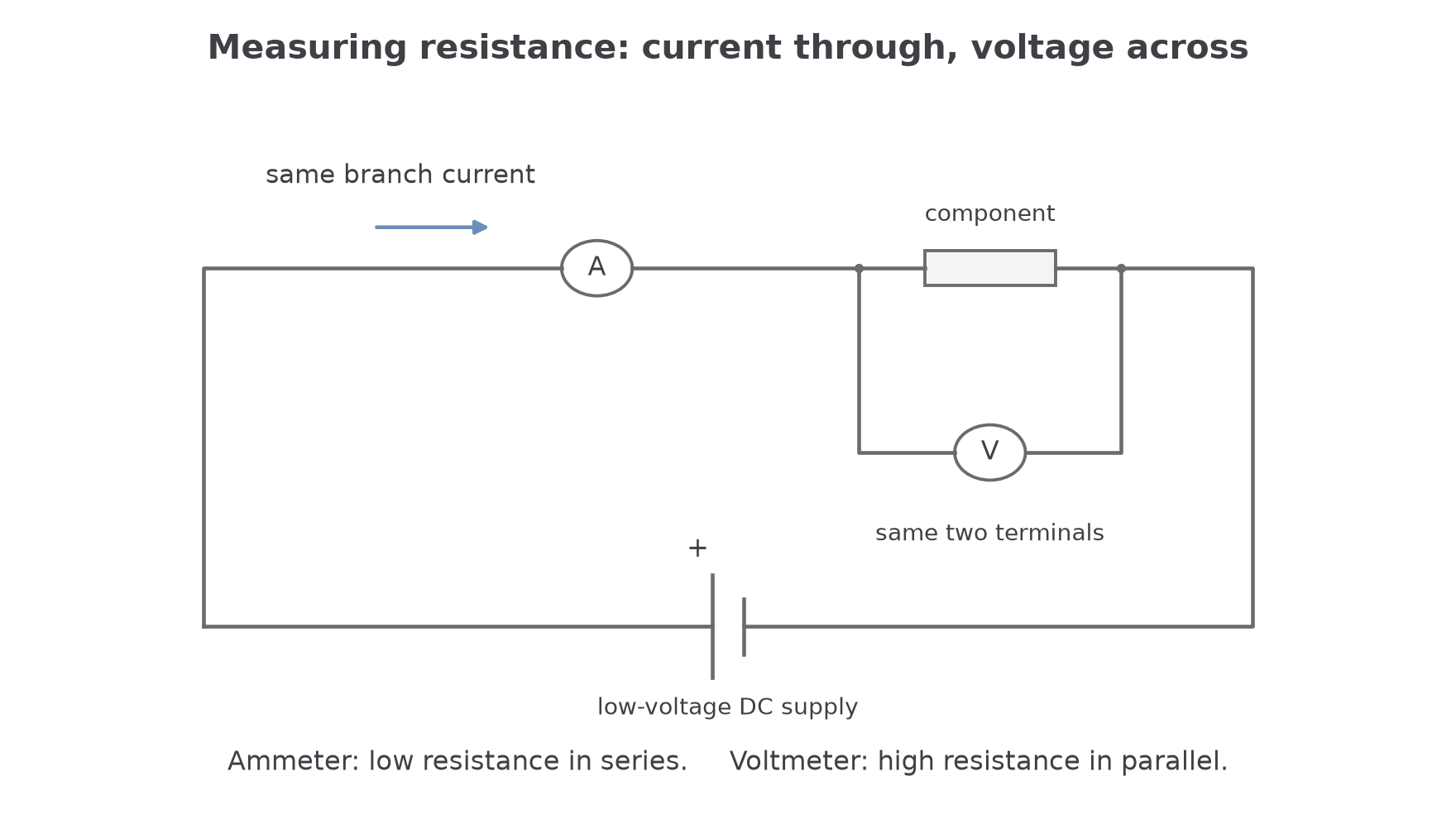
[DIAGRAM: asset_name: Ammeter and voltmeter connections; asset_slug: 9ph0_current_voltage_meters; recommended_method: deterministic; description: Low-voltage circuit with ammeter in series and voltmeter connected across the component only. Conventional current arrow runs from the positive cell terminal into the external circuit.]
| If the question asks about... | Use... | Meaning check |
|---|---|---|
| charge flow rate | coulombs per second | |
| energy transferred per charge | joules per coulomb | |
| resistance of a component | volts per ampere |
Worked mixed example:
In , of charge passes through a component. The potential difference across the component is .
Calculate the current through the component and its resistance.
Step 1: use charge and time to find current.
Step 2: use p.d. and current to find resistance.
Decision point: do not put into . Charge is not current. The charge first has to become a rate by dividing by time.
If the question also asked for energy transferred, then the p.d. equation would become useful:
That route has a different purpose: it finds total energy transferred, not current or resistance.
Practical/data transfer:
To measure resistance in a simple circuit, pair the readings correctly: measure the p.d. across the component and the current through it. A digital voltmeter and ammeter have finite resolution, so record readings to the displayed precision. If you are checking Ohm's law, keep the component at constant temperature by using small currents or switching off between readings, then look for a proportional pattern rather than trusting one reading.
Command-word transfer:
- For “calculate”, show the equation, substitution, answer and unit.
- For “determine”, use the numbers in the data to reach a quantitative conclusion.
- For “explain”, connect the calculation or pattern to the physics reason.
- For “show that”, carry extra precision in the working before rounding to the stated value.
An ammeter is connected in series so the branch current passes through it; its resistance should be very small so it changes that current as little as possible. A voltmeter connects in parallel across the two points whose potential difference is wanted; its resistance should be very large so it draws negligible current. Never connect an ammeter directly across a supply: its low resistance can give a damaging current. Select a suitable meter range, observe DC polarity and reduce the range only when the reading is safely within it. Switch off before altering connections.
In a real measurement the voltmeter draws some current. The simple calculation assumes this is negligible compared with the component current and that lead/meter resistance does not significantly alter the circuit. These are experimental assumptions to check, not reasons to change the definitions of current or p.d.