144-146 - Specific Heat, Latent Heat and Thermistors (CP12–13)
This lesson connects thermal energy calculations with two practical problems: measuring a phase-change energy and turning temperature into a control signal. The same habit runs through the whole lesson: decide where energy goes, decide what is being measured, and then use the equation or circuit ratio that matches that story.
Heating or Changing State
Put a beaker of water on a heater and the temperature rises. Put energy into melting ice at 0 °C and the temperature does not rise while melting is happening. That is the fork in the road for this lesson.
If the temperature changes, use:
Specific heat capacity
: energy transferred (J); : mass (kg); : specific heat capacity (), the energy to raise 1 kg by 1 K; : temperature change (K or °C). No change of phase.
If the substance changes phase at a constant temperature, use:
Specific latent heat
: specific latent heat (), the energy to change the phase of 1 kg without a temperature change; : mass that changes phase (kg).
| Symbol | Meaning | Usual unit |
|---|---|---|
| energy transferred | J | |
| or | mass, or mass that changes phase | kg |
| specific heat capacity | ||
| temperature change | K or interval | |
| specific latent heat |
The temperature interval can be in kelvin or °Celsius because a change of 1 K is the same size as a change of 1 °C. Do not use the absolute temperature in ; use the change.
The physical contrast matters. In heating, energy increases the average kinetic energy of the particles, so the temperature changes. During melting or boiling, energy is used to change the arrangement or separation of particles, so the temperature can stay constant until the phase change is complete.
A tempting wrong route is to think "no temperature rise means no energy absorbed". The correct model is sharper: no temperature rise means the energy is not appearing as greater average kinetic energy at that moment.
Temperature changing → . Phase changing at constant temperature → . If a sample does both, add both terms.
Energy Accounting
Thermal calculations become much calmer if you treat them as an account. One object loses energy; another object gains energy. The equation is then just a compact way to write the account.
Worked route:
of melting ice at is added to of water at . The final temperature after all the ice has melted is . Take the specific heat capacity of water as . Determine the specific latent heat of fusion of the ice.
Decision point 1: the warm water changes temperature but does not change phase, so use for the water cooling.
Decision point 2: the ice first melts, then the melted ice warms from to . That means the ice side has two terms.
For the warming of the melted ice:
Assuming energy lost by the warm water is gained by the ice and melted water:
The answer is in because latent heat is energy per kilogram that changes phase.
Notice the decision trail. We did not pick both equations because the question looked long. We picked them because the ice did two physical things: it changed phase and then changed temperature.
For Edexcel determine or calculate wording, show the energy balance, substitutions, units and a sensible final significant figure.
Latent Heat Practical
Core Practical 13 is not just "put ice in water". It is a heat-balance method. You arrange the experiment so that the energy lost by warm water is mainly the energy gained by ice.
[DIAGRAM: asset_name: Melting ice is drained before adding it to warm water in an insulated vessel on a balance, with thermometer and stirrer; asset_slug: 041_thermal_energy_latent_heat_thermistor_core_practicals__diagram_01; recommended_method: matplotlib; description: Melting ice is drained before adding it to warm water in an insulated vessel on a balance, with thermometer and stirrer.]
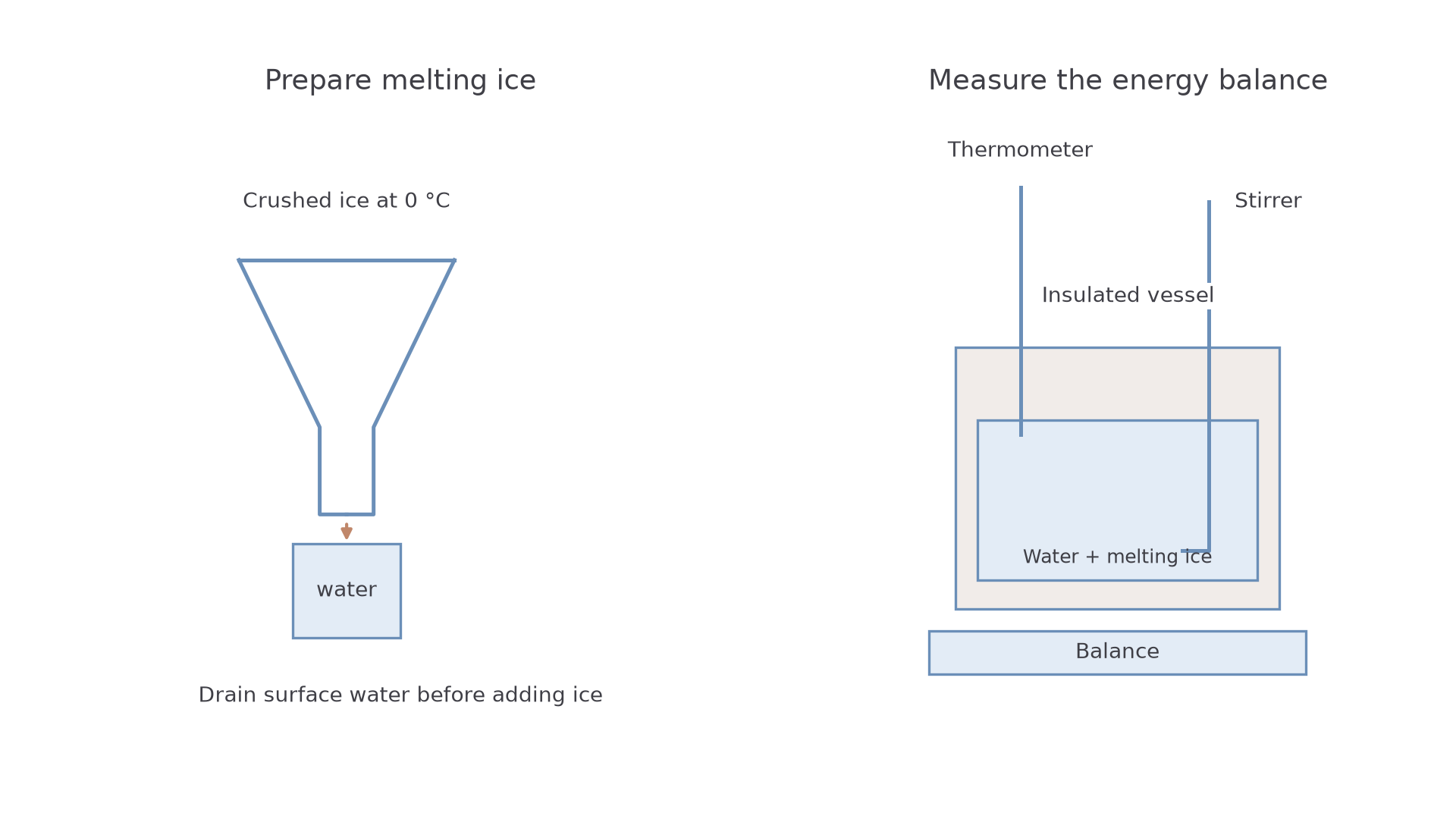
A clean method has these ideas in order:
- Let the crushed ice start melting before use, so the ice added to the water is close to , not below zero. Drain and quickly blot away adhering meltwater so the measured added mass is ice that actually requires melting.
- Measure the mass of warm water in the beaker.
- Measure the initial water temperature.
- Add melting ice, stir gently, and record the lowest temperature as the last ice melts. Measure the total mass again: the increase gives the ice mass. Use an insulated low-heat-capacity container, or include a known container heat capacity in the balance.
- Use the heat balance:
Core Practical 13 heat balance
: mass of warm water; : mass of ice; , : initial and final water temperatures (°C); ice assumed to start at 0 °C, with negligible exchange with the surroundings and container.
The left side is the energy lost by the original warm water. The first term on the right is the energy used to melt the ice. The second term on the right is the energy used to warm the melted ice from to the final temperature.
The practical details are not decoration. Crushed ice melts quickly, so the final temperature is easier to identify before much extra heat enters from the room. Stirring helps the thermometer measure the mixture rather than one local cold region. Insulation reduces unwanted energy transfer between the beaker and surroundings.
Uncertainty is especially sharp here because several quantities are found by subtraction: mass of water, mass of ice added, and temperature drop. For a mass found from two balance readings, add their maximum absolute uncertainties before dividing by the mass difference to obtain percentage uncertainty. A balance reading to is usually more useful than a rough volume estimate. A thermometer resolution of can matter a lot if the cooling is only a few degrees.
Systematic effects have directions. If the ice is colder than , some of the warm water's energy first warms the ice to , so the calculation that assumes ice started at overestimates the latent heat. If heat enters from the room while the ice melts, the warm water supplies only part of the energy gained by the ice, so ignoring the extra room contribution underestimates . If the mixture instead loses heat to the room, some water cooling is wrongly attributed to the ice and is overestimated. The direction depends on the mixture temperature relative to the room.
For Edexcel evaluate, use evidence. "Insulate better" is not enough by itself. A stronger line is: insulation reduces heat gained from the room, which is important because that heat would reduce the apparent energy supplied by the warm water and bias the calculated .
Continue this lesson.
You’re previewing NovaLearn without an account. Create a free account to read the rest.
Create free account