9.3.5 - Is psychology a science?
Psychology investigates behaviour and mental processes that are influenced by both people and their circumstances. You will examine empirical evidence, testable predictions, controlled methods and replication, then judge how core studies support scientific claims and where their conclusions remain limited.
Empirical evidence and testable predictions
A scientific explanation is accountable to evidence rather than accepted only because it sounds plausible.
Empiricism
Empiricism bases knowledge on observations and experience. In research, observations must be collected and interpreted systematically enough for other people to examine the claim.
A theory gives an explanatory account; a hypothesis makes a prediction that evidence can test. If semantic similarity causes interference in learning word order, a controlled comparison should show poorer performance for semantically similar than dissimilar lists under relevant conditions. Baddeley's study converted the broad claim into list conditions and recall scores. A theory of memory is not established just by naming stores: it must account for actual performance and survive suitable tests.
Operationalisation defines how a construct is manipulated or measured. 'Hostility' could be measured through specified insults or choices; 'recall' could be words in the correct sequence positions. A clear operation makes a test checkable, but it does not guarantee that the measure captures the whole concept. A count of insults might miss silent exclusion. Science therefore needs both clarity and validity.
Falsifiability means that some possible evidence would count against a claim. A prediction that a manipulation will impair recall risks contradiction if careful studies consistently show no impairment. 'The mind always does whatever the task requires' can fit any outcome and explains little. Testable claims should specify conditions and what result would challenge them before seeing the results.
One unexpected result does not logically settle every theory. Measurement failure, a confound or an unsuitable condition might explain it. Nevertheless, these possibilities must be checked transparently, not invented indefinitely to protect a favourite claim. Evidence normally supports, challenges or narrows an explanation rather than proving it permanently true.
[DIAGRAM: asset_name: Scientific testing cycle; asset_slug: edexcel_9ps0_i04_scientific_testing; recommended_method: image_gen; description: Theory leads to a testable prediction, controlled observation and evidence-based judgement, with a return arrow for revision and further testing; caption: Scientific explanations remain open to checking, challenge and revision.]
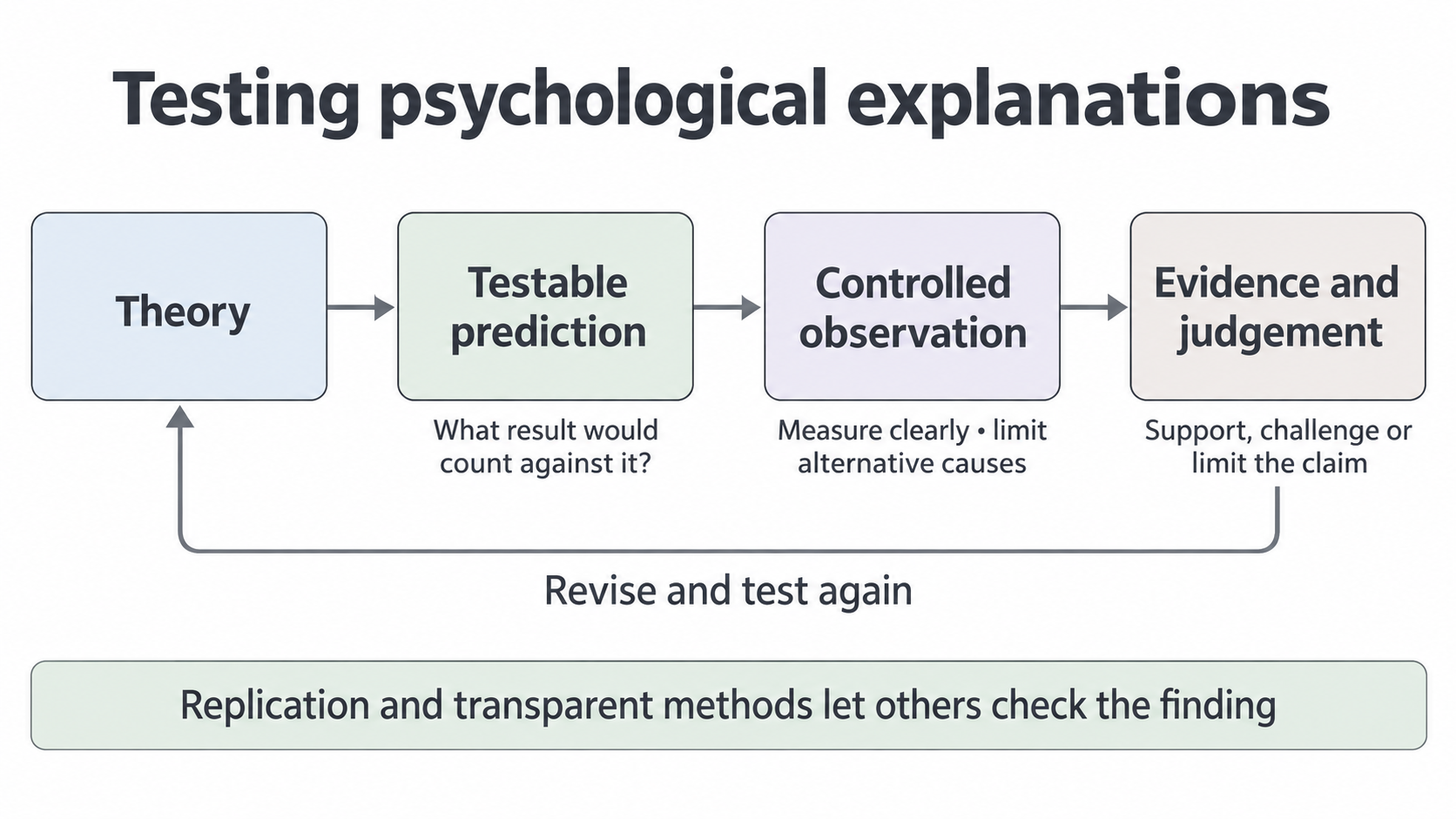
The cycle matters because collecting data is only one stage. A report also needs a defensible link between its observations and its conclusion.
Control, measurement and causal inference
Scientific quality depends on whether a design rules out relevant alternatives to its conclusion.
Baddeley's standardised word presentation and sequence scoring reduced variation unrelated to list similarity. Manipulating list characteristics makes causal inference possible, provided competing differences are adequately controlled. Consistent instructions support reliability, meaning consistency of a measure or finding. Internal validity concerns whether the observed effect can be attributed to the intended manipulation. A reliable score can still measure a narrow or misleading construct.
Raine used a standardised task and PET measures with matched controls. Numerical brain measurements make the recorded activity more explicit than an impression of someone being 'biologically different'. Yet equipment does not remove every judgement: researchers choose the task, regions, comparisons and interpretation. Existing NGRI and control groups were not randomly allocated. The study therefore tests an association with group status, not a manipulated brain cause of violence. Its technical measurement can be scientific while its causal conclusion remains limited. Original abstract.
Watson and Rayner deliberately paired a stimulus with noise and observed later responding. That gives a before-and-after record consistent with conditioning. Its single case, variable procedure and lack of an equivalent comparison limit separation of conditioning from other influences. Direct observation is empirical evidence, but empirical evidence has different strengths: one observed case does not establish a general law.
Sherif's field experiment connects manipulated goals with real group interaction. The setting gives goals social meaning, but its fixed sequence and staff involvement leave alternatives such as time together and researcher influence. This shows a trade-off between ecological validity, relevance to behaviour in meaningful settings, and isolating a causal variable. Neither perfect artificial control nor realism alone is a sufficient definition of science.
Objectivity seeks conclusions less dependent on one observer's expectations. Operational definitions, blinded coding and independent checks help. They reduce bias rather than making researchers perspective-free. A measure may be numerically precise yet poorly chosen, and a detailed qualitative account may reveal processes that the numerical measure misses.
Continue this lesson.
You’re previewing NovaLearn without an account. Create a free account to read the rest.
Create free account