6.1.3, 6.1.4 - Cognitive interviewing and formulation
Psychologists need reliable information before they can explain an individual’s offending. You will learn cognitive and ethical interviewing, then use offence analysis to build a testable formulation of the function of behaviour rather than assuming that one label explains the person.
Retrieval in the cognitive interview
The cognitive interview uses memory principles to help a witness retrieve information about an event they experienced.
Cognitive interview
A cognitive interview is a structured approach that supports a witness’s recall through retrieval techniques and careful communication, while avoiding suggestion and pressure to guess.
Memory is not a recording that can simply be replayed. Retrieval cues may make some stored details accessible; a routine account may omit apparently unimportant information. The original cognitive interview has four techniques:
| Technique | What the witness does | Proposed benefit |
|---|---|---|
| Reinstate context | Mentally reconstruct the setting and their own feelings at the time. | Features connected with encoding may cue retrieval. |
| Report everything | Include remembered details even if they seem minor or incomplete. | A detail may be useful itself or cue another memory. |
| Change order | Recall from another starting point, sometimes working backwards. | Disrupting a routine narrative may make overlooked details accessible. |
| Change perspective | Reconsider the scene from a different viewpoint. | A different retrieval approach may access details omitted from the habitual account. |
Changing perspective must remain within what the witness actually experienced. It is not an invitation to invent what another person must have seen, read minds or fill gaps. Reporting everything also does not mean guessing. The interviewer should explicitly allow “I don’t know” and distinguish uncertainty from a remembered detail.
[DIAGRAM: asset_name: Cognitive interview retrieval routes; asset_slug: edexcel_9ps0_cr03_cognitive_interview; recommended_method: image_gen; description: Four distinct cognitive interview retrieval routes around the witnessed event, with a reminder to retrieve remembered information rather than guess.; caption: The four techniques provide different routes to recall, without guaranteeing accuracy.]
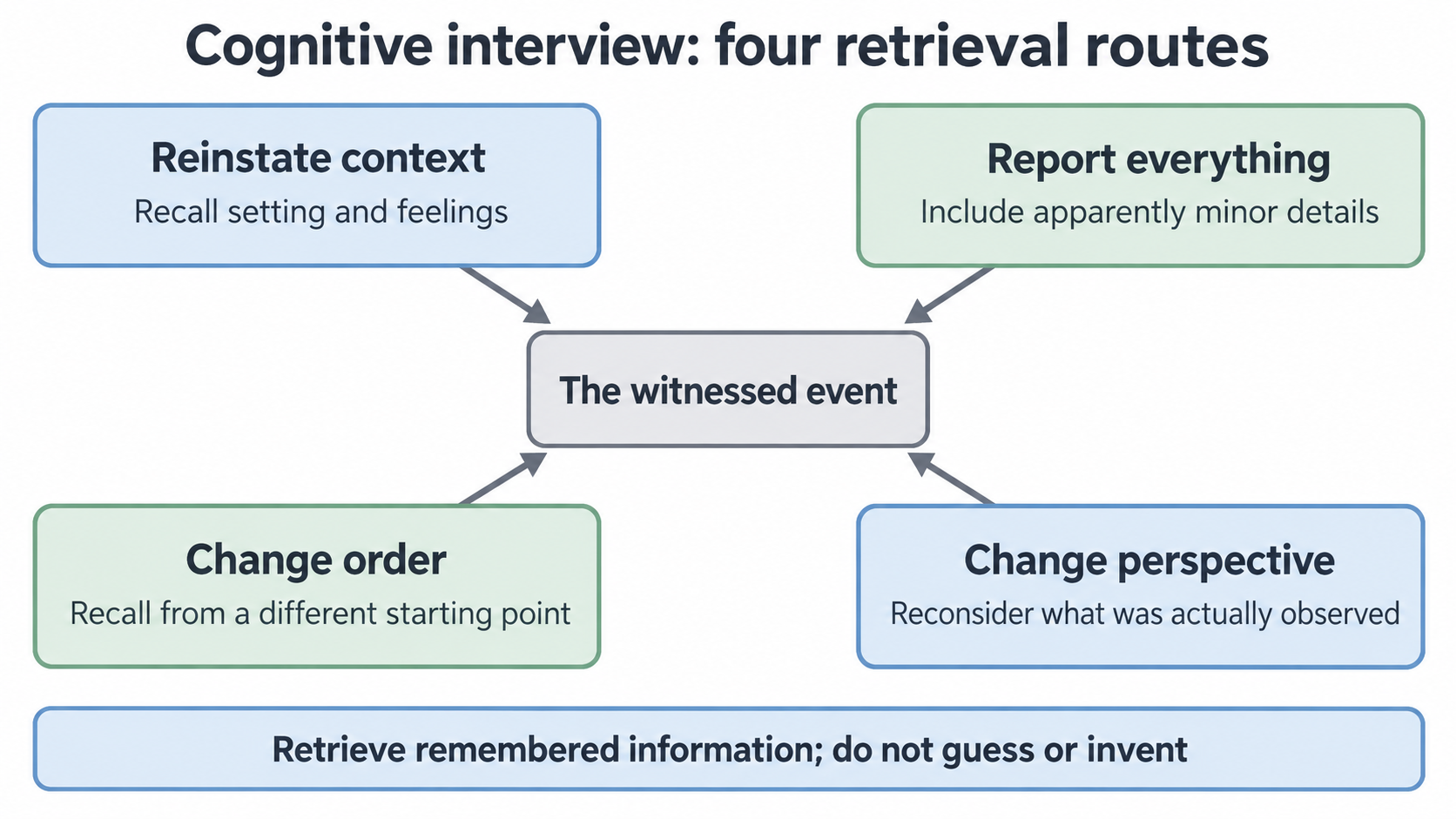
In an illustrative shop incident, mentally recalling the layout, sounds and where the witness stood may cue the location of an exit. Starting from the moment of leaving may then bring back an earlier exchange. Asking “Was the attacker holding a knife?” supplies information and can contaminate recall; it is not context reinstatement.
Ethical and accessible interviewing
Ethical interviewing protects the person and improves the conditions for obtaining reliable information.
An interviewer establishes rapport, explains the purpose and allows an uninterrupted initial account. Open invitations such as “Tell me what you remember” come before focused clarification based on what the person has already said. Questions should avoid implying an answer, rewarding agreement or pressuring someone to adopt the interviewer’s theory. The witness should control the pace where possible, and uncertainty should be recorded accurately.
The enhanced cognitive interview adds attention to communication, rapport and the witness’s own retrieval needs. Techniques may require adaptation for language, age, literacy, disability or distress. An interpreter or suitable support may be needed; difficult perspective or order tasks should not be imposed when they cause confusion. Quiet surroundings, breaks and a patient interviewer can reduce avoidable demands. Repeated questions should not imply that a previous answer was wrong.
Interviewing a witness for recall and interviewing a person about their own offending have different purposes. A cognitive interview is not a lie detector or a way to establish guilt from confidence. In a forensic assessment, explain who requested the assessment, how information will be used and the limits of confidentiality. Do not promise secrecy that cannot be maintained or suggest that pleasing the assessor guarantees release. Appropriate consent or other authority must be established, with relevant safeguards for the person’s circumstances.
HCPC standards require respect, fair treatment, valid informed consent or appropriate authority, clear communication, confidentiality and risk management. Confidentiality has justified limits, including necessary lawful disclosure or protection from harm; share only necessary information and keep accurate records. These principles apply to professional psychological practice, rather than creating one identical interview procedure for every legal setting. HCPC conduct standards.
Evidence and limits of cognitive interviewing
An interview is useful when it improves accurate information, not merely when it produces a longer account.
Continue this lesson.
You’re previewing NovaLearn without an account. Create a free account to read the rest.
Create free account