9.3.3, 9.3.4 - Reductionism and competing explanations
The same behaviour can be explained through brain processes, learning, thinking and social relationships. You will understand what reducing an explanation to one level achieves, compare the mechanisms and predictions of different themes, and judge when combining levels adds explanatory value.
Levels of explanation and reductionism
An explanation identifies processes that account for behaviour, rather than simply giving behaviour another name.
Calling someone 'aggressive' describes a pattern; it does not explain why aggression occurs. A biological account might propose reduced inhibitory control within brain networks. A learning account might propose that aggressive actions have produced rewards. A social account might propose that competing groups have incompatible goals. These explanations work at different levels of explanation, from processes within the body to relationships between people.
Reductionism
Reductionism explains a complex phenomenon in terms of simpler components or a narrower level of analysis. It becomes limiting when omitted processes are important to the claim being made.
Biological reductionism can reduce behaviour to neural, hormonal or genetic processes. Environmental reductionism can reduce behaviour to learned stimulus–response associations or consequences, leaving interpretation and social meaning out. A simplified experimental task is also a reduction of the situation being studied: word-sequence recall isolates a feature of remembering. This methodological simplification is not necessarily a claim that all memory consists only of word sequences.
[DIAGRAM: asset_name: Interacting levels of explanation; asset_slug: edexcel_9ps0_i03_levels_explanation; recommended_method: image_gen; description: Social context, psychological processes and biological processes are three connected explanatory levels with a double-headed interaction arrow; caption: A behaviour can involve interacting social, psychological and biological processes.]
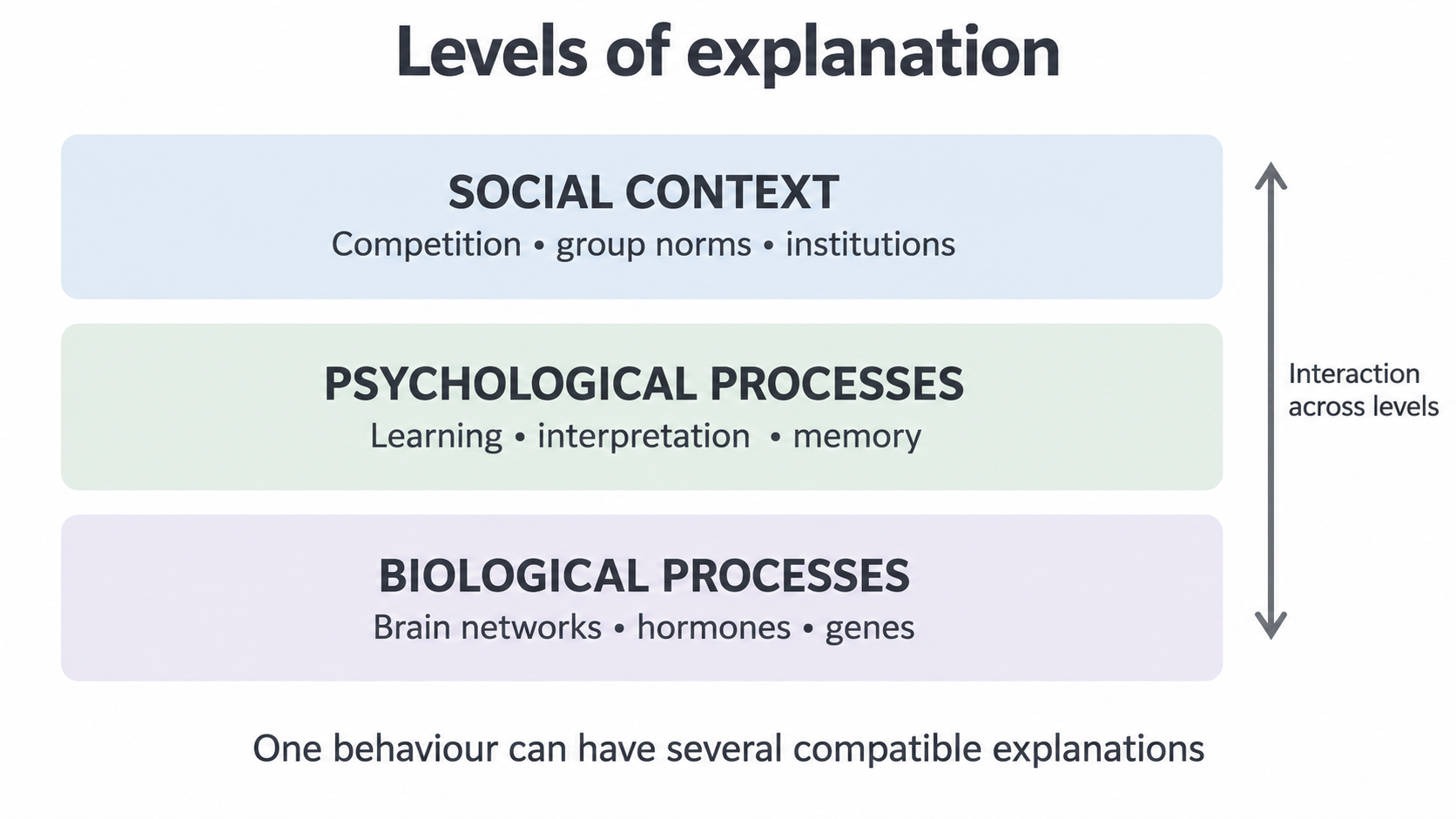
The diagram's levels are not a ranking of quality. A precise low-level mechanism may answer one question well while saying little about another. Knowing how a neuron transmits a signal does not by itself explain why one group becomes hostile to another.
Holism explains behaviour through the organised whole or interacting context. In a group, a person's action depends on relationships, norms and goals, not merely independent individual traits added together. An interactionist explanation can combine specified processes across levels: a biological vulnerability influences impulse control, while learning and social provocation influence when aggression occurs. Interaction is more informative than saying 'everything matters' only if it specifies links and testable predictions.
Different mechanisms of aggression
Biological, learning and social explanations can produce different predictions about the same aggressive act.
A biological explanation links aggression to functioning of systems involved in emotional response and inhibition. Raine's PET comparison found reduced prefrontal activity and other differences in the selected NGRI group. Reduced inhibition could make controlling a strong response harder, but the observed activity does not specify which goal or social event provokes aggression. The unmanipulated comparison also cannot show that the brain difference caused violence. The evidence supports investigating vulnerability rather than a universal brain cause. Original abstract.
An operant learning explanation proposes that consequences change the probability of an action. If threatening someone repeatedly gains a desired object, the successful outcome can positively reinforce threatening behaviour. If shouting ends an unpleasant confrontation, removal of the unpleasant experience can negatively reinforce shouting. Negative reinforcement strengthens behaviour; it is not punishment. The prediction is that changing the relevant consequences changes future behaviour, even when the person's biology has not been deliberately changed.
Social learning adds observation and cognition. A person may attend to a model, retain what the model does, reproduce it and be motivated to perform it. Seeing a model gain approval can make imitation more likely through vicarious reinforcement. This account can explain acquisition without the observer first receiving direct rewards for each action. It therefore reaches beyond a simple history of direct reinforcement.
Sherif's realistic conflict explanation focuses on the relationship between groups. When scarce rewards require one group to defeat another, outgroup hostility may serve an ingroup goal. Superordinate goals alter that relationship by making success depend on cooperation. Its prediction concerns the structure of goals: changing interdependence should affect hostility, even without a change in an individual's brain or a lesson telling them to behave kindly. Original report, Chapters 5 and 7.
These accounts need not contradict each other. In a hypothetical team dispute, competitive goals might provoke a response, learned rewards might maintain intimidation, and poor inhibitory control might make restraint harder. They do compete if each is claimed to be the sole sufficient explanation. A successful goal intervention supports a social contribution; it does not prove that biological differences never matter. Conversely, a scan association does not refute the effect of changing a group's goals.
Continue this lesson.
You’re previewing NovaLearn without an account. Create a free account to read the rest.
Create free account