4.1.10 - How phobias develop and persist
Learning theories can explain how a harmless cue comes to trigger fear and why avoidance may persist long after the original frightening event. This lesson connects classical, operant and social-learning accounts of phobia acquisition and maintenance, then considers the evidence and limits of those explanations.
Acquisition and maintenance
Explaining how a fear begins is a different task from explaining why it continues.
A phobia involves persistent, excessive fear associated with a particular object or situation, often accompanied by avoidance and interference with everyday life. Ordinary caution in genuinely dangerous circumstances is not automatically a phobia. The fictional cases used here illustrate psychological mechanisms; they do not provide a diagnosis of a real person.
Acquisition concerns the development of the fear response or avoidance pattern. Maintenance concerns its persistence after acquisition. A frightening experience could establish fear, while the relief produced by later avoidance helps maintain behaviour. Naming the original event alone therefore does not explain why the person continues avoiding a safe situation years later.
Learning accounts focus on experience with cues, consequences and models. They can make predictions about changes: if a previously harmless cue becomes associated with a frightening event, the cue may later elicit anxiety; if escaping reduces that anxiety, escape may become more likely. These links are explanations to test, not a claim that every phobia has an identical cause.
A useful analysis keeps three things separate: the feared cue, the fear response and the action taken. For a fictional person afraid of dogs, seeing a dog is the cue; anxiety is the emotional or physiological response; crossing the road is an avoidance action. The fact that the three occur together does not make them the same variable. Classical conditioning primarily explains the learned cue–fear link; operant conditioning explains how consequences affect the avoidance action.
Classical acquisition and generalisation
Classical conditioning can make an initially harmless cue elicit fear after association with an aversive event.
Imagine a fictional person bitten painfully by a dog. Beforehand, that dog was a neutral stimulus for the target fear. The painful attack is the UCS, eliciting fear as the UCR. After association with the attack, seeing that dog may become a CS eliciting fear as the CR, even without another bite. A powerful event may establish an association rapidly; the theory does not require every fear to follow numerous identical incidents.
Through stimulus generalisation, fear may spread to similar dogs or related cues such as barking. It need not spread equally to every animal. Through extinction, repeated encounters with the CS without the aversive UCS can weaken the conditioned response. An absence of encounters is not equivalent to those extinction experiences. A recovered response after rest also reminds us that weakened fear is not necessarily permanently erased.
Watson and Rayner’s 1920 report provides a historical demonstration relevant to this mechanism. They paired a white rat with a loud noise that distressed one infant, Albert. The infant later showed fear and avoidance to the rat alone. They also reported transfer to some other animals and furry objects, although responses were mixed rather than uniform. This supports the possibility of learned emotional responses, not proof that every adult phobia began in the same way.
The study involved one infant, lacked a separate control participant and used procedures whose presentation and responses varied. Its observations cannot isolate all alternative influences or establish population-wide generalisation. The researchers did not complete their proposed fear-removal work, and the report does not establish that Albert had a lifelong phobia. Deliberately distressing an infant also raises serious ethical concerns. The fuller study is taught separately; these particular findings serve here as bounded evidence for the acquisition account.
Negative reinforcement of avoidance
Operant conditioning explains how immediate relief can strengthen escape and avoidance after fear has developed.
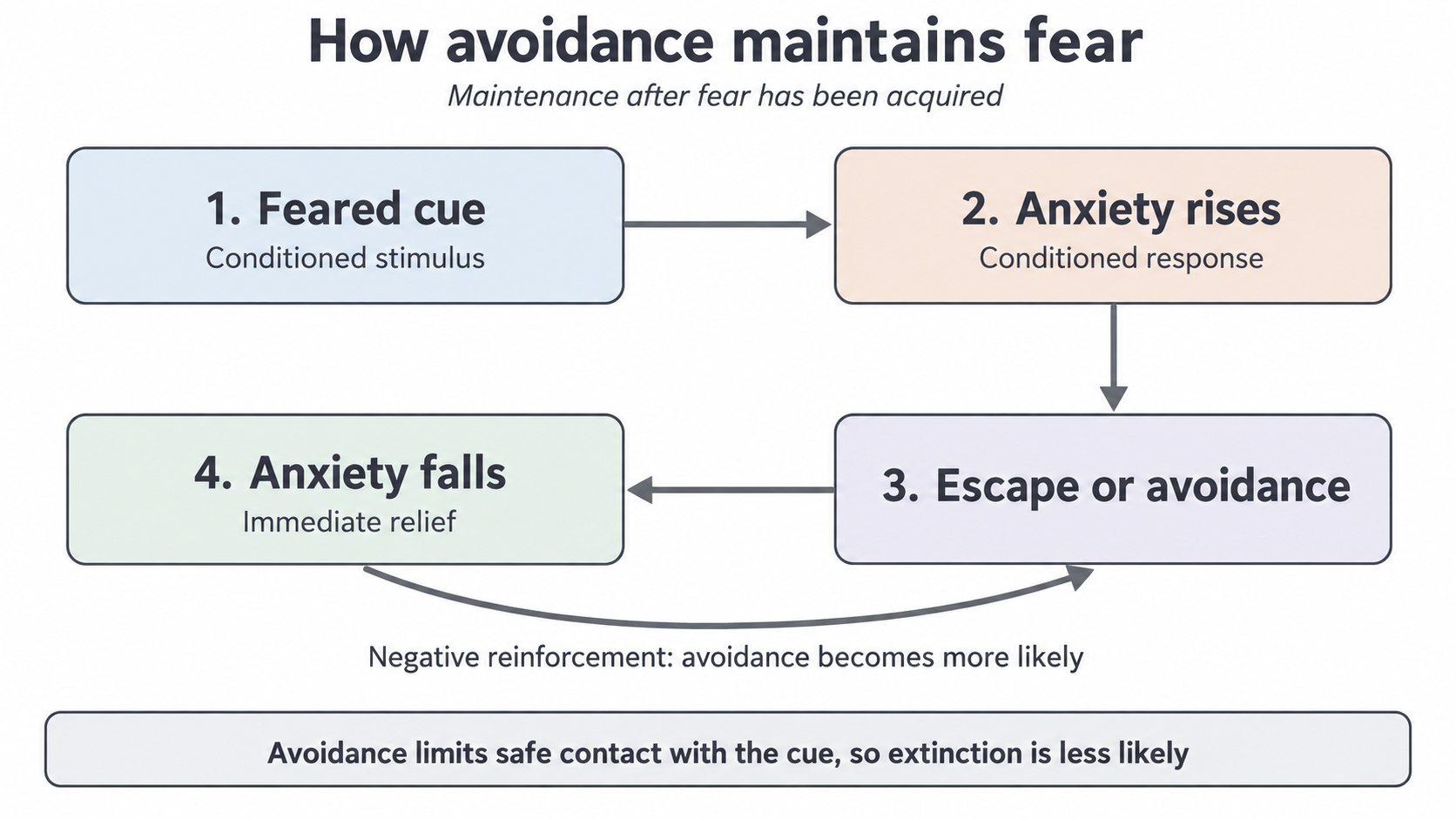
In a two-factor account, classical conditioning establishes a cue–fear association, and operant conditioning maintains escape or avoidance. Escape ends contact with a feared cue; avoidance prevents or limits that contact. Suppose seeing a dog produces anxiety and the person crosses the road. Anxiety then falls. The removal or reduction of this aversive state is negative reinforcement if it makes crossing away from dogs more likely in future.
[DIAGRAM: asset_name: How avoidance maintains fear; asset_slug: edexcel_9ps0_l05_avoidance_maintenance; recommended_method: image_gen; description: A feared cue elicits anxiety, escape or avoidance brings immediate relief, and that relief increases the likelihood of future avoidance; limited safe cue contact reduces opportunities for extinction.; caption: Relief negatively reinforces the avoidance action, while avoidance limits safe experiences that could weaken conditioned fear.]
Continue this lesson.
You’re previewing NovaLearn without an account. Create a free account to read the rest.
Create free account