8.3.2 - Mundt’s adolescent alcohol study
Mundt, Mercken and Zakletskaia’s 2012 study investigated why adolescents and their friends can have similar alcohol-use patterns. It used longitudinal friendship networks to distinguish choosing similar friends from changing behaviour to resemble friends.
Selection versus influence
Similarity between friends can arise through different processes, which imply different prevention strategies.
Peer selection occurs when adolescents choose friends who already resemble them in alcohol use or related characteristics. This is an example of homophily, a tendency to form ties with similar others. Peer influence occurs when an adolescent changes alcohol use in response to friends’ drinking. Selection changes who is connected; influence changes behaviour within connections. A photograph of a group of friends drinking cannot distinguish the two.
Imagine two fictional pupils who both rarely drink and then become friends. Their later similarity is compatible with selection. Alternatively, two friends initially drink at different frequencies and one later moves towards the other’s pattern. This is compatible with influence, although shared circumstances could also explain it. Both processes may occur together: friendships and behaviour can change at the same time.
[DIAGRAM: asset_name: Peer selection and influence; asset_slug: edexcel_9ps0_h08_selection_influence; recommended_method: image_gen; description: Two illustrative timelines distinguish already similar pupils forming a friendship from connected pupils becoming more similar in drinking; the study summary identifies significant selection and non-significant influence.; caption: Selection concerns changing friendships, whereas influence concerns changing behaviour within friendships; these timelines are illustrations, not observed individual records.]
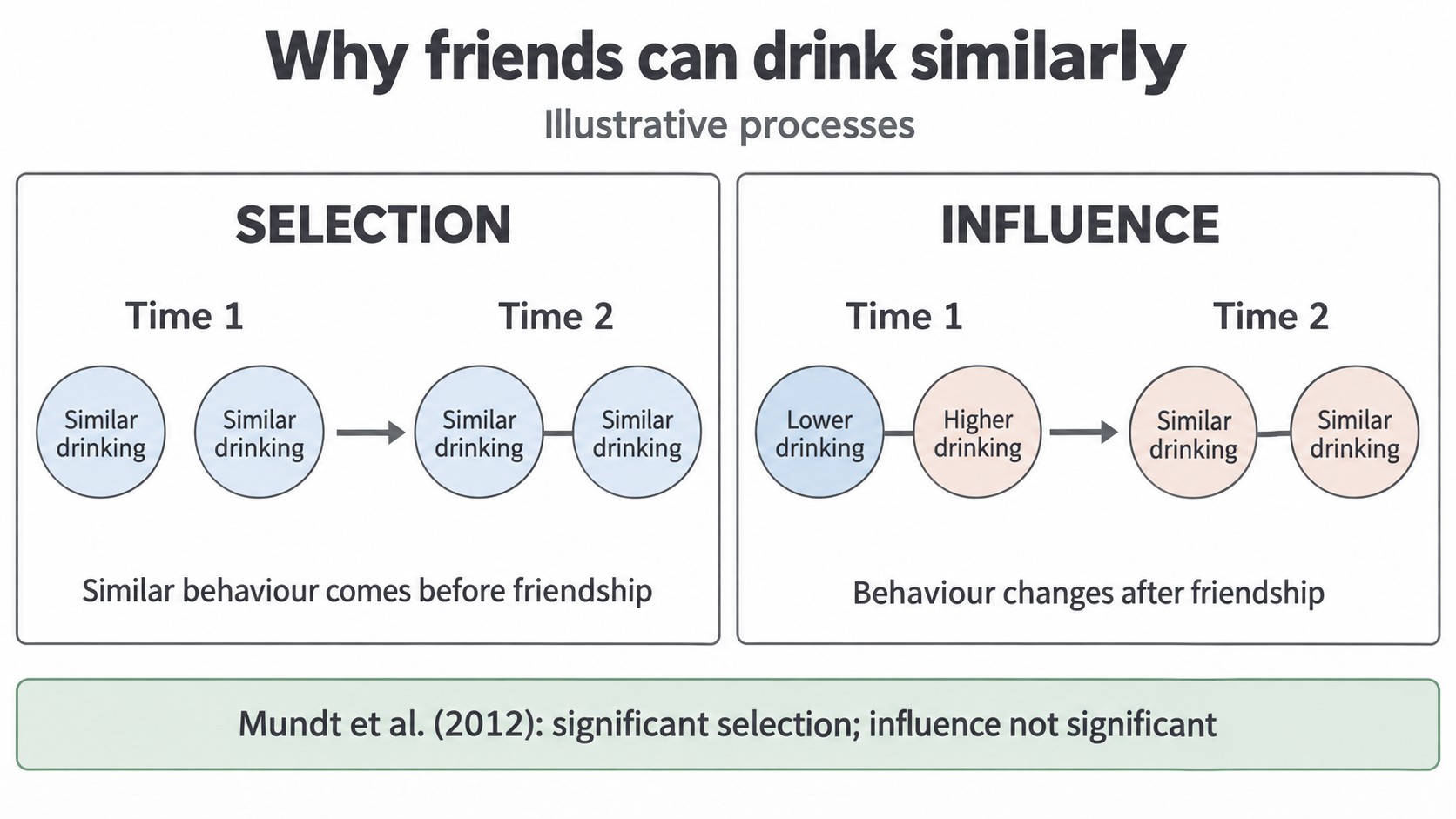
The researchers’ aim was to disentangle these processes in adolescent alcohol use. They hypothesised that both would be present. Keeping that hypothesis separate from the eventual result is essential: a predicted effect does not become a finding because it was expected.
The longitudinal network method
Following both friendships and alcohol use lets a model examine processes that a single survey cannot separate.
Mundt and colleagues analysed existing Add Health data rather than recruiting participants for an alcohol experiment. The wider US project selected schools using stratification across characteristics such as region, urban setting and school composition. This analysis used a smaller saturated-school subsample, where all attending pupils were eligible for the in-home survey so that within-school networks could be studied. It included 2,563 adolescents in grades 7–11 at Wave 1, from 13 schools, with a mean age of 15.8 years and an age range of 12–18. Of these, 2,299 responded at Wave 2. This analytic sample should not be described as all 90,118 pupils who completed the wider project’s initial school survey.
Wave 1 interviews occurred in 1995 and Wave 2 in 1996, about a year apart. At each wave, participants nominated up to five best male and five best female friends from a school roster. Nominations created directed network ties: naming a pupil did not guarantee that pupil named the respondent back. Participants reported frequency of alcohol use in the past year in ordered categories. This measured reported frequency, not units consumed or a clinical diagnosis of dependence.
A stochastic actor-based model simulated many small changes between observed waves: a pupil might change a friendship tie or move a step in alcohol-use category. The simulations estimated tendencies that could generate the observed networks and behaviour. The model accounted for reciprocity, friends of friends becoming connected, popularity and demographic similarities; the behaviour model also considered parental drinking and family bonding. These were statistical controls, not experimentally controlled conditions.
This co-evolution approach improves on treating friendships as fixed while analysing changes in drinking. Nevertheless, the intermediate choices were simulated, not directly watched. Conclusions depend on the model’s assumptions and the quality of the two observed waves. The original study gives the full method.
Findings and their meaning
The model supported selection based on alcohol-use similarity, but did not support a significant friends’ influence effect.
Continue this lesson.
You’re previewing NovaLearn without an account. Create a free account to read the rest.
Create free account