6.1.2, 6.1.9, 6.1.10 - Social explanations of crime
Social explanations consider how other people’s expectations, responses and examples can shape offending. You will learn how labelling and social learning may influence development, why individuals respond differently, and how to evaluate the evidence without treating any social group as inherently criminal.
Labelling and social reaction
Labelling theory focuses on what happens when a person is publicly defined in terms of an alleged or actual antisocial act.
Labelling
Labelling is assigning a social category to someone, such as “troublemaker”, which can influence how other people interpret and respond to their behaviour.
A description of a particular act can become a judgement of the whole person. An employer, teacher or peer may then interpret an ambiguous action as evidence of the label and overlook behaviour that contradicts it. Stigma means a discrediting social judgement that can lead to rejection or reduced opportunities. A criminal record may restrict access to some opportunities; informal labels can also affect relationships without any conviction.
For example, imagine a young person who is blamed for a damaged classroom item without adequate evidence. If staff then assume every later disturbance is their fault, the label changes social reactions before it changes the person’s behaviour. A label may follow an actual offence, a mistaken allegation or a stereotype. Explaining its effects does not excuse harm or establish whether an allegation is true.
Labelling is especially useful for explaining persistence or escalation after social intervention. It does not explain every initial act: a person may offend before receiving any negative label. An account of the first offence may therefore require other mechanisms.
A self-fulfilling prophecy
A self-fulfilling prophecy occurs when an expectation helps produce the behaviour that appears to confirm it.
The sequence begins with a label and an expectation. Others may respond with exclusion, distrust or increased surveillance. The person may lose access to supportive relationships, begin to see themselves through the label, or seek acceptance among people who tolerate antisocial behaviour. These changes can increase the likelihood of further offending. That behaviour then appears to justify the original label, reinforcing the cycle.
[DIAGRAM: asset_name: How a label can shape behaviour; asset_slug: edexcel_9ps0_cr02_labelling_cycle; recommended_method: image_gen; description: A possible pathway from a negative label through expectations and exclusion to changed self-image and choices, with a feedback arrow and protective support interrupting the cycle.; caption: A label can alter social responses and choices, but support can interrupt this possible cycle.]
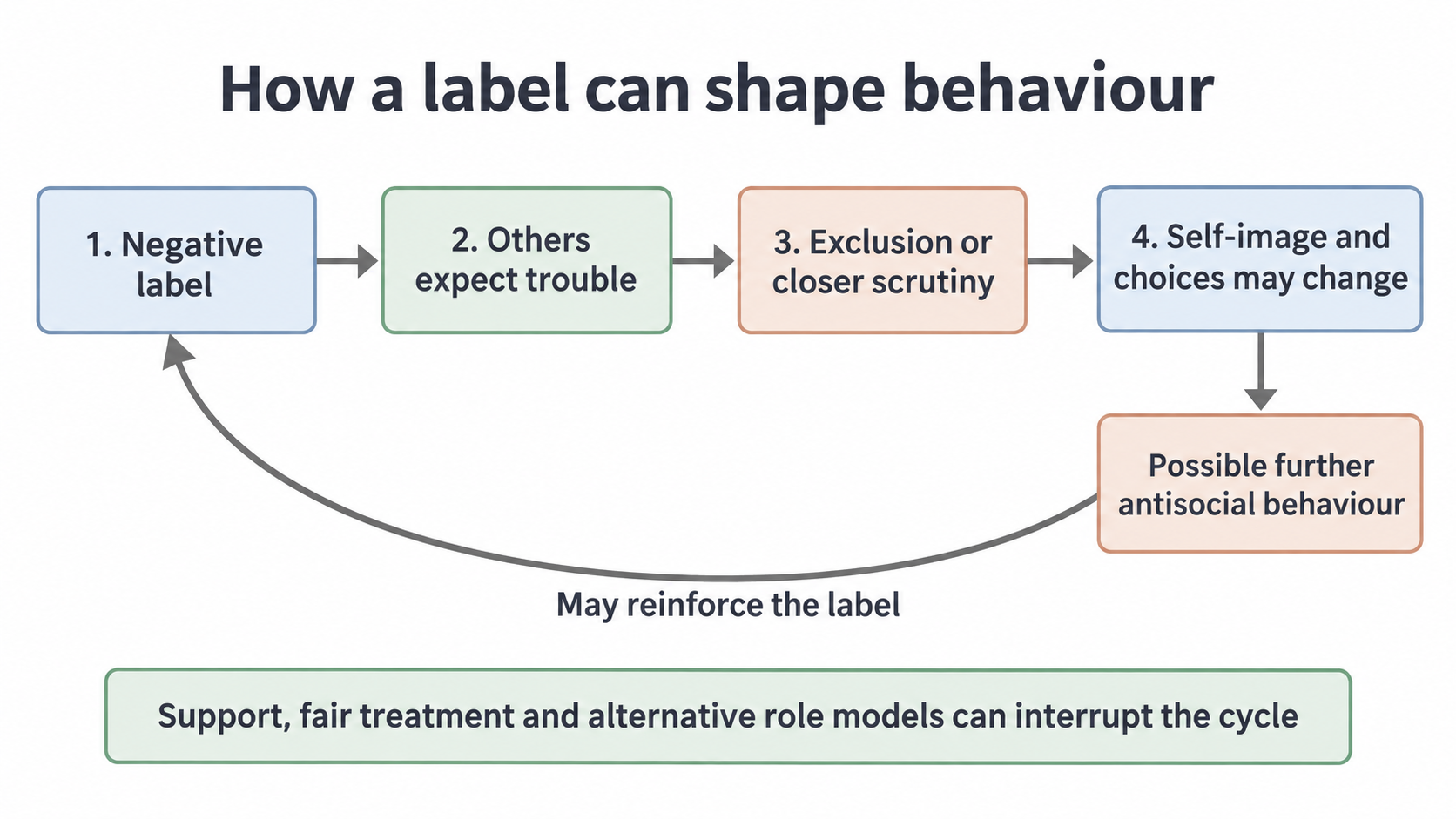
Notice the causal requirement: the expectation must contribute to the outcome. If a person is labelled after repeated theft and continues stealing for the same independent reasons, the sequence alone does not demonstrate a self-fulfilling prophecy. Evidence must examine whether treatment, opportunities or self-image changed because of the label.
There is also a recording pathway. Increased scrutiny can make existing misconduct more likely to be detected, producing more recorded offences without any increase in actual offending. This is different from an internalised label producing a change in behaviour. A good explanation distinguishes the two.
The cycle is possible rather than automatic. A person may reject a label, have an adult who challenges unfair treatment, or find a valued activity that supports a different identity. A fair response can condemn a harmful act while continuing to offer the person a route back into a community.
Social learning of offending
Social learning explains how a person can acquire a behaviour by observing others and the consequences they receive.
In Bandura’s account, an observer must attend to a model, retain what was observed, have the capacity for reproduction, and be motivated to perform it. Identification with a respected, similar or high-status model may encourage attention and imitation. Vicarious reinforcement occurs when seeing a model rewarded makes imitation more likely; seeing punishment can discourage performance. Learning and performance are distinct: someone may remember how an offence was committed but decide not to imitate it.
Continue this lesson.
You’re previewing NovaLearn without an account. Create a free account to read the rest.
Create free account