4.1.6, 4.1.7, 4.1.8 - Social learning and Bobo dolls
People can learn a behaviour by watching someone else before trying it themselves. Social learning theory in 4.1.6 and its four processes in 4.1.7 explain this route; Bandura, Ross and Ross’s 1961 and 1963 Bobo-doll experiments in 4.1.8 test imitation of live and filmed models.
Learning from models
Social learning theory explains how observation of other people can contribute to acquiring and performing behaviour.
Observation means perceiving another person’s behaviour. A model is the person or represented character whose behaviour is observed. Modelling concerns the demonstration and influence of that behaviour, while imitation is reproducing the observed action. A model may be physically present or symbolic, such as a person in a film. Seeing an action does not guarantee copying it: learning and performance depend on further processes.
Vicarious reinforcement
An observer becomes more likely to perform a behaviour after seeing a model receive a rewarding consequence for it, rather than receiving that consequence directly.
For example, a fictional learner sees a peer receive appreciative attention for explaining a difficult idea clearly. The learner may expect similar consequences for doing so and be more motivated to contribute. If the learner later receives praise for their own contribution, that is direct reinforcement. The two effects concern consequences to different people.
Models who are noticeable, valued or perceived as relevant to the observer may attract more attention. Identification involves relating to a model and wishing to be like them; it can help explain why observers select some models rather than others. Similarity does not mechanically force imitation, and a model’s status or attractiveness may matter too. These are influences to investigate, not universal rules that all boys copy men or all girls copy women.
Social learning theory adds mental processes to a learning explanation: a person notices, stores and uses information about another’s behaviour. Unlike an account requiring direct reinforcement of every new response, it allows an observer to learn before practising or being rewarded. Observed consequences can influence whether the learned action is performed, without being necessary for all acquisition.
Four processes of social learning
Attention, retention, reproduction and motivation explain why exposure to a model does not always lead to visible imitation.
Attention means noticing the relevant behaviour. An observer who is distracted or unable to see the action clearly may not acquire it. Features such as a clear demonstration, a respected model or an interesting action can direct attention, but merely having a screen switched on is insufficient.
Retention means keeping a representation of the observed behaviour in memory. The observer may store images or verbal descriptions and rehearse the sequence. Retention allows imitation to occur later when the model is absent. Remembering only the goal, rather than the relevant steps, may limit what can be reproduced.
Reproduction means being able to translate the remembered action into behaviour. A learner may remember a skilled gymnast’s routine while lacking the balance or motor skill to carry it out. Feedback and practice may improve performance. Failure to perform the whole routine is therefore not proof that nothing was noticed or remembered.
Motivation means having a reason to perform the action. Expected reward, observed approval, avoidance of disapproval and satisfaction from successful performance can affect this. Vicarious punishment can inhibit an action even though its sequence has been retained. The four processes are an explanatory framework, not four laboratory brain regions or a claim that each is observable directly.
[DIAGRAM: asset_name: From observing to performing; asset_slug: edexcel_9ps0_l03_social_learning_processes; recommended_method: image_gen; description: Attention and retention support learning from a model; reproduction and motivation affect performance, with observed consequences feeding into motivation.; caption: A remembered modelled action may remain unperformed when ability or incentives limit imitation.]
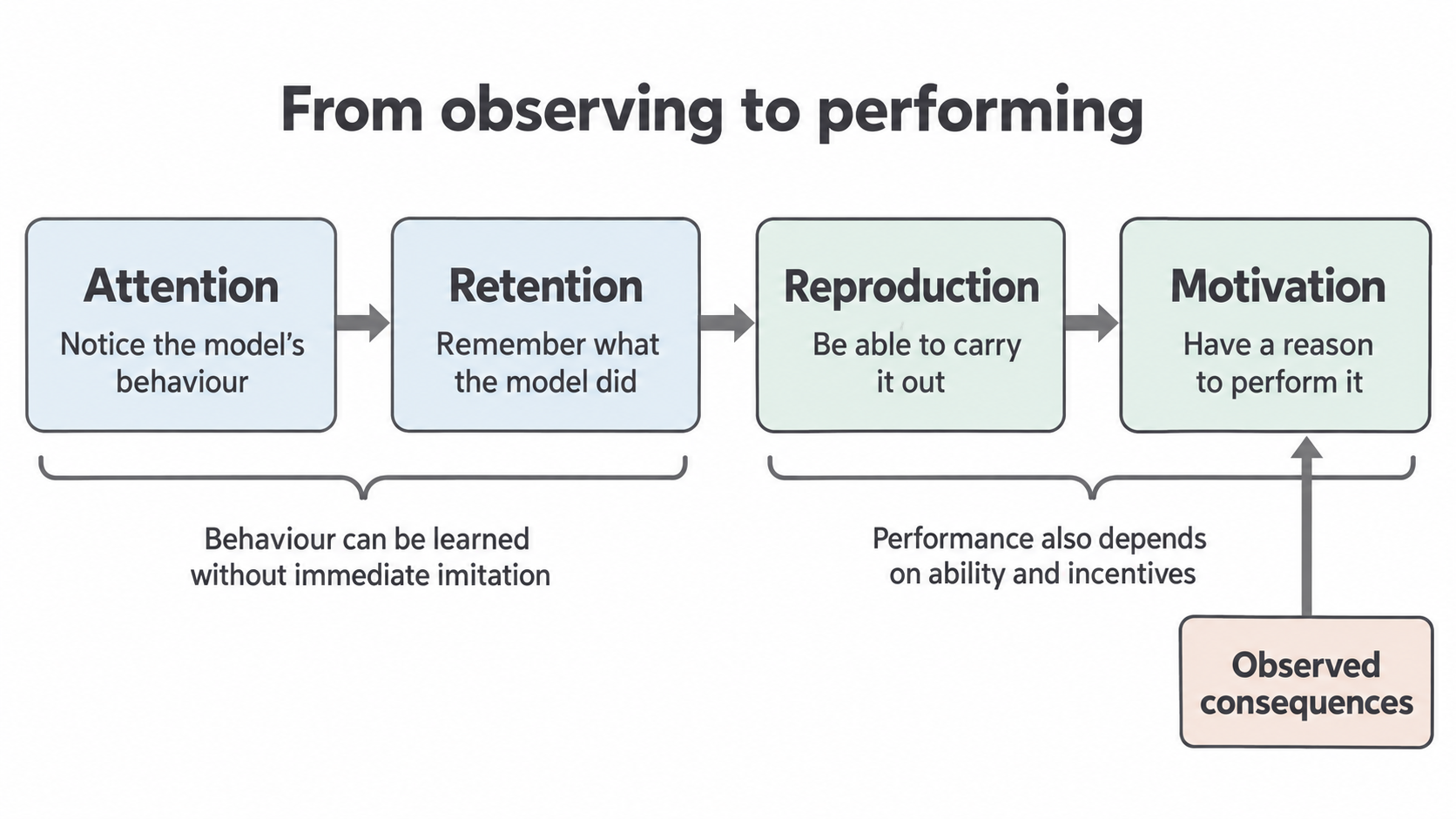
Suppose a learner watches a demonstration of a laboratory technique. Looking at the important hand movements is attention; remembering their order is retention; having the necessary manual skill is reproduction; choosing to attempt the technique safely is influenced by motivation. These processes allow us to ask why performance failed rather than assume the learner was not exposed to the model.
Bandura 1961: live models
The 1961 experiment tested whether children would reproduce an adult model’s aggression later in a different setting where the model was absent.
The sample comprised 72 children from Stanford University Nursery School: 36 boys and 36 girls aged 37–69 months. This was an available nursery population, not a representative sample of all children. Researchers first rated aggression in nursery interactions. Children were matched on these ratings and randomly assigned within matched sets to an aggressive-model condition, a nonaggressive-model condition or a no-model control, with 24 children in each. The model conditions also varied the child’s and model’s sex.
During the approximately ten-minute exposure, each child worked on picture materials while an adult played in another area. In the aggressive condition, the adult performed distinctive physical acts towards an inflatable Bobo doll, including striking it with a mallet, and made aggressive verbal remarks. In the nonaggressive condition, the model quietly assembled toys and ignored the doll. The control children had no equivalent model exposure. Neither model nor child was rewarded for aggression during this observation phase.
Continue this lesson.
You’re previewing NovaLearn without an account. Create a free account to read the rest.
Create free account