1.3.1 - Sherif’s Robbers Cave study
Can changing the relationship between groups change the way their members treat one another? Sherif and colleagues’ summer-camp study followed the formation of groups, the growth of conflict and attempts to reduce it. Learn what the three stages show, and how the method limits the conclusions we can draw.
The question and camp design
Sherif’s team wanted to explain intergroup conflict through the conditions in which groups interact, rather than assuming that hostility comes only from unusually aggressive individuals.
The Robbers Cave experiment took place in Oklahoma in summer 1954; the fuller account appeared in 1961. It tested whether cooperative activity would create organised groups, whether competition with another group would increase hostility, and whether important goals requiring both groups would reduce established conflict. These are related questions, so the sequence matters: there had to be functioning groups before their relationship could be changed.
Researchers selected 22 boys from Oklahoma City using school records, observations and interviews with teachers and parents. They were about 11 years old, from similar middle-class Protestant family backgrounds, and did not already know one another. This was a deliberately selected, homogeneous sample, not a random sample of American children. The boys were divided into two groups of 11, matched as closely as possible on characteristics relevant to camp life, such as sporting ability and previous camp experience. Two boys from the group later called the Eagles left during the first stage because of homesickness; the later intergroup work therefore involved 11 Rattlers and nine Eagles.
The camp was isolated from outside influences, and staff appeared to be ordinary camp personnel. Researchers introduced situations and recorded behaviour through covert participant observation: they participated in camp life while the boys did not know that their interactions were the subject of an experiment. They also used friendship choices and ratings of the groups. Combining these measures helped check whether observed changes were accompanied by changes in expressed attitudes.
It is a field experiment because the researchers deliberately altered the groups’ relationship in a realistic setting. The manipulated conditions were separate within-group activity, competitive intergroup activity and cooperative intergroup activity. Outcomes included hostile acts, group stereotypes and willingness to choose out-group members as friends. The same camp groups experienced the stages in sequence; there was no separate group following an unchanged timetable as a control.
How the groups formed
The first stage created groups through shared activity rather than merely assigning a name to a collection of individuals.
Initially the two groups lived and undertook activities separately. Boys within each group cooperated in appealing camp tasks such as swimming, hiking, preparing food and arranging their camping areas. These activities gave members reasons to depend on one another and opportunities to see whose suggestions worked. A status hierarchy, including leadership and follower positions, developed from interaction. So did group norms, shared expectations about acceptable behaviour.
The groups came to call themselves the Rattlers and the Eagles and developed identifying symbols. They treated places and equipment as belonging to “our” group. This is in-group identification: membership becomes psychologically meaningful, rather than simply being a researcher’s category. Norms were not identical in the two groups. For example, the Rattlers developed a stronger “tough” style, while the Eagles initially discouraged swearing. Such differences show that group organisation developed through interaction; it was not entirely prescribed by staff.
Separation was important for the planned formation period, but do not imagine that the boys remained wholly unaware of the other group until the tournament began. Towards the end of Stage 1 they heard about or became aware of the other group and wanted to challenge it. Some territorial claims and derogatory responses appeared before formal prize competition. This detail matters when evaluating a claim that competition is the only possible origin of hostility.
The finding supports the idea that working towards common goals can organise strangers into cohesive groups. It does not establish that cohesion automatically produces kindness to outsiders. The next stage showed that close cooperation within a group can coexist with hostility between groups.
Competition and escalating conflict
The second stage made the groups’ goals incompatible: success for one group meant failure for the other.
Staff arranged a tournament with activities such as baseball and tug of war, a trophy and attractive prizes for the winning group. These were competitive goals. Both groups wanted the reward, but both could not win it. Frustration could now be attributed to the other group: its success blocked the in-group’s success. This is the central mechanism later associated with realistic conflict theory.
During competition, hostile name-calling, flag incidents and raids on the other group’s accommodation occurred. The boys increasingly glorified their own group and described the other negatively. Loyalty within each group also grew. Prejudice, a negative attitude towards a group, was visible in derogatory stereotypes; discrimination, differential treatment based on group membership, was visible in hostile actions and exclusion. Attitude and behaviour are related, but they are different kinds of evidence.
Researchers did more than rely on striking incidents. At the end of this stage they obtained friendship choices and group ratings, which largely favoured the in-group and rejected the out-group. The convergence between behaviour and these measures strengthened the interpretation that hostility was a group trend rather than a single boy’s isolated outburst.
Competition therefore intensified antagonism among boys with broadly similar backgrounds. It challenges an account in which conflict requires pre-existing ethnic, religious or family differences. However, hostility had begun to emerge before the formal tournament, and staff shaped the wider situation. The defensible conclusion is that incompatible goals can increase conflict, not that every instance of prejudice requires a contest for prizes.
Contact and superordinate goals
The third stage first tested simple contact, then introduced repeated situations in which the groups needed one another.
Shared meals and films brought the groups into physical proximity, but did not reliably remove hostility. Boys still sat along group lines and exchanged insults; a meal even developed into throwing objects. Contact alone meant being together without changing the relationship that made the other group a rival. These contact situations belong inside Stage 3; they are not a separate fourth stage.
Superordinate goal
A valued goal shared by different groups whose achievement requires cooperation between them, because one group alone lacks the necessary resources or effort.
The researchers then arranged a series of superordinate-goal situations. A staged problem with the water supply led the boys to search for and work on its cause. Both groups contributed towards obtaining a wanted film. During a trip, a deliberately stalled truck that would fetch food had to be pulled into action using their combined effort. The relevant change was from “we succeed if they lose” to “we benefit if we work together”. Simply telling both groups to value friendship would not create that interdependence.
[DIAGRAM: asset_name: Robbers Cave three-stage sequence; asset_slug: edexcel_9ps0_s06_robbers_cave_stages; recommended_method: image_gen; description: Three successive stages show separate group formation, competitive goals and reducing friction through contact followed by repeated superordinate goals. Schematic people represent groups, not sample counts.; caption: Stage 3 included unsuccessful simple-contact situations before repeated cooperative goals reduced hostility.]
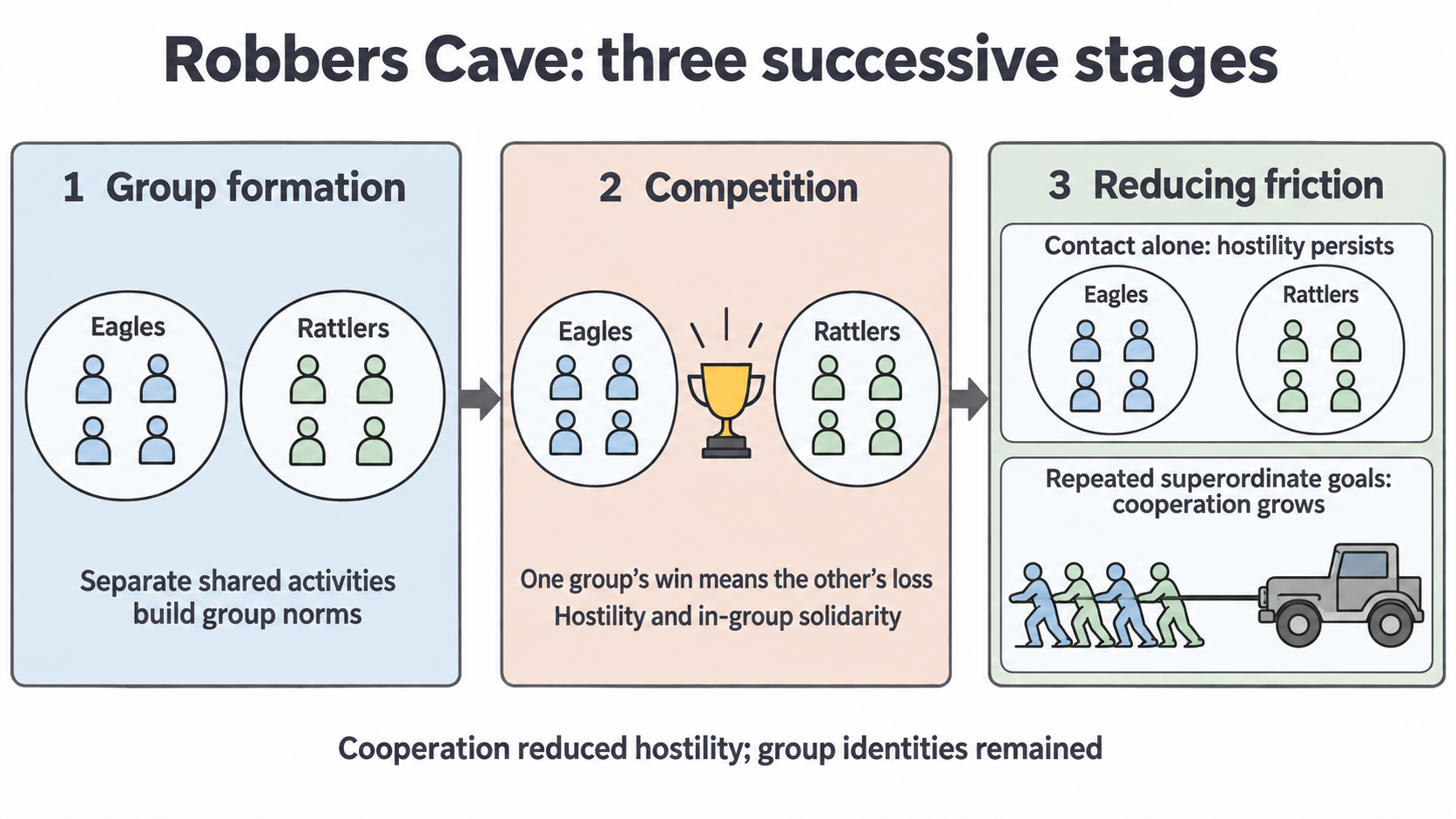
Cooperation grew across the sequence. Boys increasingly mixed at meals and activities; out-group friendship choices increased and rejection decreased. At the end they wanted to travel home on the same bus, and the Rattlers used a reward to buy drinks for both groups. These are converging indications of improved relations. The first water task did not immediately erase hostility: later conflict still occurred. Nor did the groups cease to exist. Change was cumulative, and considerable in-group friendship preference remained.
The conclusion is therefore conditional: repeated cooperation towards genuinely shared, important goals can reduce established conflict. It suggests a practical route for improving relations, but does not prove that any shared activity, or one brief encounter, will remove every form of prejudice. The account of the sequence comes from the original Stage 3 report.
What the evidence can support
The study combines a persuasive demonstration of changing group relations with important limits on causal certainty, generalisation and ethics.
The camp tasks were meaningful to the boys, who believed the setting was an ordinary camp. Their stakes and relationships were more realistic than a brief paper task, supporting ecological validity for small-group conflict. Carefully selecting similar strangers also reduced some competing background explanations. Observation, friendship choices and ratings provided different checks on the same overall trend. Staff were instructed to record observations and ratings independently, a precaution against merely agreeing on an expected story.
Nevertheless, researchers knew the hypotheses while introducing activities and observing them. Their expectations could influence which events they noticed or how they interpreted ambiguous behaviour. Independent recording reduces one source of bias, but does not make observers blind. The ordered stages also changed more than one thing: time together, familiarity, location and kinds of task. Without a parallel control sequence, improved relations cannot be attributed to a single cooperative event with the precision of a tightly controlled laboratory comparison.
Generalisation is another question. A small, selected set of pre-adolescent boys from similar backgrounds cannot stand for all genders, ages or cultures. Real social conflicts may involve unequal power, long histories and institutions, rather than temporary groups formed at camp. This does not make the camp evidence worthless; it means an intervention needs testing in its intended setting rather than assuming identical results.
Ethically, the boys did not knowingly consent to an experiment that would deliberately create conflict. Parents gave permission for camp participation and were told a general research purpose, but this did not provide the children with fully informed consent about the manipulations. Deception and engineered hostility exposed them to distress and possible harm. Sending homesick boys home shows concern for welfare, yet does not cancel the risks created by the design. A modern student practical must not recreate these procedures.
Overall, the study is strong evidence that relationships between groups can shape hostility and cooperation. Its best use is as support for a situational mechanism and a promising intervention principle, with qualified conclusions about other populations and settings. Treating it as proof that competition explains all prejudice, or that shared goals always solve it, exceeds the evidence.