1.1.4 - Social identity and realistic conflict
People can favour members of their own group before they have met them. They can also become hostile when two groups compete for something they both need. Social identity theory and realistic conflict theory explain these patterns through different mechanisms. This lesson develops each explanation, examines its evidence, and shows why cooperation can change relations between groups.
How group membership becomes part of the self
A group can shape how someone answers the question “Who am I?” A person may think of themselves as a musician, a member of a school house, or a supporter of a particular team. Social identity is the part of their self-concept that comes from perceived membership of social groups, together with the value and emotional significance attached to that membership. An ingroup is a group they identify with; an outgroup is a relevant group they see as outside it.
Tajfel and Turner developed social identity theory in 1979 and 1986. Its explanation connects three processes. Social categorisation sorts people into categories, such as “our house” and “the other house”. This simplifies the social world but can exaggerate similarities within groups and differences between them. Social identification means adopting a group membership as part of the self. A pupil may feel proud when their house does well even if they did not personally contribute. Social comparison involves evaluating the ingroup against a relevant outgroup, such as another house rather than an unrelated professional orchestra.
People generally seek a positive social identity. A favourable comparison can make “our group” seem better and support a positive view of the self. The search for positive distinctiveness can lead someone to favour their ingroup, judge its performance generously, or put down a comparable outgroup. Imagine two equally resourced drama clubs. Members of one insist that their club is more creative and allocate publicity to their own members. Their aim may be to establish a superior group identity even when neither club needs to deprive the other of equipment.
This is a conditional explanation, not a rule that every category produces hatred. Membership must matter to the person, the comparison must be relevant, and the dimension compared must carry value. Ingroup favouritism can occur without outright hostility. People can also respond to an unsatisfactory identity by leaving a group, changing what they value about it, or challenging its status, rather than attacking an outgroup. The theory therefore links categorisation to motivation and social context; it does not say that noticing any difference automatically causes prejudice.
Positive distinctiveness
A favourable difference between the ingroup and a relevant outgroup that supports a positive social identity.
What minimal groups show
A strong test of an explanation removes some of the other possible causes. Tajfel, Billig, Bundy and Flament (1971) asked whether intergroup favouritism could emerge when group membership was minimal: the groups had no established rivalry and no shared history of conflict. Two laboratory experiments used schoolboys placed in groups on trivial grounds. This was an attempt to find how little group structure was needed for discriminatory allocation, not an investigation of an existing ethnic conflict.
The boys made choices from allocation matrices, which were tables offering different ways to distribute rewards to anonymous recipients. A recipient was identified by a code and group membership. The boys did not know which individual was receiving a particular reward, and decisions did not allocate rewards directly to themselves. This reduced explanations based on a personal friendship or an immediate personal payment.
The experiments found ingroup favouritism. Choices could favour a larger difference between the ingroup and outgroup even when another choice would give the ingroup more in absolute terms. Seeking a relative advantage rather than simply the greatest total reward is compatible with positive distinctiveness. Billig's account as a co-author confirms that the two experiments found discrimination in these minimal groups. The results challenge the claim that an established conflict over scarce resources is necessary for every instance of ingroup bias. Original paper abstract, co-author's account.
The laboratory design made group information and reward choices clearer than they would be in everyday life. This helps identify the effect of a group label. However, allocating points or small rewards in an unfamiliar task is not equivalent to sustained hatred or discrimination in employment. Schoolboys also provide a limited basis for generalising to other ages and contexts. Participants might infer that the researcher expects group-based decisions. These possibilities qualify what the research demonstrates: it supports the emergence of allocation bias under minimal conditions, but does not prove that every later conflict is caused by a need for self-esteem. The proposed psychological motive requires evidence beyond the allocation itself.
How incompatible goals create conflict
Groups sometimes have goals that cannot both be achieved. Sherif's realistic conflict theory, associated with his 1966 account, explains intergroup hostility through competition over valued resources. Resources can include money, land, jobs, rewards or power. Scarcity matters because success for one group can mean loss for the other: this is negative interdependence. It gives members a reason to see the outgroup as an obstacle or threat.
Suppose two departments are told that only one will keep its training budget. Each department's gain means the other's loss. Members may defend their own department, exaggerate its virtues and stereotype the rival as undeserving. Cooperation within each department may strengthen while relations between departments deteriorate. The mechanism runs from the relationship between group goals to perceived threat and group hostility. It does not require every member to have a hostile personality before the competition begins.
The important issue is the conflict of interests as experienced by the groups. People may believe an outgroup threatens their jobs even when the actual economic evidence is uncertain. That belief can still generate hostility, but explaining it requires investigating how the threat was constructed. A researcher should distinguish objective scarcity from a perceived threat rather than assume that hostility proves genuine scarcity.
Sherif and colleagues' Robbers Cave research manipulated relations between groups of boys at a summer camp. The researchers first allowed separate groups to form, then introduced competitions with rewards for the winners. Rivalry was followed by hostile behaviour and negative judgements of the other group. Later, tasks requiring cooperation were associated with improved relations. This supports the importance of changing goal relations rather than attributing the whole pattern to fixed personalities. The full classic study is examined in its own lesson. Original report, conflict stage.
Competition is a useful explanation for hostility in such a situation, but cannot explain all bias on its own. The minimal-group experiments found favouritism without an established conflict of interests. Moreover, at Robbers Cave some group differentiation existed before the formal competition. Competition can intensify group hostility without being its only starting point.
[DIAGRAM: asset_name: Two routes to intergroup bias; asset_slug: edexcel_9ps0_s04_intergroup_bias; recommended_method: image_gen; description: Separate social identity and realistic conflict routes. The social identity row connects categorisation, identification, comparison and positive distinctiveness. The realistic conflict row connects scarce resources, competing goals and hostility. A separate superordinate-goal route points toward cooperation.; caption: Social identity can support ingroup favouritism without scarce resources; incompatible goals can intensify hostility, while shared goals requiring both groups can encourage cooperation. These routes describe possible mechanisms, not inevitable outcomes.]
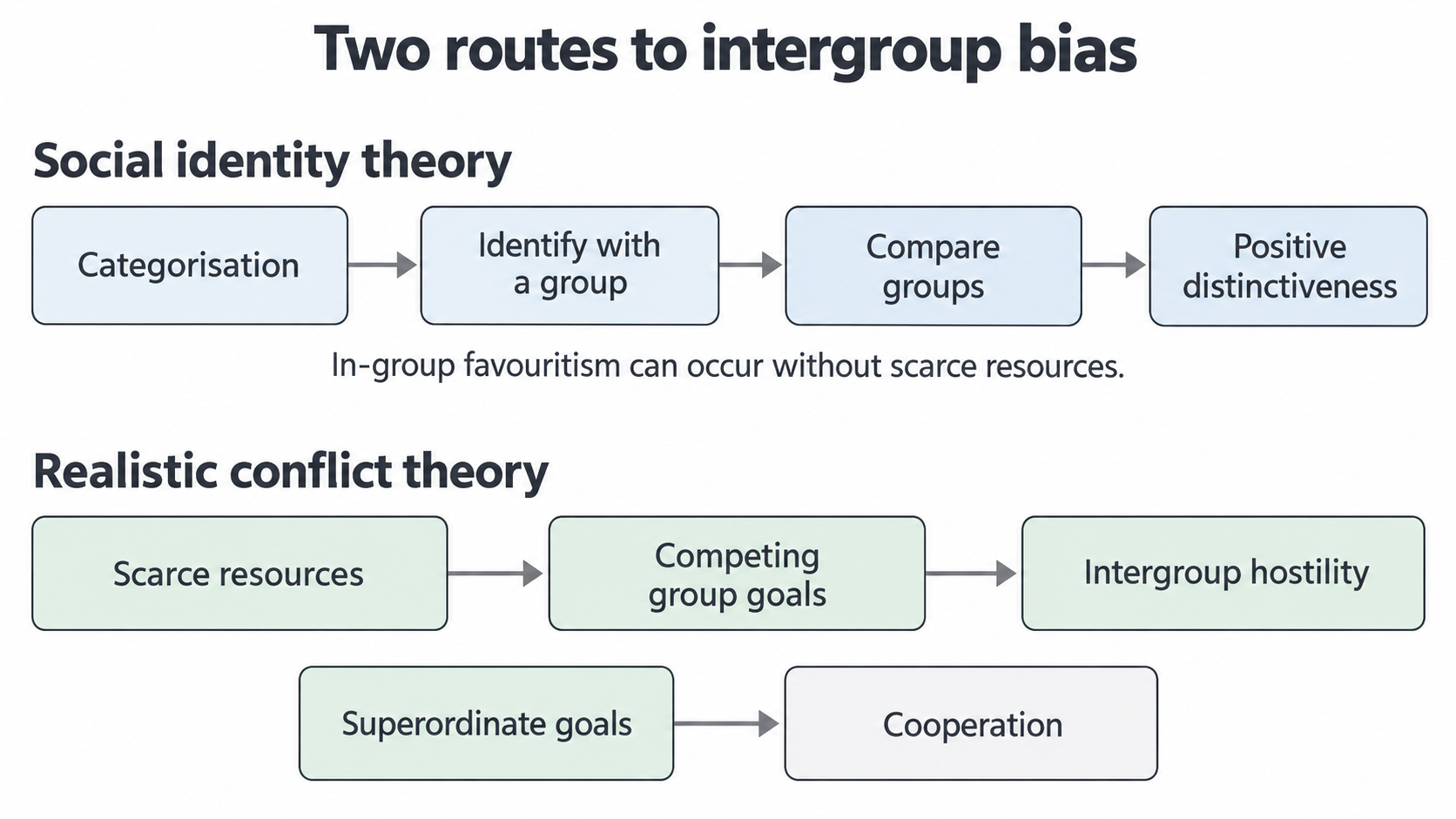
Realistic conflict concerns incompatible group goals. Social identity concerns the value of a group membership and comparisons with other groups. The mechanisms can operate together.
Why shared goals can change relations
Bringing rivals into the same room does not by itself change their interests. If each group still benefits from the other's failure, contact can provide another opportunity to argue. Sherif distinguished mere contact from a superordinate goal: a goal valued by both groups that neither can achieve through its own efforts alone. Achieving it requires cooperation across the group boundary.
This produces positive interdependence. Helping the other group now contributes to one's own success. Members can encounter the outgroup as useful partners rather than obstacles, weakening hostile expectations. Repeated successful cooperation can also make a broader “we” relevant while the original groups remain recognisable.
In the later Robbers Cave stage, shared activities without this dependency, such as eating together, did not remove hostility. Researchers then arranged problems requiring joint action, including restoring the camp water supply and pulling a stalled truck. Relations improved over a series of cooperative tasks. These were staged research situations: the researchers created the problems, including the disruption to the water supply. They were not naturally occurring crises. The findings support cooperation toward shared goals, but do not demonstrate that one brief task cures every group conflict. Original report, cooperation stage.
Return to the departments competing for a budget. Asking them to attend a friendly lunch leaves the competition intact. Giving both departments separate projects with separate prizes also leaves success independent. A shared project becomes a superordinate goal when both value its success and each supplies skills or information the other needs. Management would also need to deal with the budget competition: a cooperative exercise may have little lasting effect if the reward system continues to make the departments rivals.
Assessing the two explanations together
An explanation is stronger when it accounts for the particular trigger and evidence in a case. Both theories focus on group relations and can explain ordinary people developing bias. Their different mechanisms lead to different questions and predictions.
| Question | Social identity theory | Realistic conflict theory |
|---|---|---|
| What generates bias? | Identification and valued comparisons can motivate positive ingroup distinctiveness. | Incompatible goals create competition and threat. |
| Is scarce-resource competition required? | No; a relevant comparison can support favouritism without it. | Competition over valued resources is the central mechanism for hostility. |
| What evidence fits? | Favouring a minimal ingroup even at a cost to its absolute reward. | Rivalry after competitive goals and improvement after cooperative goals at Robbers Cave. |
| What might help? | Reduce hostile comparisons or make an inclusive identity meaningful. | Change incompatible goals and create valued goals requiring joint effort. |
Social identity theory has controlled evidence showing that a group label can influence allocation. Its usefulness extends beyond conflicts over material goods. However, behaviour compatible with the theory does not uniquely establish a self-esteem motive; norms about loyalty or expectations of the task may also contribute. The original theory recognises that identification and context matter, so a fair evaluation should not criticise it for claiming that all group distinctions inevitably produce hatred.
Realistic conflict theory provides a clear situational mechanism and suggests practical changes to incentives. Robbers Cave gives field evidence linking different goal relations with changing hostility. Yet the study involved a selected group of boys in one camp, and researchers both organised events and recorded behaviour. This limits generalisation and creates possibilities of observer expectations. Its successive stages also mean that cooperation happened after time together and earlier competition; the later improvement cannot be attributed to an isolated goal change with every other influence held constant.
The explanations are often complementary. A contest can create an actual resource conflict while also making membership more important and inviting comparisons about which group is superior. Removing competition may reduce hostility but leave a valued group distinction in place. A defensible judgement therefore identifies what each theory explains, weighs its evidence, and specifies what it leaves uncertain rather than declaring one theory universally correct. Tajfel and Turner's original theoretical chapter.