2.1.6, 2.3.4 - Digit span across development
Learn how a digit-span task measures one aspect of verbal memory, and how Sebastián and Hernández-Gil’s Spanish study informs developmental explanations. Distinguish its observed age differences from claims about an individual’s development or the cause of a cultural difference.
Digit span and development
A digit-span task asks how much spoken information a person can briefly retain in the correct order.
Forward digit span
The longest sequence of digits a person can repeat in the same order under a specified scoring rule.
If someone hears 4, 1, 8, 6 and repeats 4, 1, 8, 6, they retain both the items and their order. Repeating 4, 8, 1, 6 is an error even though all four digits are present. Increasing sequence length makes the task harder. Forward span is not a measure of every form of memory: remembering an event from last year, navigating a route and solving a problem involve additional processes.
In the working memory model, the phonological loop briefly stores speech-based information. Its phonological store retains sounds, while articulatory rehearsal refreshes them through internal repetition. Development can improve performance because older children can use rehearsal more effectively and process or articulate information faster. Faster rehearsal could refresh more items before they fade; better attention and strategies may also contribute. The 2012 paper discusses rehearsal emerging around ages 7–8, drawing on earlier research. It does not establish a sharp birthday at which every child acquires rehearsal.
This gives a testable developmental question: does span increase across childhood and adolescence, and does the Spanish pattern match the plateau around age 15 reported in earlier English-language research? The authors also compare their new child sample with older groups examined previously. Processing speed is a proposed contributor, not an independently manipulated cause in this study.
The Spanish study’s method
Sebastián and Hernández-Gil (2012) compared different age groups rather than following the same children for twelve years.
Their cross-sectional study tested 570 volunteers, aged 5–17, from public and private schools in the Community of Madrid. There were 272 males and 298 females. Participants were born in Spain, selected across the thirteen school courses, had not repeated a school year, and had no reported hearing, reading, writing or other cognitive difficulties. These criteria make the comparison more focused but narrow who the sample represents. This was not a random sample of all Spanish children. Age and school grade were pre-existing characteristics, so participants could not be randomly allocated to them.
Each participant was tested individually during a school break. An experimenter read random digit sequences aloud at one digit per second. An example checked understanding. Testing began with three sequences of three digits, then sequence length increased by one digit. The participant recalled each sequence in its original order. Span was the maximum length at which at least two of three sequences were reproduced without error. Thus a participant succeeding on two five-digit sequences but only one six-digit sequence would have span five.
The researchers analysed the thirteen school-year groups and five wider developmental groups: age 5, ages 6–8, 9–11, 12–14 and 15–17. Individual testing, a common presentation rate and an explicit scoring rule improve consistency. However, using live voices may leave differences in articulation or emphasis unless these are carefully standardised. School experience and age also change together; this method cannot isolate maturation from schooling or rehearsal practice.
Findings and their meaning
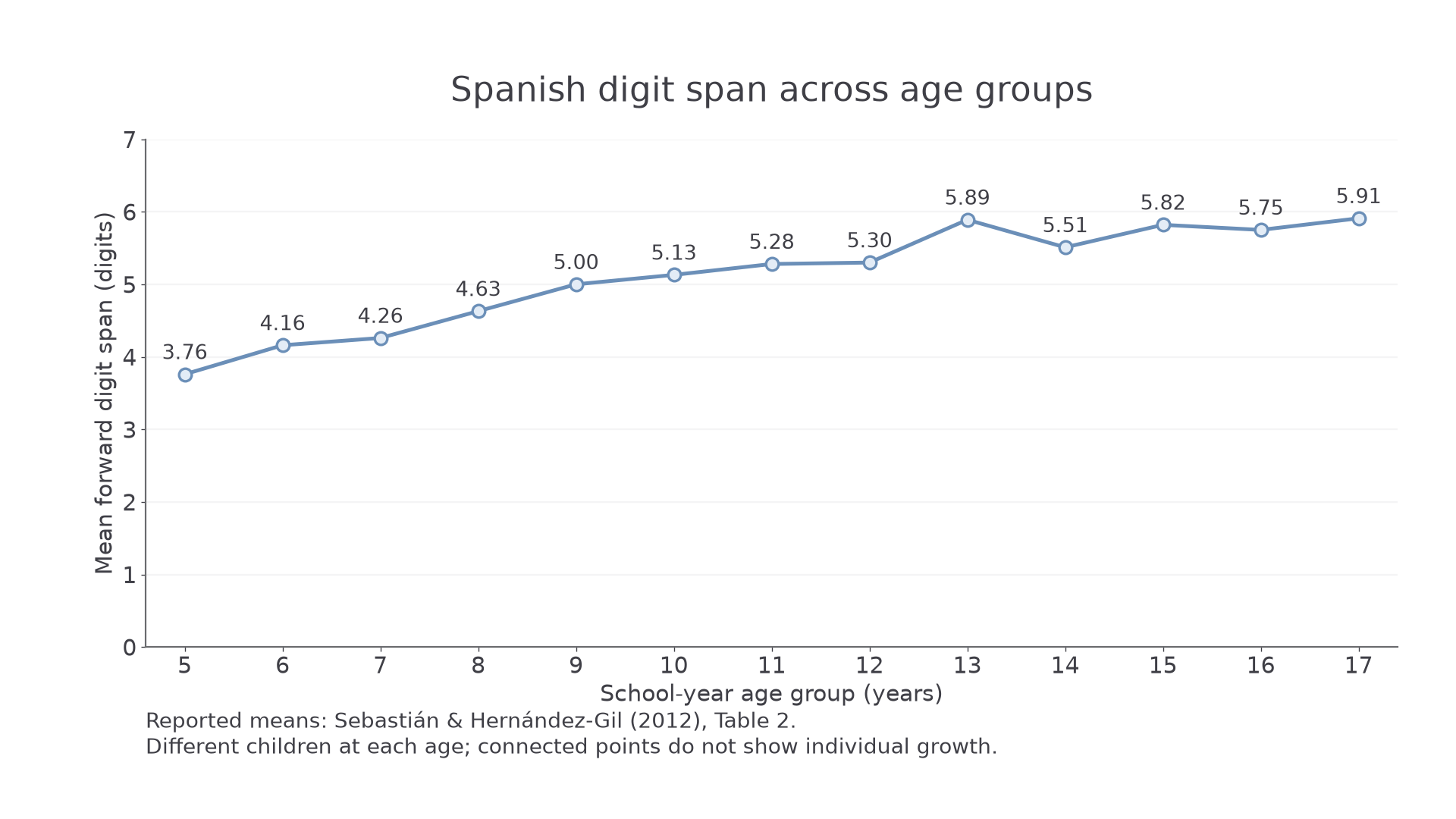
The study found a clear overall increase in digit span with age, although each older school-year mean was not higher than the preceding one.
| Developmental group | Mean span | Standard deviation |
|---|---|---|
| 5 years | 3.76 | 0.52 |
| 6–8 years | 4.34 | 0.58 |
| 9–11 years | 5.13 | 0.81 |
| 12–14 years | 5.46 | 0.85 |
| 15–17 years | 5.83 | 0.84 |
These are reported group means, not minimum capacities or limits applying to every person. The youngest group had a lower mean than every older group. The reported school-year means include 5.82 at age 15, 5.75 at age 16 and 5.91 at age 17; those three ages had similar spans. The paper concludes that Spanish span develops up to at least 17, contrasting it with earlier English-language estimates reaching adult levels around 15. That conclusion should not be rewritten as a statistically significant increase at every year or proof that growth stops exactly at 17: there were no newly recruited participants above 17 in this sample.
[DIAGRAM: asset_name: Spanish digit-span age means; asset_slug: edexcel_9ps0_c05_digit_span_development; recommended_method: deterministic_plot; description: Exact reported school-year mean digit spans from ages 5 to 17, showing an overall rise with local fluctuations.; caption: Different age groups show an overall rise in mean span; the points are not repeated measurements of the same children.]
The authors compared these results with the same task in an earlier 2010 sample: 25 healthy older adults, 25 patients with Alzheimer’s disease and nine with frontal-variant frontotemporal dementia. Their respective means were 4.44, 4.20 and 4.22. The reported comparison did not find significant span differences between these older groups. This suggests that simple forward span may be relatively less affected by those dementias than some other memory functions. It does not mean dementia leaves all memory intact, and a nonsignificant difference does not prove identical capacity. The small frontotemporal group limits sensitivity.
The original report and its numerical tables are available from Psicothema, pp183–187. The adult comparison belongs to the earlier study, not to an additional older cohort recruited as part of the 570 children.
Developmental and cultural inference
The results support an age-related pattern, but explaining that pattern requires more evidence than comparing mean spans.
The authors propose a word-length effect: longer spoken digit names take more time to rehearse and recall, allowing other items to fade. Many Spanish digit names take longer to articulate than English ones, so span differences could partly reflect language and rehearsal time. Differences in schooling, task procedure, grouping or learned chunking strategies could also matter. The study compared its data with earlier studies and published norms; it did not randomly assign Spanish and English participants to language conditions. It therefore cannot demonstrate that nationality or an innate cultural difference caused the result.
The developmental sample is large and covers all thirteen school courses, giving a more stable description than a few convenience observations. Standard timing and scoring make replication feasible. Nonetheless, excluding pupils with learning difficulties or repeated years limits generalisation to those learners. The school task is controlled, but retaining isolated digits is less representative of remembering meaningful classroom material. Good reliability of span scoring would not by itself establish ecological validity.
Cross-sectional comparisons are efficient and avoid years of participant loss, but differences between cohorts can mimic development. A longitudinal follow-up would test how the same individuals change; its disadvantages include practice effects and attrition. Directly measuring articulation speed and rehearsal strategy could test the proposed explanation more closely. Even then, age-related processing speed alone need not account for every difference in working memory.
Use digit span as evidence about a specified verbal-memory task. Keep the observed age pattern, the proposed rehearsal mechanism and the limits on causal or cultural inference separate.