9.1.3, 9.1.6, 9.1.9, 2.2.1, 2.2.2, 2.2.5, 2.2.6, 2.2.7, 2.2.8, 2.2.10 - Experiments, designs and controls
An experiment can test whether changing one variable affects another, provided competing explanations are controlled. Learn to choose a setting and participant design, define the variables precisely and judge how controls improve the conclusions a study can support.
A fair test of a causal prediction
An experiment deliberately changes an independent variable and measures its effect on a dependent variable.
The independent variable (IV) has conditions created by the researcher. The dependent variable (DV) is the recorded outcome. In a hypothetical memory experiment, the IV is word presentation speed: one second or three seconds per word. The DV is the number of ten target words correctly written in a 30-second immediate recall test. Defining “speed” and “recall” this way is operationalisation. It makes instructions and scoring repeatable, although this narrow recall task does not measure every aspect of memory.
The logic is that if the conditions differ only in the intended IV, an outcome difference is more plausibly attributable to that change. Control and suitable allocation strengthen this inference; the label “experiment” alone does not prove causation. Merely asking how often people study and how many words they remember measures an association without manipulating studying, so other differences could explain it.
A control condition provides a comparison, often a baseline without the active manipulation. It is not the same as a controlled variable, which is kept consistent across conditions. In a font-readability experiment, ordinary font could be the control condition; the same word list, screen brightness and viewing distance are controls in both conditions. A study comparing two active teaching methods can also be experimental without a no-treatment condition.
Plan ethical adult recruitment, voluntary informed consent, withdrawal and confidential recording before testing. Use harmless materials and manageable timing; do not create exhaustion or distress to obtain an effect. Pilot the instructions, apparatus and scoring rule, then specify them before the main data collection. The results must test the planned hypothesis, rather than a measure chosen afterwards because it gives an attractive result.
Choosing the experimental setting
Laboratory and field experiments both manipulate an IV, but differ in the setting and the control it permits.
A laboratory experiment takes place in a controlled environment arranged for research. A quiet room with identical screens can make presentation time, lighting and instructions consistent. This improves internal validity, the confidence that the IV rather than another cause accounts for the DV. A detailed procedure also supports replicability, the ability to repeat the method, although reliable repeated results are something to check rather than assume.
The artificial task or awareness of being studied can alter behaviour. Ecological validity concerns whether the task and conditions support generalisation to everyday behaviour. Recalling isolated words at a desk may tell us less about remembering a conversation while travelling. A laboratory location does not automatically make every finding ecologically invalid: judge the psychological task and intended generalisation.
A field experiment manipulates an IV in an ordinary setting. A researcher might vary the layout of a voluntary, non-sensitive library reminder and measure use of a signposted resource, with the organisation's agreement and proportionate ethical safeguards. The ordinary activity can improve relevance to everyday behaviour. Yet differences in visitors, distractions or busy periods can threaten internal validity unless planned controls address them. Field research also makes consent, privacy and withdrawal more difficult if people are unaware of participation; a natural setting does not excuse ignoring these issues.
An observation in a real-world location is not automatically a field experiment: it needs a deliberately manipulated IV. Likewise, a classroom can serve as a controlled research setting. Identify what the researcher changed, what was measured and how the environment was arranged before classifying the method.
Who completes each condition?
The participant design determines whether the comparison is between different people or between measurements from the same people.
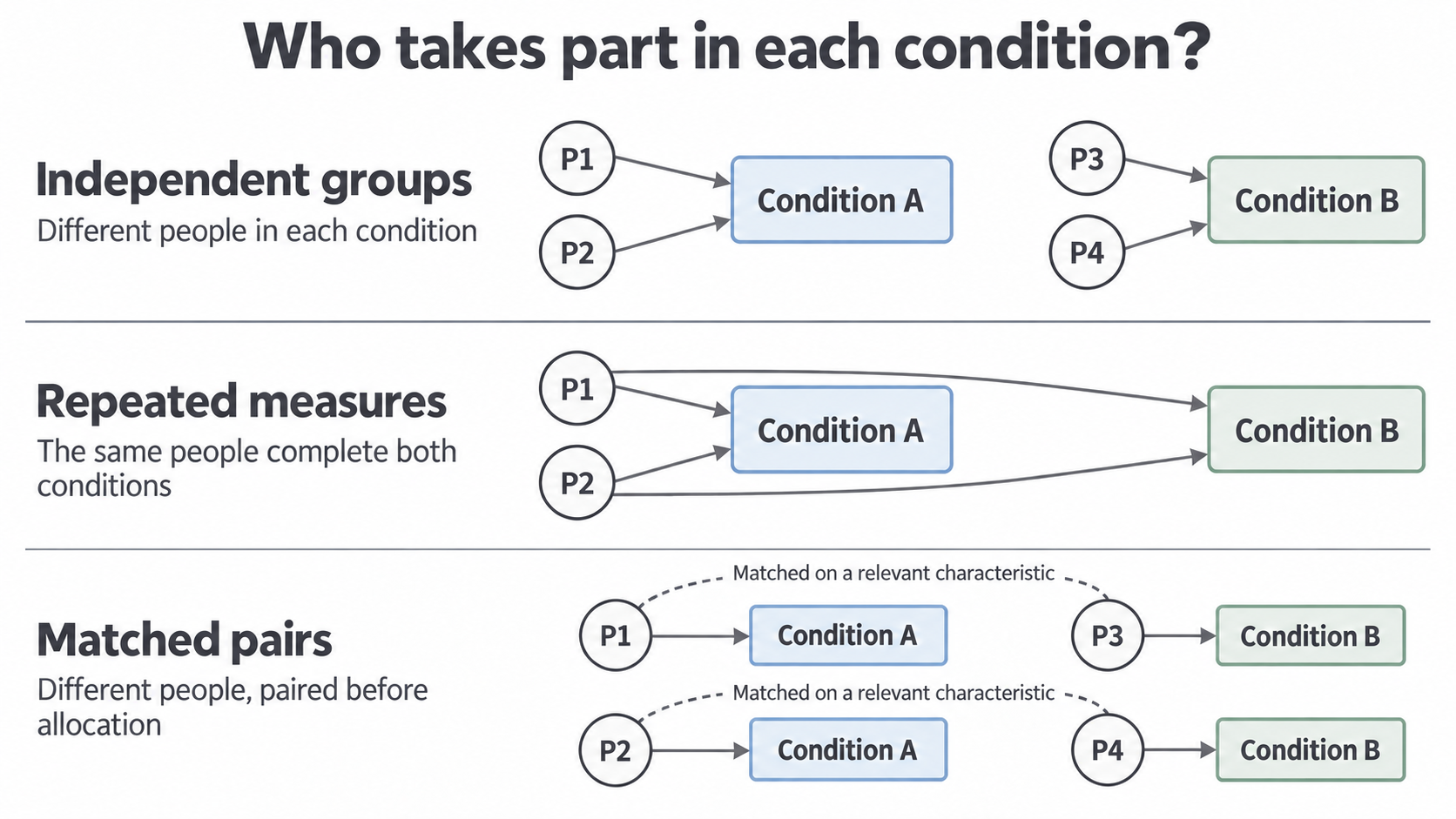
In independent groups, different participants complete each condition. For example, ten adults see one-second presentation and ten different adults see three-second presentation. Nobody repeats the task, avoiding practice and fatigue from completing both conditions, and reducing opportunities to infer the comparison. However, the groups may differ in memory ability or motivation. Random allocation can reduce systematic differences, but a small randomly allocated sample can still contain chance imbalances. More participants are needed than if each person supplies a score in both conditions.
In repeated measures, the same participants complete all conditions. Each adult provides a recall score at each speed, using equivalent different word lists. Stable individual memory differences are controlled because each person is compared with themselves, and fewer people are usually needed for the same number of observations per condition. However, earlier performance can change later performance through practice, fatigue or the discovery of a strategy. Seeing both conditions may also reveal the hypothesis.
In matched pairs, researchers first pair different people on a relevant characteristic, such as a baseline memory score, then put one member of each pair in each condition. Randomly deciding which member receives each condition reduces allocation discretion. Matching reduces differences on the measured characteristic without making a person repeat the experimental task. It is time-consuming, matching is rarely exact, and people may still differ on unmeasured factors such as motivation. A matching test itself should not train participants on the outcome task.
[DIAGRAM: asset_name: Participants across experimental designs; asset_slug: edexcel_9ps0_r03_participant_designs; recommended_method: image_gen; description: Independent groups use different participants in A and B; repeated measures use P1 and P2 in both A and B; matched pairs link P1 with P3 and P2 with P4 while each person performs one condition.; caption: Repeated measures compare the same people, whereas matched pairs compare different people paired on a relevant characteristic.]
Design choice involves a trade-off. If trying one teaching technique permanently teaches a useful strategy, repeated measures may contaminate the next condition in a way that no short rest can undo. Independent groups, or matched pairs with a suitable baseline, may be preferable. For a brief neutral reaction-time task where practice can be managed, repeated measures may be efficient. Justify the decision by the actual task, not by naming a design as universally best.
Continue this lesson.
You’re previewing NovaLearn without an account. Create a free account to read the rest.
Create free account