6.1.7, 6.3.1 - Eyewitness memory and Loftus
An eyewitness can sincerely report something that did not happen. This lesson explains how attention and later information affect testimony, distinguishes both Loftus and Palmer experiments, and evaluates what their evidence means for real investigations.
How an eyewitness report is constructed
An eyewitness report depends on what was noticed, retained and retrieved, rather than on a perfect recording of an event. At encoding, attention selects some details and misses others. During retention, the witness may hear a news report or another witness's account. At retrieval, the wording of an interview question may influence what is reported.
Post-event information
Information encountered after an event that may influence a person's later memory or report of that event.
Imagine someone sees a cyclist fall, then hears a bystander describe a collision with a van. Later the witness may include a van in the account, confusing the source of the detail. This is reconstructive memory: remembering involves assembling an account using retained information and expectations. A leading question suggests an answer, for example by assuming that a van was present. It can influence a report without a deliberate lie.
[DIAGRAM: asset_name: Where eyewitness errors can arise; asset_slug: edexcel_9ps0_cr06_memory_process; recommended_method: image_gen; description: Encoding retention and retrieval with weapon focus post-event information and leading questions as possible influences; caption: Different influences can affect attention memory and the final report.]
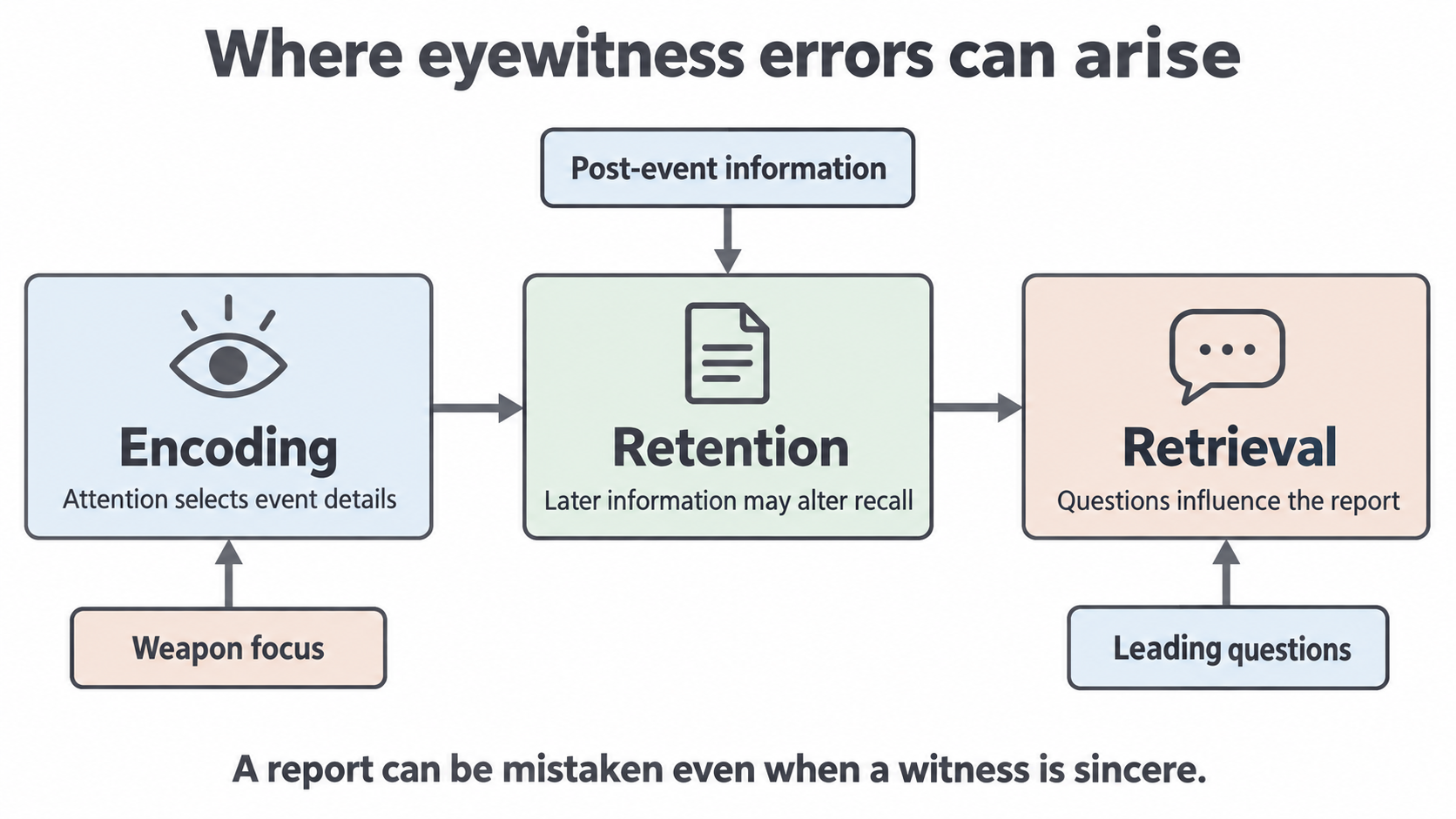
Reliability includes consistency across accounts or measurements; accuracy is correspondence with what happened. A repeatedly reported error can be reliable but inaccurate. A changed account may reflect contamination, but may also reflect genuinely retrieving another detail. We therefore need evidence about the conditions of witnessing and questioning, rather than treating consistency alone as proof.
Loftus and Palmer's first experiment
Loftus and Palmer (1974) investigated whether question wording influences estimates of a vehicle's speed. Their laboratory experiment used 45 students and seven accident clips, each lasting 5–30 seconds. After each clip, participants first described the accident in their own words and then answered specific questions. Five groups of nine received different verbs in the speed question: smashed, collided, bumped, hit or contacted. Verb was the independent variable; estimated speed in miles per hour was the dependent variable. The verb comparison used independent groups, although each participant viewed several clips; the full session lasted about ninety minutes.
| Verb | Mean speed estimate, mph |
|---|---|
| Smashed | 40.8 |
| Collided | 39.3 |
| Bumped | 38.1 |
| Hit | 34.0 |
| Contacted | 31.8 |
The same event could produce different speed reports depending on wording. Four staged crashes had known actual speeds, but estimates did not closely track those speeds. The verb pattern supports a wording effect, but leaves two explanations open: response bias, where an uncertain person chooses an answer suggested by the verb, and a changed memory representation. The original report describes students but does not specify a recruitment technique; calling it a documented random population sample would be unjustified. Original report, pp585–587.
Standardising the films and changing the critical word supports a controlled comparison. The film order varied between groups, reducing a fixed ordering influence. However, interpreting an accident film as a student is different from being involved in a real accident. The experiment establishes an effect in its task, not the exact size of an effect in every real witness.
The delayed broken-glass experiment
The second experiment tested whether wording had consequences beyond the immediate speed answer. A different sample of 150 students watched one multiple-car accident film lasting less than a minute, with the collision occupying four seconds. After giving their own account, fifty received a smashed speed question, fifty a hit question, and fifty no speed question. Mean immediate estimates were 10.46 mph for smashed and 8.00 mph for hit. One week later, without seeing the film again, they answered ten questions about the accident. The critical yes/no question about broken glass appeared at a random position in that list. No glass had appeared. Original report, p587.
| Original condition | Said yes to glass | Said no | Total |
|---|---|---|---|
| Smashed | 16 | 34 | 50 |
| Hit | 7 | 43 | 50 |
| No speed question | 6 | 44 | 50 |
Continue this lesson.
You’re previewing NovaLearn without an account. Create a free account to read the rest.
Create free account