1.1.1 - Agency and social impact theories
Why might someone follow an instruction they believe is wrong? Agency theory explains obedience through a change in perceived responsibility, while social impact theory explains how the people around us influence our behaviour. These accounts make different predictions and need to be judged against evidence.
Autonomy and agency
Obedience means following a direct instruction from someone perceived to have authority.
A firefighter following an evacuation order and an employee following an unsafe order both obey. The behaviour is not necessarily harmful: its consequences depend on what is commanded. Dissent is disagreement with an instruction; resistance involves acting against the pressure to obey. Someone can express disagreement and still carry out the instruction.
Milgram's agency theory proposes two ways of understanding our actions. In an autonomous state, a person sees themselves as choosing what to do and accepts personal responsibility for its consequences. In an agentic state, they see themselves as carrying out another person's wishes. They feel accountable for doing the assigned task correctly but attribute responsibility for its overall consequences to the authority.
Agentic shift
The proposed change from acting as a self-directed individual to seeing oneself as an agent who executes an authority's wishes.
Imagine a fictional technician, Noor, who normally checks that a machine is safe. A supervisor orders her to restart it while a guard is open. If Noor thinks, “I am deciding whether this is safe,” she is reasoning autonomously. If she thinks, “My job is to follow the supervisor; the supervisor is responsible,” agency theory predicts greater obedience. The crucial change is her interpretation of responsibility, not simply that another person is present.
This is a psychological explanation, not a legal or moral excuse. Feeling that another person is responsible does not remove one's actual responsibility. Nor does obedience itself prove that an agentic shift occurred: a person could follow an order because they independently agree with it.
Legitimacy, strain and resistance
Agency theory needs to explain why someone accepts an authority and why they sometimes break away from it.
Legitimacy of authority means that a person is perceived to have the right to issue instructions in a particular setting. A qualification, institutional role, uniform or respected organisation can signal legitimacy. These are cues to a judgement, not guarantees: a surgeon has relevant authority in an operating theatre, but this does not give the surgeon authority over every aspect of a stranger's life.
People learn expectations about authority through family, school and organisations. Entering a situation voluntarily, accepting an assigned role and recognising a credible authority can make the agentic shift more likely. Once involved, binding factors can keep someone obeying. They may feel obliged to finish what they began, fear appearing rude, or find each small increase easier to accept than making an abrupt break. These factors maintain obedience; they do not make dissent impossible.
Moral strain is the distress produced when an instruction conflicts with a person's values. A person may sweat, protest or feel anxious while continuing to obey. Agency theory explains this combination by separating concern about harm from perceived responsibility for causing it. Someone may reduce strain by concentrating on the task, minimising the harm or reminding themselves that the authority is responsible. Alternatively, strain can become strong enough for them to reject the authority's demand and resume autonomous decision-making.
In Milgram's obedience research, participants were told to administer what they believed were increasing electric shocks. Some protested and showed distress while continuing. This is consistent with conflict between personal values and an accepted role. However, distress alone does not tell us whether they shifted responsibility: fear of confrontation or uncertainty about the research could also produce it. The proposed mental state must be distinguished from the behaviour used as evidence for it.
Moral discomfort and obedience can coexist. To explain resistance, consider whether the person rejects the authority's legitimacy, accepts personal responsibility, or finds the conflict impossible to tolerate.
Strength, immediacy and number
Latané's social impact theory predicts influence from the relationship between a source of pressure and its target. His 1981 paper sets out the framework and its supporting evidence. Original article.
A source is a person exerting influence; the target is the person influenced. The theory applies to a wider range of social influence than obedience, including conformity to a group. It identifies three influences, often remembered as SIN.
Strength is the source's perceived importance, power or status to the target. A manager who controls a worker's promotion may exert more influence than an unfamiliar visitor giving the same instruction. Strength is not physical strength and need not come from formal rank: a respected friend can be influential.
Immediacy is closeness in space or time, with fewer barriers between source and target. An instruction given face to face can exert more pressure than an old message from a distant source. In Milgram's telephone variation, resistance increased when the experimenter gave instructions from outside the room. This is consistent with reduced immediacy, although it also reduced direct surveillance.
Number means how many sources exert influence. Several people making the same demand usually have more impact than one. The theory predicts diminishing marginal impact: adding a source to a small group generally makes a larger difference than adding one to an already large group. It does not predict that every additional person adds the same amount, or that everyone necessarily obeys a large group.
[DIAGRAM: asset_name: Social impact sources and target; asset_slug: edexcel_9ps0_s01_social_impact; recommended_method: image_gen; description: Strength, immediacy and number each contribute to influence on a target individual, with diminishing gains from additional sources.; caption: Social impact depends on the source-target relationship, not just the presence of other people.]
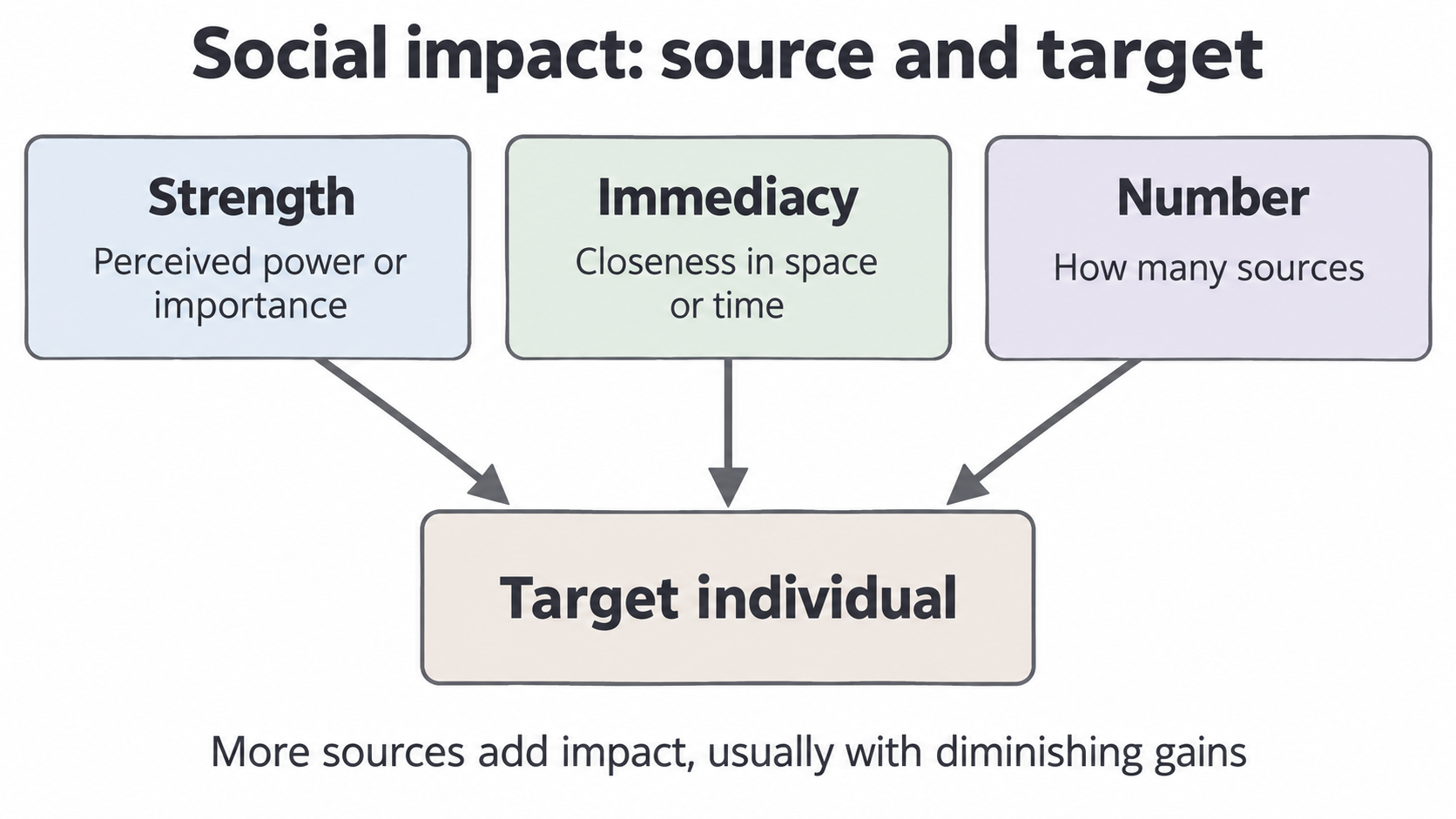
Consider a fictional trainee asked to ignore a safety rule. The senior manager's control over the trainee's job increases strength; standing beside the trainee increases immediacy; agreement from several supervisors adds sources. Social impact predicts increased pressure when these combine. This prediction describes likely influence; it does not establish that the request is legitimate or should be followed.
Latané also distinguishes adding sources from adding targets. If a demand is directed at several people together, its impact on each can be diluted: no single target carries the whole pressure. Supportive peers may also supply competing influence in favour of resistance. Counting everyone in a room as an obedience-promoting source would therefore misapply the theory.
Evaluating obedience mechanisms
The value of each theory depends on what it explains and what the evidence can actually establish.
Agency theory provides a mechanism for the troubling combination of harm, distress and continued obedience. It also offers a practical warning: organisations should encourage people to take responsibility and question inappropriate instructions. Milgram's reports of participants looking to the experimenter for guidance and some attributing responsibility to authority are compatible with this account.
A limitation is that an agentic state is inferred rather than directly observed. If every act of obedience is labelled agentic and every refusal autonomous, the theory risks merely redescribing the outcome. Stronger tests would measure perceived responsibility independently and examine whether changing it changes obedience. People may also willingly identify with a valued project, expect expert instructions to be safe, or comply to avoid confrontation. These alternatives can explain some of the same behaviour without assuming that personal judgement has disappeared.
Social impact theory makes systematic predictions about changing the situation. Milgram's reduced obedience when an ordinary participant issued orders is consistent with reduced strength; the telephone condition fits reduced immediacy. Latané's 1981 review also describes a street study in which larger groups looking upward attracted more passers-by, with diminishing gains from additional sources. That finding supports the predicted number relationship across another form of influence, but looking upward is not the same as obeying a harmful command.
The theory describes the amount of influence more clearly than the mental process producing it. It does not, by itself, explain why one source is trusted, why an order conflicts with values, or why equally exposed people respond differently. Strength and immediacy must be defined independently of the outcome, otherwise a source could be labelled “strong” simply because people obeyed. Evidence for diminishing impact is also not uniform across every task: the situation and meaning of the demand matter.
The accounts can complement one another. Social impact identifies features that make pressure greater; agency theory proposes how accepting authority could change perceived responsibility. Neither establishes that personality, cultural learning or the content of an order is irrelevant. A defensible judgement is that both illuminate aspects of obedience, while the observed behaviour does not uniquely prove either proposed explanation.