2.1.2 - The multi-store model
A glance at a sign may vanish from memory, a telephone number may last while you repeat it, and a familiar address may remain available for years. This lesson uses Atkinson and Shiffrin’s multi-store model to explain those differences through information processing, then examines the evidence and limits of treating memory as a set of stores.
Encoding, storage and retrieval
Remembering involves representing information, retaining it and making it available when it is needed.
Information processing describes how a system receives information, changes its representation and uses it. Cognitive psychologists infer those processes from behaviour such as recall, recognition and response time. The analogy with a computer helps distinguish stages, but human remembering also depends on experience, meaning and goals.
Encoding, storage and retrieval
Encoding changes information into a representation that memory can use. Storage retains information over time. Retrieval makes stored information available for current use.
These are different processes. When you see the word “harbour”, you may encode its visual appearance, its sound or its meaning. Retaining its meaning is storage. Bringing that meaning to mind when reading a later sentence is retrieval. A code is the form of representation, not the ink on the page or the sound wave itself. Acoustic encoding concerns sound; semantic encoding concerns meaning.
Failure to report something does not identify where the problem occurred. You may not have attended to it sufficiently to encode it, may have lost information during storage, or may be unable to retrieve an available representation with the present cue. For example, recognising a name after seeing several alternatives suggests that more information was available than an unsuccessful unaided recall revealed. It does not show that every forgotten item is still stored.
Stores and control processes
Atkinson and Shiffrin’s 1968 account distinguishes memory structures from the strategies that control information flow.
The familiar model contains sensory registers, a short-term store and a long-term store. Incoming stimulation leaves a brief sensory representation. Attention selects some of that information for short-term use; much unattended information rapidly becomes unavailable. Short-term memory keeps a limited amount immediately available. Long-term memory retains information more enduringly.
[DIAGRAM: asset_name: Multi-store information flow; asset_slug: edexcel_9ps0_c02_multi_store_flow; recommended_method: image_gen; description: Environmental input enters sensory registers, attention selects information for short-term storage, encoding and transfer connect it to long-term storage, and retrieval returns information for current use.; caption: The model distinguishes brief registration, temporary use and enduring retention.]
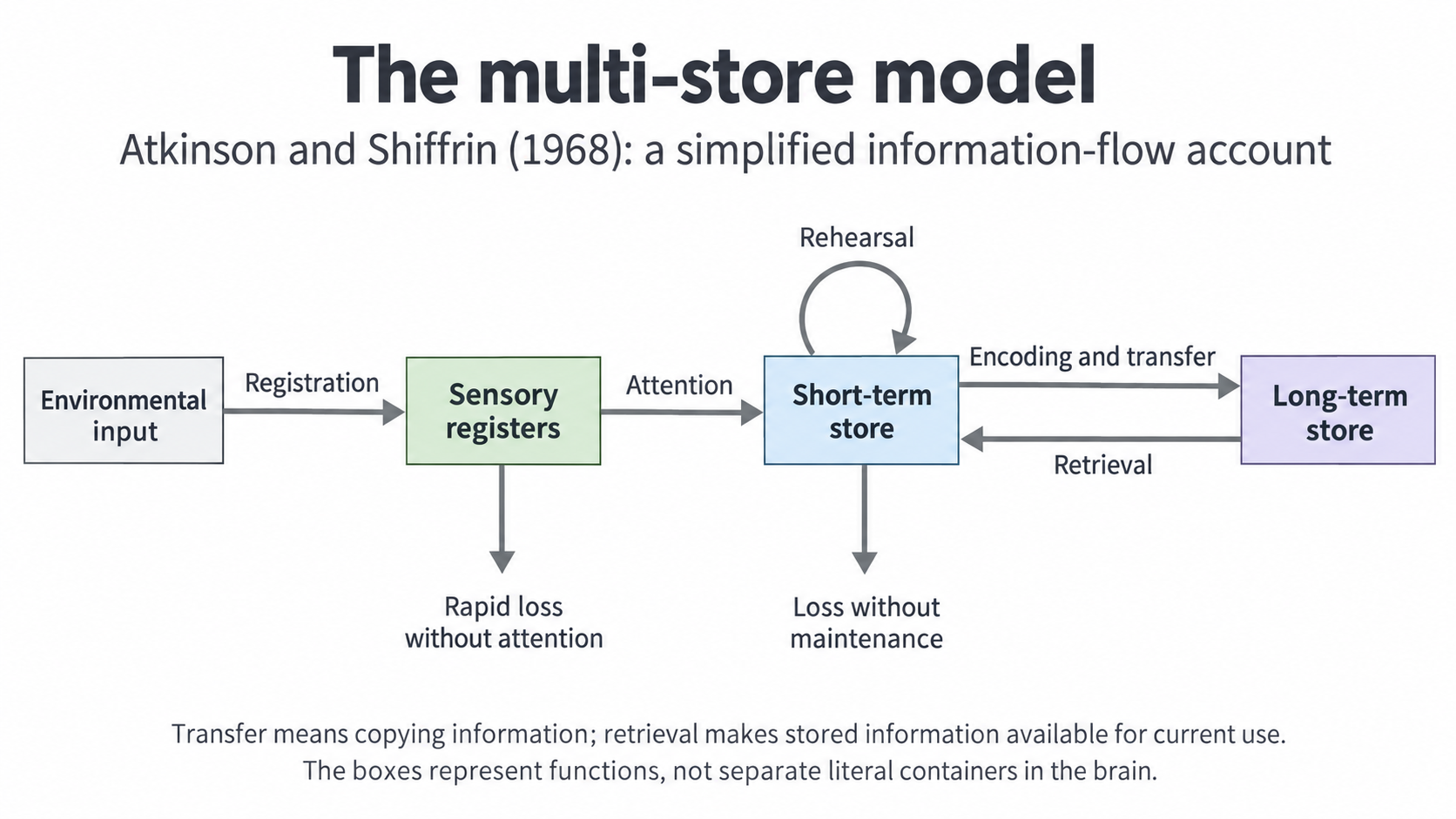
Rehearsal is repetition that maintains selected information in short-term memory. Imagine hearing a locker code, attending to it and repeating it until you reach the locker. Without maintenance, the temporary representation may become unavailable. The model links time in short-term memory with opportunities to establish a longer-lasting representation. Retrieval brings long-term information into short-term use: remembering a familiar locker code does not require learning it again.
The original account also includes control processes, such as choosing what to rehearse, coding material meaningfully and searching long-term memory. These can vary with instructions, material and personal experience. It is therefore too crude to say that the original theory only describes automatic movement between three boxes, or that any amount of repetition guarantees long-term learning.
“Transfer” means copying information into another representation, not emptying one physical container into another. An item can be available in temporary memory while a more lasting representation is established. Attention, encoding and retrieval are proposed psychological processes, not arrows that researchers can directly see in a brain.
Comparing the stores
Capacity and duration describe different limits on memory, and neither can be inferred simply from whether recall succeeds.
Capacity is how much information can be retained. Duration is how long it remains available. A store could hold much information very briefly, or a small amount for longer. Measuring one does not automatically measure the other.
| Store | Typical representation | Capacity | Duration and conditions |
|---|---|---|---|
| Sensory registers | Closely related to the incoming sense, such as a visual representation | Relatively large briefly; more may be registered than can be reported | Very brief: a visual trace commonly lasts a fraction of a second; duration differs across senses and conditions |
| Short-term store | Often sound-based for verbal lists, but other representations are possible | Limited to a small number of units or chunks | Roughly 15–30 seconds in the classic account without maintenance; rehearsal and interference affect availability |
| Long-term store | Often meaning-based, with visual, auditory and other information also retained | Very large; no simple fixed maximum has been established | Potentially years or a lifetime, although information may be forgotten or difficult to retrieve |
A chunk combines separate items into a meaningful unit using existing knowledge. The letters N, H and S may be three unfamiliar units to one learner but the familiar abbreviation NHS to another. A traditional short-term estimate is about seven items, plus or minus two, but this is not a universal law. Performance depends on chunking, material, attention, rehearsal and the task used. Capacity is better understood as limited than as an exact number everyone must share.
Duration figures also have conditions. Asking people to retain a list without rehearsing does not produce the same result as allowing active repetition. A distractor used to prevent rehearsal may create interference as well. An observed decline therefore does not establish that elapsed time alone erased the memory.
Sound-based short-term coding and meaning-based long-term coding are useful tendencies in verbal tasks, not exclusive rules. You can remember a tune over years, and understand the meaning of a sentence immediately. Store distinctions describe characteristic patterns rather than banning particular kinds of content from a store.
Evidence and limits of separate stores
Evidence supports distinctions in memory, while leaving open how many systems are needed and how they interact.
Research discussed by Atkinson and Shiffrin provides a reason for distinguishing sensory registration from later report. In Sperling’s partial-report method, people briefly saw an array of letters and received a cue indicating which row to report. A cue delivered almost immediately allowed accurate report of a requested row; delaying the cue reduced availability. Because the row was selected after presentation, people must briefly have had access to more of the array than they could report before it faded. This supports a relatively rich but short-lived visual representation. The outcome does not mean that sensory memory has unlimited capacity.
Clinical evidence also distinguishes immediate retention from enduring learning. Patients with severe amnesia following medial temporal damage could sometimes maintain information through rehearsal while struggling to establish lasting new memories. Henry Molaison is studied in a separate lesson. This pattern supports a distinction between short-term availability and processes needed for long-term learning: damage does not necessarily impair both equally. Patient differences, the extent of damage and the tasks used limit a direct inference to healthy memory.
The model’s strength is an organised account that generates measurable questions about duration, capacity, coding and control. A delay or distractor can affect one kind of performance more than another. Several converging findings are more convincing than taking one result as proof of three stores.
However, a single short-term box gives little detail about retaining sounds, tracking locations and reasoning simultaneously. The working memory model distinguishes executive attention from verbal and visual-spatial resources, explaining why some concurrent tasks interfere more than others. Both accounts use limited temporary memory and links with longer-term knowledge; they differ in the detail they give to temporary processing. The multi-store model has a broader store-to-store emphasis, whereas working memory is particularly concerned with temporary storage and use.
Long-term memory is also not uniform: remembering an event and knowing a fact can be affected differently, as Tulving’s distinction explores. Finally, repetition alone does not explain why understanding and connecting information can support durable memory. The original model includes coding strategies, but a simplified diagram hides these. The reasonable judgement is that separate stores provide a useful starting framework, supported by distinct performance patterns, while a full account must explain the organisation within stores and the control processes linking them.