3.2.3 - Brain scans, twins and adoption
Biological psychologists need evidence that connects the body with behaviour. This lesson explains what CAT, PET and fMRI scans measure, then uses Gottesman and Shields’ twin research and Tienari’s adoption research to show how researchers investigate genetic and environmental contributions. The central question is what each method allows us to conclude.
What brain scans measure
Brain scans make otherwise inaccessible features of a living brain measurable, but different scans answer different questions.
CAT, computed axial tomography, is commonly called CT, computed tomography. X-rays pass through the head from different angles. A computer uses differences in absorption to reconstruct cross-sectional images that can be combined into a three-dimensional view. These are mainly evidence about structure, such as tissue damage after an accident. If an aggressive patient has a damaged frontal region, a CT scan can locate damage; it cannot establish that this damage explains every aggressive act.
PET, positron emission tomography, uses an injected radiolabelled tracer. Detectors register signals produced following positron emission. With a glucose tracer, uptake provides evidence about glucose metabolism, an indirect indicator of brain activity. Researchers can compare regional activity while participants perform a standard task. Raine’s study used this approach to compare people pleading not guilty by reason of insanity (NGRI) with matched controls. PET does not photograph aggression or directly record individual neurons firing.
fMRI, functional magnetic resonance imaging, uses magnetic fields and radiofrequency signals to track blood-oxygenation changes. The blood-oxygen-level-dependent (BOLD) signal is an indirect indicator: active tissue generally receives an altered supply of oxygenated blood. Researchers compare signals across tasks or conditions to investigate functional involvement. It offers detailed spatial information without ionising radiation, but the blood response lags behind neural events. Greater BOLD activity does not mean that one region alone produces the behaviour.
[DIAGRAM: asset_name: Different brain scan signals; asset_slug: edexcel_9ps0_b06_scan_signals; recommended_method: image_gen; description: Three panels distinguish CAT X-ray tissue structure, PET radiolabelled tracer metabolism, and fMRI blood oxygenation as an indirect activity signal.; caption: CAT, PET and fMRI measure different signals; explaining behaviour requires further evidence.]
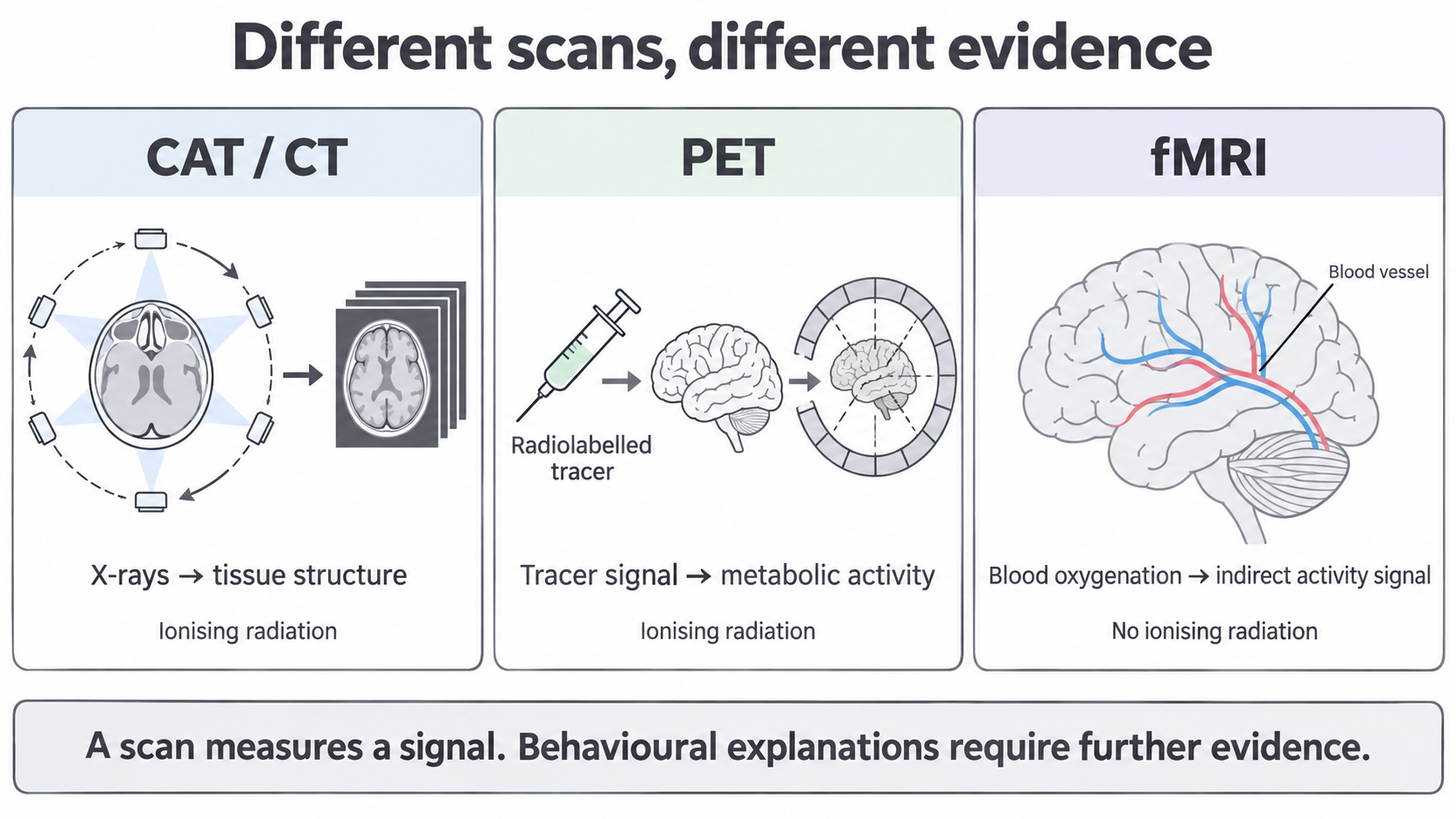
CT and PET expose participants to ionising radiation, so repeated research scans need a justified benefit and risk assessment. fMRI avoids that radiation but can be uncomfortable, noisy and difficult for people who cannot remain still; metal implants and other safety factors require screening. All three require specialised equipment and skilled interpretation. Scanner conditions and motion can affect the data, while behaviour inside a scanner may differ from behaviour in everyday conflict.
The logic of twin comparisons
A twin comparison asks whether greater genetic similarity is associated with greater similarity in a measured characteristic.
Monozygotic (MZ) twins develop from one fertilised egg and share nearly all their inherited DNA sequence. Dizygotic (DZ) twins develop from separate eggs and share, on average, about half of their segregating genetic variation, as other siblings do. Twins raised together also share aspects of their environment. If MZ pairs are more similar than DZ pairs, this is consistent with a genetic contribution, provided that the relevant environmental similarity does not account for the difference.
Concordance
Concordance describes both members of a pair showing a specified characteristic. A concordance rate depends on the definition of the characteristic and on how pairs are counted.
Researchers may compare concordance for a diagnosis or correlations between continuously measured scores. These are different forms of similarity, so a correlation of 0.60 is not automatically “60% of pairs have the disorder”. Nor is a heritability estimate the percentage of one individual’s behaviour caused by genes: it concerns variation among people in a particular population and environment.
The equal-environments assumption concerns environmental influences relevant to the characteristic. MZ twins may be treated more similarly, share friends more often or experience more similar expectations than DZ twins. If these experiences affect the measured behaviour, extra MZ similarity may partly reflect nurture. Twin designs therefore support a qualified inference rather than an experiment in which genes have been manipulated.
Gottesman and Shields’ schizophrenia evidence
Gottesman and Shields (1966) investigated whether schizophrenia showed greater concordance in MZ than DZ twins using a London psychiatric-clinic sample.
They examined twins identified through admissions to the Maudsley and Bethlem Royal hospitals over 1948–1964. Pearson’s study summary reports 62 affected registered twins, with both members registered in five pairs, giving 57 distinct pair comparisons: 24 MZ and 33 DZ. This was an ascertained clinical sample, not a random sample of the general population. The researchers combined hospital records and case histories with interviews and psychological assessments, including the MMPI, to investigate the twins’ mental state. Using several forms of evidence made assessment richer than a single unchecked self-report.
For the narrower outcome in which both twins had a schizophrenia diagnosis, the reported figures were 10 of 24 MZ comparisons, approximately 42%, and 3 of 33 DZ comparisons, approximately 9%. Broader definitions involving other psychiatric difficulties produced higher similarity, which shows why the outcome definition matters. The relevant comparison is between MZ and DZ twins assessed using the same definition, rather than treating every reported percentage as interchangeable.
Greater MZ concordance supports an inherited contribution to liability. However, most MZ comparisons were not concordant for this narrow diagnosis, despite their very high genetic similarity. This challenges a simple account in which inherited DNA inevitably produces the disorder. Different experiences, development and measurement also matter. This schizophrenia example illustrates biological research methodology; it is not evidence that schizophrenia implies violence.
Hospital ascertainment may favour more severe or treated cases, limiting generalisation to people outside that setting. Diagnostic judgements from the 1960s may also differ from later criteria. The extra environmental similarity of MZ pairs remains a potential explanation of some concordance difference. Records and interviews improve detail, but they do not turn the study into a randomised genetic experiment.
Adoption and gene–environment interaction
Adoption studies help separate inherited relationships from the family environment in which someone grows up.
An adoptee is genetically related to biological parents but is raised by adoptive parents. Researchers can examine whether an outcome relates to biological-family risk, adoptive rearing or their combination. This separation is useful, but incomplete: prenatal conditions, experiences before adoption, age at placement and selective placement can also influence outcomes. Adoption is not random allocation of children to environments.
Tienari et al. (2004) asked whether genetic liability changed sensitivity to the adoptive-family environment. The Finnish national sample with family ratings contained 303 adoptees: 145 with higher identified genetic risk and 158 with lower risk. Adopted-away offspring of biological mothers with schizophrenia-spectrum diagnoses were compared with adoptees without this identified maternal risk. The biological-mother diagnosis indexed genetic liability; it was not a direct test for a single “schizophrenia gene”. Adoptive-family functioning was assessed through extended home observations, interviews and rating scales. Assessments were organised to keep relevant raters blind to the other family’s status. Adoptees were independently re-diagnosed after a median 12-year interval, with register follow-up after 21 years.
Adoptive-family ratings predicted later schizophrenia-spectrum outcomes significantly in the higher-genetic-risk group, but not in the lower-risk group. The authors interpreted this as gene–environment interaction: the association between rearing conditions and outcome depended on genetic-risk status. It does not mean that all high-risk adoptees developed a disorder, that adoptive families should be blamed, or that the same pattern has been demonstrated for aggression.
Interaction means that the effect associated with one influence depends on another. It differs from simply listing “genes plus environment” as two independent causes.
Direct observations of the rearing family and long follow-up made the study stronger than a comparison of biological relatives alone. Blind assessment helped limit expectancy effects. Nevertheless, biological maternal diagnosis may also be associated with prenatal or early-life conditions, and family functioning was observed rather than randomly assigned. A child’s emerging difficulties could influence family interactions as well as be influenced by them. These limits prevent a simple causal verdict about parenting.
Choosing and protecting biological evidence
A sound biological investigation chooses a measure that fits the question and protects people whose sensitive information is being collected.
To investigate structural damage after an accident, CT may provide relevant structural evidence. To compare regional metabolism during a task, PET is appropriate; to investigate changes in blood-oxygenation signals across tasks without radiation, fMRI may be useful. None of these measures establishes inherited influence. Twin and adoption designs instead examine patterns of similarity and risk, but do not locate a brain lesion or explain a particular episode of aggression by themselves. Combining methods can test competing explanations more effectively than treating one method as complete proof.
Informed consent must explain procedures, risks and intended data use in language participants can understand. Mental-health difficulties do not automatically remove capacity to consent, but capacity and possible pressure require careful assessment. Researchers must protect diagnostic and family information, use secure records and avoid unnecessary identifying detail in reports. Scan studies also need a plan for unexpected findings and appropriate professional referral. Family studies require care because information about one relative can reveal something about another who did not choose to participate.
Responsible reporting distinguishes a group association from an individual prediction. A person must not be labelled dangerous because of a scan, a twin’s diagnosis or a biological parent’s history. These methods can improve explanations while leaving substantial uncertainty about individuals.