1.4.1, 1.4.2 - Reducing prejudice in society
How can social psychology reduce prejudice? For 1.4.1, consider this as a practical question facing communities today; for 1.4.2, use psychological explanations and research to develop an answer. Learn to connect a proposed intervention to the mechanism it changes, while recognising that attitudes, behaviour and unequal opportunities require different evidence.
Prejudice as a social problem
Reducing prejudice matters because group judgements can affect who is welcomed, trusted and allowed to participate in everyday social life.
Prejudice is an attitude towards people because of their group membership, commonly an unfavourable one. Discrimination is behaviour that treats people differently on that basis. A person may express inclusive attitudes yet exclude an out-group member from an opportunity. Conversely, a rule can prevent discriminatory conduct without immediately changing privately held attitudes. A successful intervention must state which outcome it aims to change.
The problem is contemporary without being limited to one news event. Communities have to make decisions about shared facilities, new arrivals, school participation and online group hostility. UNHCR’s integration handbook describes social cohesion as a concern for both receiving communities and resettled refugees. That establishes a real social context; it does not prove that one classroom theory supplies a complete solution.
Consider a hypothetical community centre used by established residents and recently arrived residents. Some established members assume newcomers will take the best time slots and stop inviting them to planning meetings. Some online messages describe the two groups as having nothing in common. Merely counting reported dislike would miss exclusion from decision-making. The centre wants both fair participation and better relations.
Two questions guide the psychology. Are the groups’ goals arranged so that one group’s success appears to cost the other? Does categorising people as “us” and “them” encourage favourable comparison with the in-group? These are mechanisms to investigate, not diagnoses of every resident. Individual experiences and wider institutions also matter, and the affected groups should help define the problem rather than being labelled as deficient.
Changing the relationship between goals
Realistic conflict theory suggests that reducing competition and creating interdependence can change how groups relate to one another.
In realistic conflict theory, groups can become hostile when they compete for scarce valued resources. Competition may involve an actual shortage, or a perceived incompatibility of interests. If our group believes the other group is blocking its access to the community centre, frustration can become directed towards that out-group. Insults and exclusion may then seem to members like ways of defending their own interests.
One response is to change the resource arrangement. Transparent booking rules and sufficient access may reduce a genuine source of rivalry. Calling a shortage imaginary when people really lack access would fail to address the mechanism. Another response is a superordinate goal: a goal both groups value that requires their combined effort. For example, the centre could invite mixed groups to design and run a neighbourhood event, with each contributing a needed skill and the benefit shared. Interdependence changes the other group from an obstacle into a partner.
Sherif’s Robbers Cave study provides relevant evidence. After competition intensified hostility, simple contact at meals and films did not reliably reduce it. Repeated shared problems, including restoring water and pulling a stalled food truck, encouraged cooperation; friendship choices and observed mixing also improved. The pattern supports changing the relationship between outcomes rather than merely putting rival groups in the same room.
The practical inference has conditions. The goal must appeal to both groups, participation must matter to success, and the benefit should not be captured by just one side. A project in which established residents control every decision and newcomers merely clean up does not create an equal partnership. Repetition matters too: one successful task may leave established stereotypes intact. The camp’s temporary child groups also differ from adult communities with long histories and unequal power, so local effectiveness needs assessment.
Changing who counts as us
Social identity theory suggests that prejudice reduction also needs attention to group categorisation and the value people attach to membership.
People categorise themselves and others into groups, identify with some memberships, and compare their in-group with other groups. A favourable comparison can support a positive social identity. This can encourage in-group favouritism even without a tangible prize: benefiting “our” group may help it seem distinctive and worthwhile. Favouritism is not identical to hatred, and categorisation does not make every person inevitably prejudiced, but it can organise biased decisions.
Tajfel and colleagues’ minimal-group experiments found preferential reward allocation to an in-group even when the categories were relatively insignificant and participants lacked a history of intergroup hostility. The original article’s abstract also reports choices favouring a difference between groups. This challenges an account in which prejudice always needs serious material competition. It is evidence about constrained allocation behaviour, however, rather than proof of every kind of social exclusion.
An application is to make an inclusive shared category meaningful. At the hypothetical centre, “members of this neighbourhood” can connect established and recently arrived residents through joint responsibilities and achievements. Naming mixed teams after shared projects, recognising contributions from both groups and rotating leadership can support a wider “us”. Simply removing group labels from a notice while people remain segregated in practice is unlikely to create the same identification.
This application is a prediction from identity-based reasoning, not something directly tested by the minimal-group study. A shared identity should also allow people to retain valued cultural identities. Demanding that newcomers abandon theirs can create threat and resistance. A useful approach can recognise both subgroup membership and a common community identity, rather than making inclusion conditional on becoming indistinguishable from the established majority.
[DIAGRAM: asset_name: Complementary routes to prejudice reduction; asset_slug: edexcel_9ps0_s08_prejudice_reduction_routes; recommended_method: image_gen; description: Two possible routes show competition changing to a shared interdependent goal and cooperation, and us-and-them categorisation changing to an inclusive identity and a wider in-group. Outcomes are conditional, not guaranteed.; caption: Resource relations and group identity offer complementary targets for reducing prejudice.]
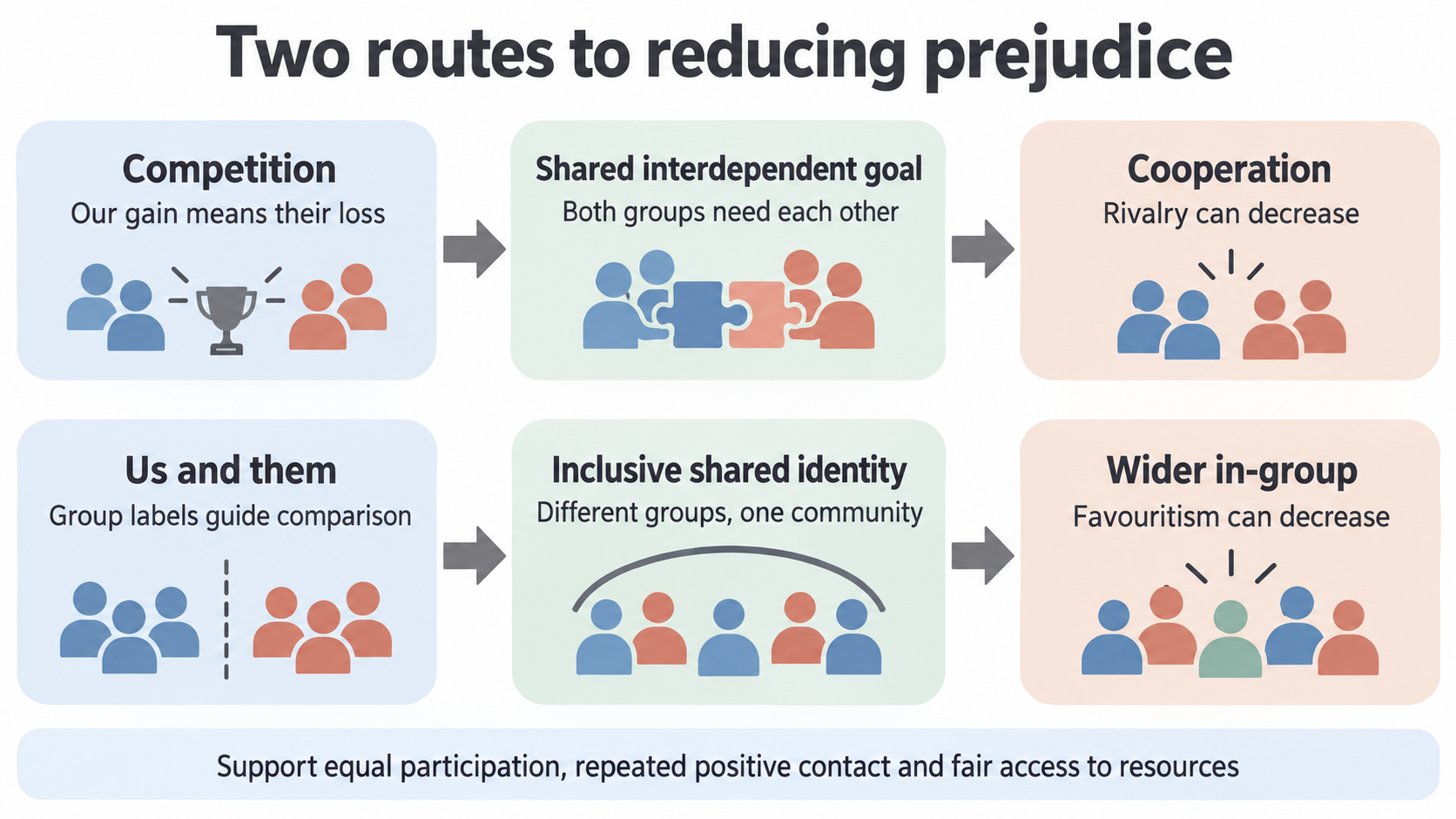
Identity and resource interventions can work together. Fair access addresses a material conflict, while shared membership addresses the meaning of group boundaries. Neither implies that minority groups should tolerate unequal treatment for the sake of harmony.
Making contact useful and measuring change
An intervention needs positive interaction and credible evidence of change, rather than assuming that attendance itself demonstrates reduced prejudice.
Contact is more promising when participants have equal standing in the activity, pursue common goals, cooperate and receive clear support from responsible authorities. At the centre, this means meaningful roles for both groups, a shared outcome, accessible meetings and staff who challenge exclusion. These are facilitative conditions, not a guarantee or a checklist that is always individually necessary. Contact arranged as another contest, or contact in which one group is humiliated, may reinforce negative beliefs.
Supporting evidence extends beyond one camp. Pettigrew and Tropp’s 2006 meta-analysis combined 515 studies with 713 independent samples and found that intergroup contact generally related to lower prejudice. Optimal conditions were associated with greater reduction, but were not essential in every case. The primary research abstract supports that qualified conclusion. Combining studies broadens the evidence base, but varied settings and methods still make local outcomes uncertain. An association in a survey is also open to self-selection: less prejudiced people may seek more contact.
For the hypothetical project, agree outcomes with both groups before starting. An anonymous questionnaire can assess attitudes, but answers may become more socially acceptable without beliefs changing. Invitations, participation rates and experiences of exclusion provide behavioural evidence. Open responses can show whether people feel heard or merely feel pressure to appear grateful. Ask about views of the wider out-group as well as particular partners, because liking one individual need not generalise to the group.
A before-and-after change alone cannot establish that the project caused improvement. Other local events may change relations, and volunteers may already be unusually willing to cooperate. A feasible ethical comparison group or staggered introduction, consistent measures and later follow-up can strengthen the inference. Do not manufacture prejudice, deny fair access or provoke conflict to make an intervention appear effective. Where opportunity cannot be controlled, report the design’s limits honestly.
An evidence-based community response
The key question is best answered by linking the proposed response to the actual source of exclusion and assessing more than one outcome.
At the hypothetical centre, a combined plan would first make booking and decision-making fair, so newcomers are not treated as a threat to a limited resource. It would then invite equal participation in repeated projects with interdependent roles, while recognising a shared community membership and both groups’ contributions. This connects realistic conflict theory to resource relations and social identity theory to categorisation and comparison. It gives a psychological reason for each action rather than simply recommending “education” or “mixing”.
The explanations also give competing predictions. If hostility is closely tied to scarce time slots, improving allocation may matter more than an identity slogan. If favouritism persists despite adequate access, changing the meaning of group boundaries and norms of inclusion may be more relevant. A welcome meeting can create opportunities for contact, but does not by itself solve a resource shortage or establish cooperation. Explaining these alternatives makes the discussion responsive to the social problem.
There are costs and ethical choices. A joint project requires staff time, accessible communication and genuine shared influence. People affected by exclusion must be able to decline research or speak critically without losing access. Presenting every difficulty as a psychological attitude may hide institutional barriers. A respectful intervention therefore combines psychological knowledge with practical fairness and participation by the people it aims to help.
The evidence warrants cautious optimism: group relations are changeable, and theory helps design purposeful opportunities for change. It does not warrant a claim that prejudice will disappear after one event. Judge success through sustained fair participation, attitudes towards the wider group and follow-up accounts from both sides. A defensible answer is that social psychology can contribute to reducing prejudice when interventions change relevant mechanisms and are evaluated in their real setting.