3.1.1 - Neurons and synaptic transmission
Reading a message, remembering a face and stopping an angry response all depend on communication between nerve cells. This lesson explains the central nervous system, how a neuron carries an electrical signal, and how chemical messengers pass information across a synapse. You will see why changing this communication can influence behaviour without giving each chemical a single fixed psychological effect.
The central nervous system and neurons
The central nervous system coordinates information so that a person can detect events, interpret them and respond.
The central nervous system (CNS) consists of the brain and spinal cord. Nerves outside these structures form the peripheral nervous system, which carries information between the CNS and the rest of the body. The brain supports functions such as perception, memory, emotion and planning; the spinal cord carries signals and contains circuits involved in rapid reflex responses. Behaviour depends on connected circuits rather than on one cell working alone.
Neuron
A neuron is a specialised nerve cell that receives and transmits information through electrical and chemical signalling.
A typical neuron has branching dendrites that receive inputs, a cell body containing the nucleus and machinery that keeps the cell functioning, and an axon that carries a signal towards its terminals. These structures have different jobs: receiving a message is different from maintaining the cell or passing the message onwards. Many axons are wrapped in myelin, an insulating layer made by supporting cells. Gaps in the covering are called nodes of Ranvier. At the axon terminals, the cell communicates with another neuron, a muscle or a gland.
Sensory neurons carry information from receptors towards the CNS. Relay neurons, also called interneurons, connect neurons within the CNS. Motor neurons carry information towards effectors such as muscles. For example, recognising a threatening expression involves sensory information, processing by interconnected brain neurons, and potentially motor output. The same general communication principles support a calm response and an aggressive response; the circuits and inputs differ.
Electrical signalling along the axon
An electrical nerve signal is a travelling change in the voltage across a neuron's membrane.
Charged particles called ions are distributed unequally inside and outside the cell. This creates a voltage difference across its membrane. Inputs can change that voltage. If sufficient excitation brings the region where the axon starts to a threshold, a brief electrical event called an action potential is initiated. Sodium channels open, allowing sodium ions to enter and making the inside less negative; potassium movement then helps return the voltage towards its resting state. The changing voltage activates the next region of membrane, so the signal propagates along the axon.
An action potential is all-or-none: reaching threshold produces the event; failing to reach it does not produce a smaller action potential. Stronger stimulation can change how frequently action potentials occur, rather than making each one proportionately larger. A brief refractory period after an action potential limits immediate firing again and helps normal propagation proceed towards the terminals.
Myelin speeds transmission because the action potential is regenerated at the nodes, with rapid spread of electrical change along the insulated regions between them. This is called saltatory conduction. The phrase “the impulse jumps” describes the pattern, not ions flying through the air from one gap to another. Loss of myelin can disrupt the speed and coordination of signals, illustrating why neuron structure matters for functioning.
Electrical transmission along an axon does not mean an electrical current simply jumps across every gap between neurons. At a chemical synapse, the arriving electrical event initiates a different communication process.
An action potential travels along a neuron's axon. At a chemical synapse, its arrival triggers the release of a chemical messenger.
Chemical transmission across a synapse
A chemical synapse allows one neuron to influence another without the two cells forming one continuous wire.
The sending cell is the presynaptic neuron and the receiving cell is the postsynaptic neuron. A narrow synaptic cleft separates them. The presynaptic terminal contains vesicles, small membrane-bound sacs holding neurotransmitters. A neurotransmitter is a chemical messenger released by a neuron that acts on receptors on a target cell.
When an action potential arrives at the terminal, voltage-sensitive calcium channels open. Calcium enters and triggers vesicles to fuse with the presynaptic membrane. Their neurotransmitter is released into the cleft, diffuses across it and binds to matching receptors on the postsynaptic membrane. Receptors are proteins that respond to particular chemicals. Binding changes the receiving cell's activity, for example by changing ion-channel opening. The receptor does not swallow a whole neuron or carry its electrical impulse across the gap.
[DIAGRAM: asset_name: Chemical synaptic transmission; asset_slug: edexcel_9ps0_b01_chemical_synapse; recommended_method: image_gen; description: An arriving action potential initiates calcium entry and vesicle release, neurotransmitter crosses the cleft to postsynaptic receptors, and reuptake or diffusion removes it.; caption: Electrical activity triggers chemical signalling across the synaptic cleft.]
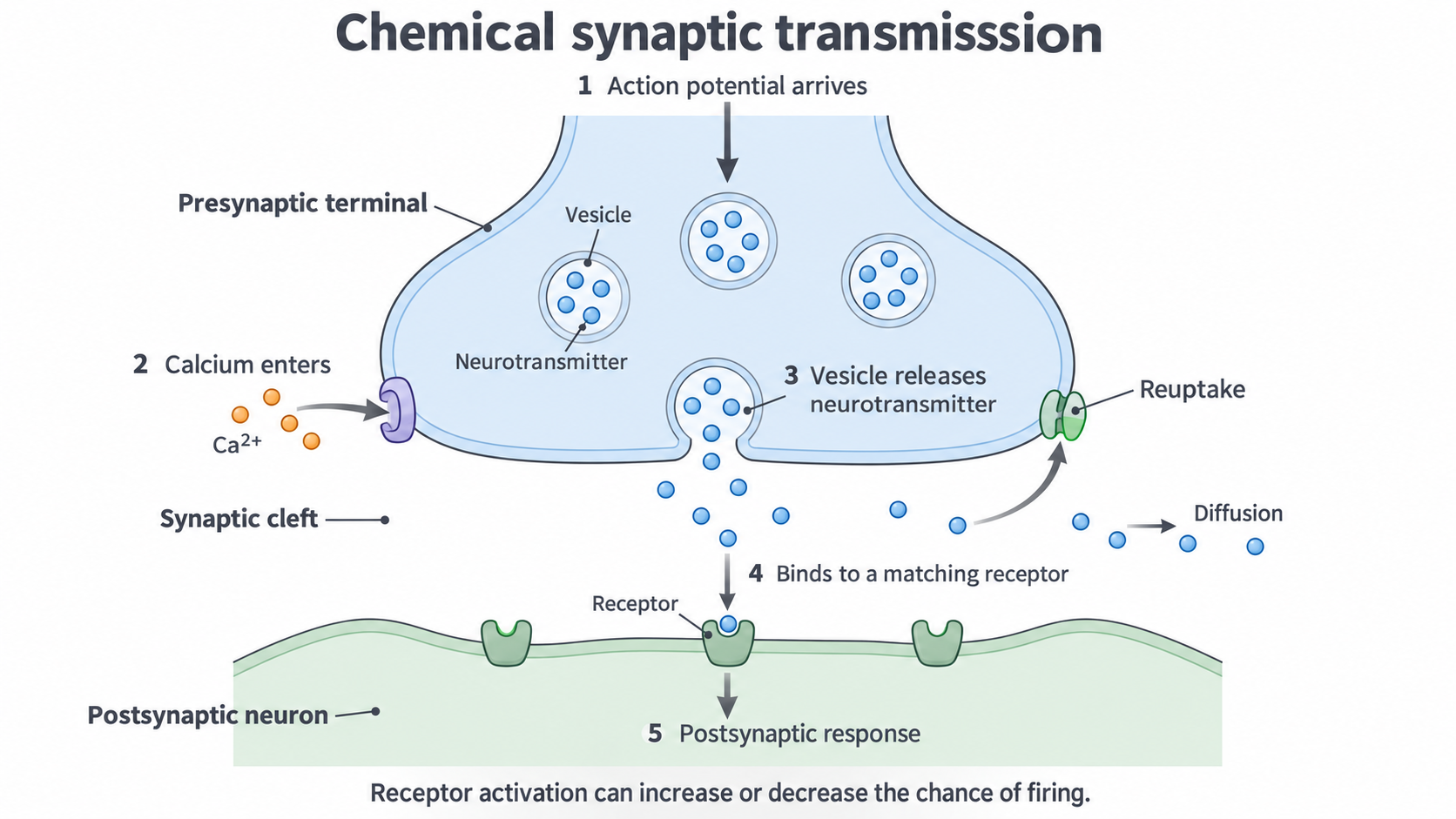
For many transmitters, reuptake through transporters returns molecules to the presynaptic neuron. Other removal processes include diffusion away or enzyme breakdown, depending on the transmitter. For example, acetylcholine is broken down by acetylcholinesterase. Removing a messenger limits how long it acts and allows later signals to remain distinguishable. Receptors and reuptake transporters are different proteins with different functions: one responds to a messenger; the other helps remove it.
The usual direction across this chemical synapse is from the transmitter-releasing terminal to the receptor-bearing cell. Other forms of neural communication exist, but this electrical–chemical–electrical sequence explains the chemical synapses considered here.
From receptor effects to behaviour
The behavioural effect of a neurotransmitter depends on the receptors and circuits through which it acts.
An excitatory effect increases the likelihood that a postsynaptic neuron will fire an action potential; an inhibitory effect reduces that likelihood. A neuron receives many inputs, whose combined effects influence whether threshold is reached. Receptor activation therefore does not guarantee that a new action potential follows. In the CNS, glutamate commonly produces excitation and GABA commonly produces inhibition, but the effect of a chemical must be understood in relation to its receptor and conditions.
Dopamine contributes to processes including movement, motivation and reinforcement learning. Serotonin influences several processes, including mood and the regulation of behaviour. Calling dopamine “the pleasure chemical” or serotonin “the happiness chemical” hides the range of functions and receptor types involved. A chemical is not a personality trait, and its overall amount cannot explain an entire person's behaviour.
Consider a hypothetical circuit involved in withholding an impulsive response. If an inhibitory input to one neuron becomes stronger, that neuron may become less likely to fire. The behavioural consequence then depends on what the neuron normally does. If it normally restrains another part of the circuit, inhibiting it could indirectly increase that other activity. This is why “more inhibition means a calmer person” is an unsafe shortcut.
Synaptic mechanisms offer a testable explanation of how communication changes. Linking them to complex behaviour still requires evidence about the particular circuit, the person's experiences and the situation. A neurotransmitter difference associated with aggression does not, by itself, show that the difference caused aggression or that everybody with it will behave aggressively.