7.1.5, 7.1.8, 7.1.9 - Day care and child development
Learn how day-care experiences may relate to cognitive, social and emotional development, how care quality and individual differences matter, and how research can support balanced conclusions without blaming families or overstating causation.
Day care and developmental outcomes
Day care is regular care outside a child’s usual parental care arrangement, and its developmental meaning depends on what the child experiences there.
Care can occur in a nursery, with a childminder or in another regular arrangement. Research definitions vary: the NICHD programme studied regular nonmaternal care, which could include fathers and relatives as well as centres. Its findings should not automatically be described as effects of nursery attendance alone.
Separate three dimensions. Quantity concerns hours or duration of care. Type concerns the arrangement, such as centre or home-based care. Quality concerns features such as responsiveness, safety, interaction and learning opportunities. A long day in a stable responsive setting and a shorter day with repeated impersonal care are different experiences. “In day care” is therefore too broad a variable to explain every developmental outcome.
Potential advantages include language practice through conversation, cognitive stimulation through varied play, and opportunities to cooperate, share and negotiate with peers. Care may also provide a stable additional relationship and support family employment and resources. These are plausible pathways, not guarantees: placing children together without responsive adult guidance does not automatically teach cooperation.
Potential disadvantages include distress during unfamiliar transitions, difficulty obtaining individual comfort in poorly staffed groups, or conflict where play is inadequately supported. Some research links more hours in care with modestly higher behaviour-problem ratings. A risk association is not proof that all attending children become aggressive. Cognitive, social and emotional outcomes can differ: a setting might be associated with stronger language scores and more reported conflict at the same age.
Quality and proposed developmental pathways
Good-quality care combines conditions that make responsive interaction possible with the responsive interaction itself.
Structural features include staffing, group size, staff training, continuity and a safe suitable environment. A smaller group with sufficient adults can create time to notice distress, converse and guide play. These are enabling conditions, not a complete measure of what adults do. A well-equipped room alone does not show that a child receives comfort or sustained conversation.
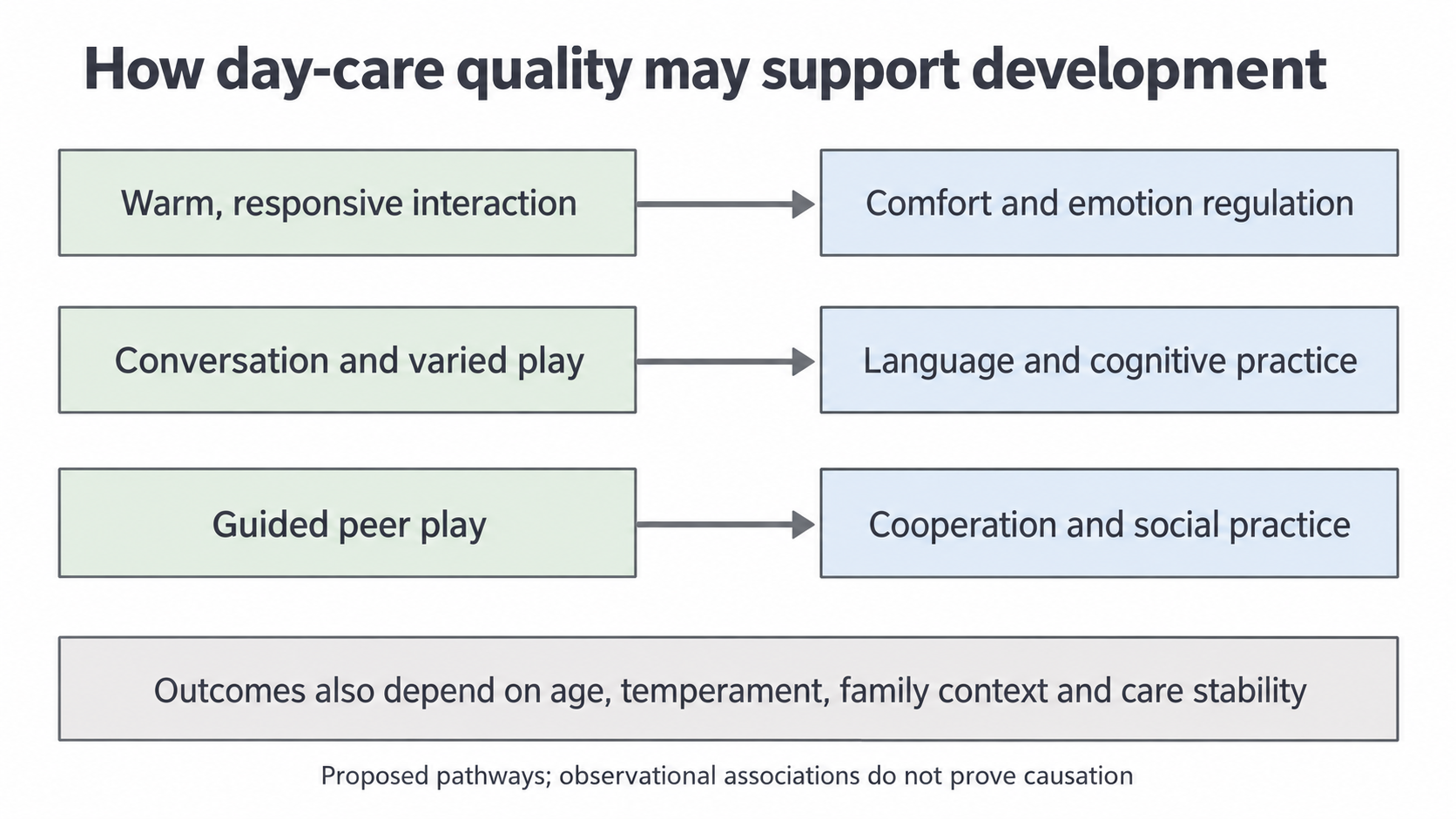
Process quality is the child’s actual experience of interaction. A responsive caregiver notices a child’s cues, responds warmly and appropriately, and adjusts activities to development. A stable caregiver can learn how that child signals tiredness, uncertainty or a wish to join play. Conversation that follows the child’s attention can supply meaningful vocabulary; guided turn taking can give practice in cooperation; help naming feelings can support emotional regulation. These are the mechanisms connecting care to possible developmental outcomes.
[DIAGRAM: asset_name: Day-care quality pathways; asset_slug: edexcel_9ps0_ch05_daycare_quality; recommended_method: image_gen; description: Three proposed routes linking responsive interaction to emotion regulation, conversation and play to language and cognitive practice, and guided peer play to cooperation, with a separate reminder of individual and contextual influences.; caption: Care quality concerns the interactions children experience, and outcomes also depend on the child and wider context.]
Poor-quality care may involve detached or harsh interaction, frequent turnover, limited stimulation or failure to respond when a child needs support. Naming the inadequacy is more useful than calling a whole arrangement “bad”. For instance, instability primarily limits predictable relationships; a lack of varied talk limits language practice. They need not produce identical outcomes.
Familiarisation, predictable routines and communication between home and the care setting can support continuity. A child can maintain a parental attachment while developing relationships with other regular carers. Distress at initial drop-off does not establish permanent attachment disruption, and the absence of crying does not prove the setting is good. Assess care over time and across the actual interactions, rather than judge it from one moment.
NICHD longitudinal evidence
The NICHD Study of Early Child Care and Youth Development examined care experiences alongside child and family characteristics, rather than treating care as the only influence.
The US programme enrolled 1,364 children at ten sites in 1991 and followed development over time. It gathered repeated reports of arrangements and hours, observed caregiving interactions, and assessed development and behaviour using several sources. The sample included varied backgrounds but was not nationally representative. Families chose their arrangements; this was a longitudinal observational study, not random allocation to hours or quality. NICHD’s research programme report
The programme’s research report describes modest associations between higher-quality care and stronger cognitive and language development, with some favourable social outcomes. The 2003 socio-emotional analysis examined behaviour at four and a half and during kindergarten. More time in nonmaternal care was associated with more reported externalising behaviour and adult–child conflict, even after measured care and family characteristics were taken into account. The effects were modest; the vast majority of children’s behaviour ratings remained within the normal range. Family factors were also strongly related to development. Original 2003 article abstract, NICHD’s account of the finding
Continue this lesson.
You’re previewing NovaLearn without an account. Create a free account to read the rest.
Create free account