2.1.1 - The working memory model
Keeping information in mind often means doing something with it: following instructions, understanding a sentence or planning a route. This lesson explains how Baddeley and Hitch’s working memory model accounts for that temporary mental work, and how psychologists use interference between tasks to test the account.
An active system with limited attention
Working memory holds information temporarily available while we use it in thinking and action.
Suppose you calculate the total cost of several items without writing anything down. You retain the prices, add them and keep track of which items you have included. Temporary storage and processing must work together. A single passive store does not tell us much about how those activities are coordinated.
Working memory
A limited-capacity system that temporarily maintains and manipulates information for current tasks.
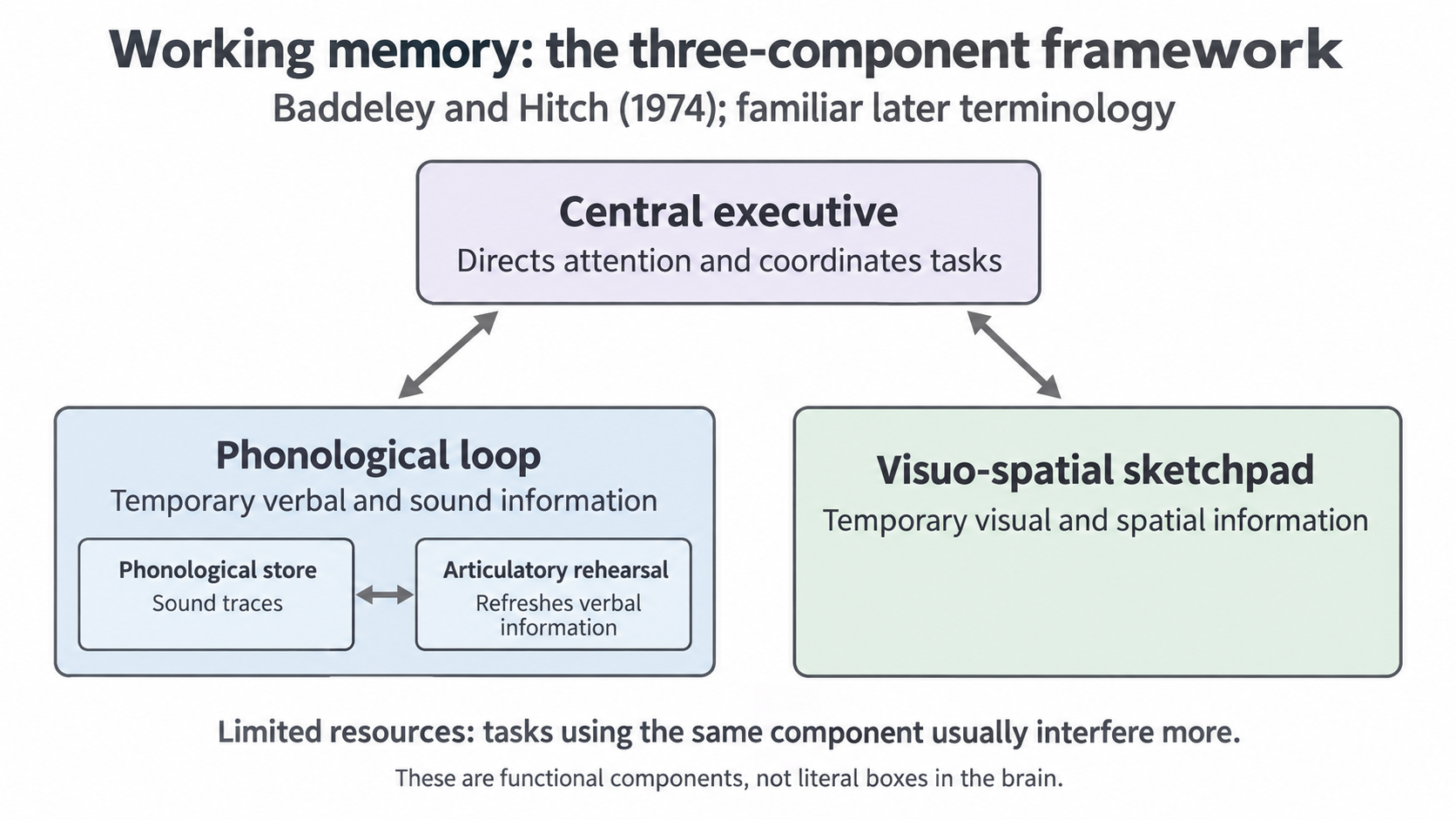
Baddeley and Hitch proposed their model in 1974. Its core distinction is between attentional control and temporary systems for different kinds of information. The central executive directs attention: it selects what matters, coordinates activities and helps switch between tasks. In the developed account it is a control system, rather than the store that holds all words and pictures. Its resources are limited, so coordinating two demanding tasks can itself become difficult.
The phonological loop handles verbal and sound information; the visuo-spatial sketchpad handles visual and spatial information. These familiar names and more detailed subcomponents developed as the framework was refined. The boxes in the model describe functions inferred from evidence. They are not three small physical containers inside the brain.
[DIAGRAM: asset_name: Working memory components; asset_slug: edexcel_9ps0_c01_working_memory_components; recommended_method: image_gen; description: Central executive linked to verbal and visual-spatial temporary systems, with storage and rehearsal shown within the phonological loop.; caption: Attention coordinates partly separate verbal and visual-spatial resources.]
For example, choosing a different route when a corridor is closed requires executive control, while keeping the turning sequence in mind draws on spatial information. Calling every difficulty “poor memory” hides these different demands.
Verbal storage and rehearsal
The phonological loop explains how speech-based information can remain available for a short time.
The developed loop has a phonological store, which briefly holds sound-based traces, and an articulatory rehearsal process, which refreshes information by saying it aloud or silently. Hearing a short instruction gives a sound representation; repeating it to yourself can keep it available. Written words can also be recoded into speech through rehearsal. The way an item is presented therefore does not determine the only system it can use.
A trace is a temporary representation, not a recording we can inspect directly. If several letters sound alike, their sound representations are harder to distinguish in order. This phonological similarity effect helps explain why a spoken list containing similar-sounding items can be harder to repeat correctly than a dissimilar list. It particularly concerns remembering sequence order, rather than proving that every kind of verbal remembering is acoustic.
Articulatory suppression means making a person repeatedly say an irrelevant sound or word during another task. That occupies the speech-based rehearsal process. It can interfere with maintaining a written verbal list because the person cannot easily rehearse the target words. This gives a testable prediction connecting a proposed mechanism to performance.
Do not confuse this account with Baddeley’s 1966 experiments. The 1966b prescribed study concerns acoustic and semantic similarity in learning word sequences and is taught separately. It predates the 1974 model; it is not an experiment conducted to test a model already published in 1974.
Maintaining images and locations
The visuo-spatial sketchpad keeps visual appearance and spatial relationships temporarily available.
Visual information concerns what something looks like, such as a shape or colour. Spatial information concerns locations, distances or movements, such as where a shape was in a grid. You may imagine the arrangement of furniture when deciding whether a desk will fit, or keep a short route in mind while walking. Both involve temporary visual-spatial work, but appearance and location are distinguishable aspects of it.
A task need not use only one component. Remembering a route could involve a mental map, verbal instructions and executive decisions. A person who names each position in a grid may partly convert a spatial task into a verbal one. Predictions therefore concern the processes actually used, not just whether material appears on a screen or is spoken.
The model predicts that remembering a pattern while performing another demanding visual-spatial task will often produce greater interference than remembering the pattern while doing a modest verbal task. The first pair competes for overlapping resources. The second pair distributes some storage demands across systems. Neither pair is guaranteed to be easy: both may still require executive attention.
Separate resources can reduce interference between tasks, but they do not give unlimited multitasking capacity.
Testing the model with two tasks
Dual-task evidence tests whether two activities depend on the same limited resources.
A dual task requires two activities concurrently. Performance is compared with doing each activity alone or with a different secondary task. If all temporary storage and reasoning depended on one store, loading that store heavily should seriously disrupt other activities that need it.
In their research leading to the 1974 model, Baddeley and Hitch used student volunteers in concurrent-task experiments. A secondary task required retention of spoken digit sequences of varying lengths. In one experiment, participants also judged visually presented grammatical statements about letter order. For instance, an illustrative item might ask whether “A comes before B” correctly describes BA. The digit load used temporary verbal storage while the judgement required reasoning. Researchers measured reasoning response time and errors while varying the concurrent load.
Baddeley’s later account reports that heavier digit loads slowed reasoning, but did not cause a collapse in accuracy. Thus the tasks shared some resources, yet reasoning was not entirely dependent on the system measured by digit span. This supported separating executive processing from temporary verbal storage. The research tested more than one cognitive activity; a model should account for the pattern across tasks rather than one isolated result.
There is a useful qualification. Less interference between two different tasks does not, by itself, prove separate stores. One task may simply be easier. A stronger comparison holds instructions and difficulty as constant as possible, measures each task alone, and checks whether an added verbal or visual-spatial load selectively harms the corresponding target task. Strategies also matter: a person could verbalise a visual pattern.
What the model explains and leaves open
The model is useful when it explains selective interference, but each component still needs an independently testable account.
A major strength is its move from “short-term memory is a box” to predictions about the work being done. Sound-based confusion, disruption of rehearsal and dual-task interference can be studied using controlled tasks. Their combined pattern supports distinctions between verbal storage, visual-spatial storage and attentional control more strongly than any one finding alone. The account also suggests a practical application: avoid presenting several competing spoken instructions while a learner is trying to rehearse unfamiliar vocabulary. That is a reasoned prediction, not a promise that a classroom change will help every learner.
There are also limits. Laboratory recall and reasoning tasks isolate processes, but following a real conversation involves knowledge, goals and distraction together. A controlled result may establish a mechanism without establishing how large its effect is in a classroom. The central executive was initially specified broadly. If researchers explain every unexplained difficulty by saying “the executive did it”, they rename the problem instead of explaining it. Particular functions such as switching attention need their own operational measures and evidence.
The original three-component framework also left questions about how different kinds of information become integrated and linked with long-term knowledge. Baddeley added an episodic buffer in 2000: a limited temporary system intended to bind information from different sources into an integrated representation and link it with long-term memory. The buffer is a later extension, not a fourth component proposed in 1974, and it is not the same thing as Tulving’s long-term episodic memory.
Revision is a strength when evidence identifies a specific explanatory gap and a new proposal yields tests. It also reminds us that the diagram is an evolving framework, not a complete explanation of all memory. The defensible judgement is that working memory provides a productive account of temporary storage and processing, with strong testable distinctions, while the precise nature of executive control and integration remains a research question.