3.1.4, 3.1.6, 3.1.8 - Evolution, hormones and aggression
Evolutionary explanations ask why capacities for particular behaviours could have persisted across generations; hormonal explanations ask how chemical signals influence a developing and functioning person. This lesson connects natural selection and aggression in 3.1.4, hormonal influences in 3.1.6, and the developmental roles of both in 3.1.8. It separates these levels of explanation and examines evidence that challenges simple claims about testosterone and violence.
How natural selection changes populations
Natural selection explains how inherited characteristics can become more or less common across generations.
Individuals within a population vary. Some of that variation is heritable, meaning differences can be transmitted through genetic inheritance. In a particular environment, some characteristics can contribute to surviving and reproducing more successfully. If their carriers leave more surviving offspring, associated inherited variants may become more common over generations. This process is natural selection. The relevant outcome is reproductive success, not simply being the strongest person.
Adaptation
An adaptation is an inherited characteristic shaped by selection because it contributed to survival or reproduction in relevant ancestral conditions. A behaviour being useful today is not, by itself, evidence that it is an adaptation.
Selection does not occur because a population decides what it needs. Nor does an individual evolve a new inherited trait by practising it during their lifetime. Learning and maturation change an individual; evolution changes populations across generations. Sexual selection is selection relating to success in obtaining mates, including competition or mate choice. It is a form of selection, rather than an alternative to inheritance.
Behaviour is more complex than a single characteristic such as coat colour. Genes can influence development of neural systems, sensitivities and capacities for learning; environments influence how those capacities develop and are expressed. A heritable tendency is not a gene that issues a fixed command to perform one action. An evolved capacity to respond flexibly can itself be valuable because circumstances vary.
Consider a hypothetical ancestral setting in which some individuals respond effectively to threats to their resources. If an inherited capacity contributing to that response increased reproductive success, it could become more common. This illustration explains the selection mechanism. It does not establish that a particular modern aggressive behaviour actually arose in that way.
Evolutionary explanations of aggression
An evolutionary account considers circumstances in which aggressive responses could have had benefits as well as costs.
Aggression could sometimes have helped defend resources, protect offspring or compete for mating opportunities. For example, a capacity for responding to an immediate threat might have helped an individual protect dependants. These are proposed functions: the evolutionary claim is that capacities contributing to successful responses could have been favoured through differential reproduction. It is not that people consciously calculate genetic success before behaving aggressively.
Aggression also carries costs: injury, retaliation, expulsion or damage to cooperation can reduce survival and reproductive opportunities. Selection therefore need not favour constant aggression. A conditional tendency, responsive to the seriousness of a threat and available alternatives, can be a more plausible proposal. Cooperation and restraint can also be advantageous. Differences in opportunities and social arrangements can alter when aggression is expressed.
An evolutionary explanation should generate predictions that distinguish it from alternatives. If defence of offspring is the proposed function, the circumstances of threat and who is being protected should matter. Merely observing aggression and inventing an ancestral benefit afterwards risks an untestable story. Researchers can compare patterns across contexts and populations, examine development and investigate inherited influences. An observed modern pattern can nevertheless reflect learning, current inequality or several interacting causes; it does not directly reveal ancestral reproductive outcomes.
Neither an evolutionary origin nor a biological influence morally justifies harming others. An explanation of a capacity is different from a recommendation about how to use it. A claim about an average group pattern also cannot predict every individual or establish that one sex or culture is naturally violent.
An evolutionary account needs inherited variation, differential reproduction and evidence for a proposed function. “Aggression was useful” alone is an incomplete explanation.
The defensible judgement is that evolutionary theory can explain why capacities for threat response and competition exist, while particular adaptation claims require evidence and consideration of costs and alternative explanations. Learning and social context help explain when a capacity is expressed.
Hormonal influences on behaviour
Hormones influence behaviour by changing the functioning of target cells and interacting with neural systems.
Hormones are chemical messengers released by endocrine glands into the bloodstream. They circulate through the body, but cells respond only when they have the relevant receptors. This differs from the local release of a neurotransmitter across a synaptic cleft. Hormonal signals can influence brain functioning and therefore processes such as motivation, arousal or sensitivity to social events.
Testosterone is an androgen, a class of steroid hormones. It is present in people of all sexes, with differing concentrations and patterns of production. The testes are a major source; the ovaries and adrenal pathways also contribute. Testosterone acts through receptors and can affect cell functioning, including gene expression. It is involved in development and adult functioning, rather than being a substance whose only purpose is aggression.
A hormonal explanation proposes that testosterone can influence responses to challenge, competition or perceived status threats. Under some conditions this may increase aggressive responding; under others, status may be gained by generosity or cooperation. The social situation matters to the behavioural result. Hormone concentrations also fluctuate, so a single measurement is not a permanent label attached to a person.
Other hormonal systems matter. For example, cortisol is involved in stress responses. A response to a confrontation occurs within interacting hormonal and neural systems, not a testosterone-only system. Considering this interaction helps avoid reducing every aggressive action to one blood measurement.
Judging evidence about testosterone and aggression
Research supports a qualified hormonal influence more convincingly than a claim that testosterone inevitably causes violence.
Geniole et al. (2020) brought together studies of baseline testosterone, changes in testosterone and experimentally manipulated testosterone. Baseline levels showed a weak overall association with aggression; pooled experimental effects on aggression were not statistically significant. This does not prove that testosterone never matters. It shows that a strong universal causal claim is not supported by this pooled evidence and that measurement and context require attention.
An association between naturally measured testosterone and aggression allows several explanations. Testosterone might influence responding; competition or an aggressive interaction might alter testosterone; or a third factor might influence both. If measurements are taken after a competitive event, their timing is particularly important. Statistical association alone does not identify the direction of causation.
Dreher et al. (2016) used random assignment and a double-blind testosterone-or-placebo manipulation in healthy young men. Participants played a bargaining game with opportunities to punish or reward an offer-maker. Testosterone treatment increased punishment in response to unfair offers but also increased rewarding behaviour following generous offers. This provides evidence for a contextual influence, while a game decision is not equivalent to real-world physical violence. The restricted sample and pharmacological manipulation also limit generalisation.
Manipulation helps test causation because random assignment reduces systematic pre-existing group differences and a placebo comparison helps separate the hormone's action from other features of taking part. It does not make every result universal. The exact outcome, participants, manipulation and situation determine what can be concluded. Laboratory endocrine studies require specialist ethical and medical oversight; these are research evidence to interpret, not learner experiments to repeat.
The reasoned conclusion is that testosterone can influence social responding, but effects are often weak, conditional or different across contexts. Biological influences are compatible with generosity as well as aggression. Predicting an individual's behaviour from sex or one hormone reading is not warranted.
Evolution and hormones in human development
Evolution helps explain developmental capacities, while hormones help explain processes that change within a developing individual.
Humans undergo a prolonged period of dependence, learning and maturation. An evolutionary account asks how developmental characteristics, such as capacities to learn from caregivers and adjust to local circumstances, could have helped ancestors survive and reproduce. It concerns why such capacities and patterns persisted across generations. A developmental account asks how they unfold in a particular person through maturation and experience. Learning a social rule during childhood is therefore not the same event as the evolutionary origin of the capacity to learn rules.
[DIAGRAM: asset_name: Two timescales of biological explanation; asset_slug: edexcel_9ps0_b04_biological_timescales; recommended_method: image_gen; description: Separate columns contrast inherited population change through selection across generations with hormone-related development and experience within an individual.; caption: Population evolution and individual development answer different questions on different timescales.]
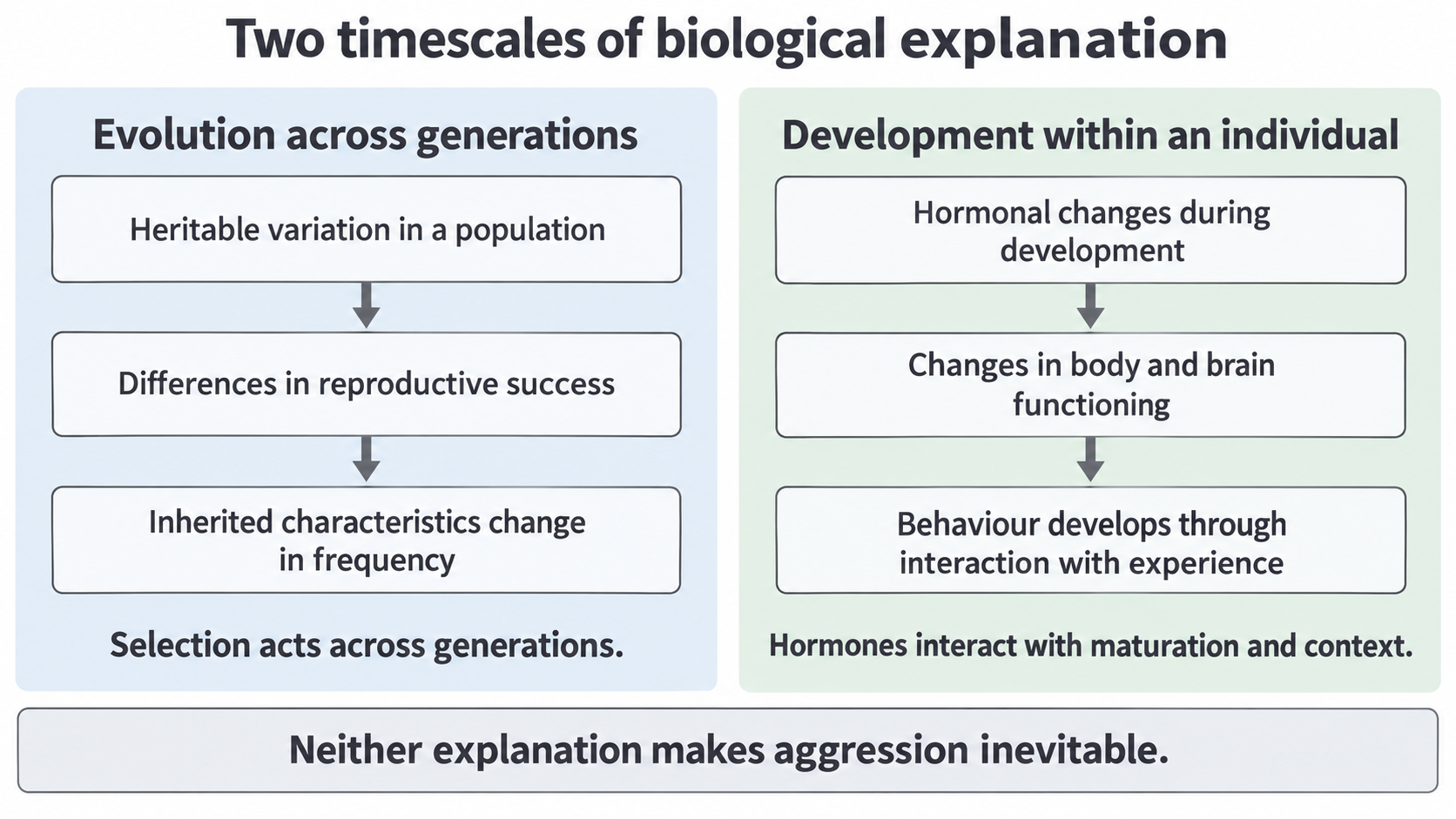
Hormonal influences operate at different times. During early development, hormones can help organise developing body and brain systems. Later changes can activate or modify the functioning of established systems. At puberty, changes involving the hypothalamus, pituitary and gonads increase sex-hormone activity and contribute to physical maturation. Testosterone and oestradiol contribute to this development. Hormonal changes can also interact with changes in motivation, social priorities and neural functioning.
Puberty does not prove that teenagers inevitably become aggressive. Regulation continues developing, experience changes and peer or family circumstances vary. The age and pace of hormonal change differ between individuals, and the same developmental transition occurs in different environments. A rise in hormones and a behavioural change at a similar age can be associated without hormones being the only cause.
Consider a hypothetical young person whose competitive opportunities and peer expectations change during puberty. A hormonal sensitivity to social challenge might interact with those opportunities. Respect earned through cooperation may encourage different responding from a setting that rewards intimidation. The illustration combines biological development with learning and context; it does not assign a fixed personality to the young person.
Evolutionary and hormonal explanations thus address complementary questions. Evolved developmental capacities provide possibilities; hormones contribute to their organisation and functioning; experiences influence how those possibilities become actual behaviour. Good explanations distinguish these timescales and preserve individual variation.