4.1.11, 4.3.4 - Phobia treatments and Capafóns
A learned fear can change through new experiences. This lesson explains systematic desensitisation and flooding, then examines what Capafóns and colleagues' fear-of-flying study actually shows about treatment effectiveness.
Systematic desensitisation and new associations
Systematic desensitisation changes the person's response to a feared stimulus through gradual exposure paired with relaxation.
In a conditioning account, a previously harmless stimulus becomes a conditioned stimulus that elicits fear. Avoiding it brings immediate relief, so negative reinforcement can maintain avoidance. Treatment therefore needs opportunities to encounter the stimulus and learn a different response, rather than repeated opportunities to escape it.
Systematic desensitisation
A behavioural treatment in which a person learns relaxation, constructs an ordered fear hierarchy and gradually encounters feared situations while practising relaxation.
First, a therapist teaches skills such as controlled breathing and progressive muscle relaxation. The person then helps construct a fear hierarchy, an individual ordering from less to more anxiety-provoking situations. For a flying fear, looking at an airport photograph might come before approaching the airport, boarding and take-off. This is an illustrative hierarchy: another person's fears could be ordered differently.
Exposure begins at a manageable step, in imagination or in a safe real situation. The person practises relaxation and progresses as that step becomes manageable. Counterconditioning means learning a new response to the stimulus; the traditional explanation is that a relaxed response competes with anxiety. Reciprocal inhibition is the idea that the incompatible relaxed response inhibits the anxious response. These explain the design of classical systematic desensitisation; they do not establish that relaxation alone is the only mechanism that makes exposure work.
Gradual progression gives the person control and can make treatment more acceptable. It requires time, practice and an appropriate hierarchy. Imagined situations can be practical when repeated real flights are costly, but improvement in imagination must transfer to real travel. Individual suitability and consent remain necessary.
Flooding and sustained exposure
Flooding starts with an intense feared situation rather than working gradually through a hierarchy.
In a professionally agreed treatment, a person remains in prolonged contact with a safe feared stimulus without the predicted harmful outcome. Exposure can be real or imagined. The traditional learning explanation is extinction: the conditioned stimulus occurs without the frightening unconditioned stimulus, so the conditioned fear response weakens. Anxiety may reduce during exposure through habituation, a reduction in responding to repeated stimulation. Avoidance is reduced, so immediate escape relief no longer repeatedly reinforces that avoidance.
The important learning is not that the person must be too exhausted to feel afraid. A further account is that exposure creates a competing memory: the feared situation can be encountered without catastrophe. The earlier association can remain, helping explain why fear can return in a different setting or after time has passed. Successful exposure is therefore not proof that the original fear memory has been permanently erased.
[DIAGRAM: asset_name: Two phobia-treatment pathways; asset_slug: edexcel_9ps0_l06_treatment_pathways; recommended_method: image_gen; description: Separate left-to-right pathways compare relaxation and graded hierarchy exposure in systematic desensitisation with agreed intense sustained exposure in flooding.; caption: Systematic desensitisation progresses gradually with relaxation; flooding begins with intense exposure. Both depend on consent and safe supervision.]
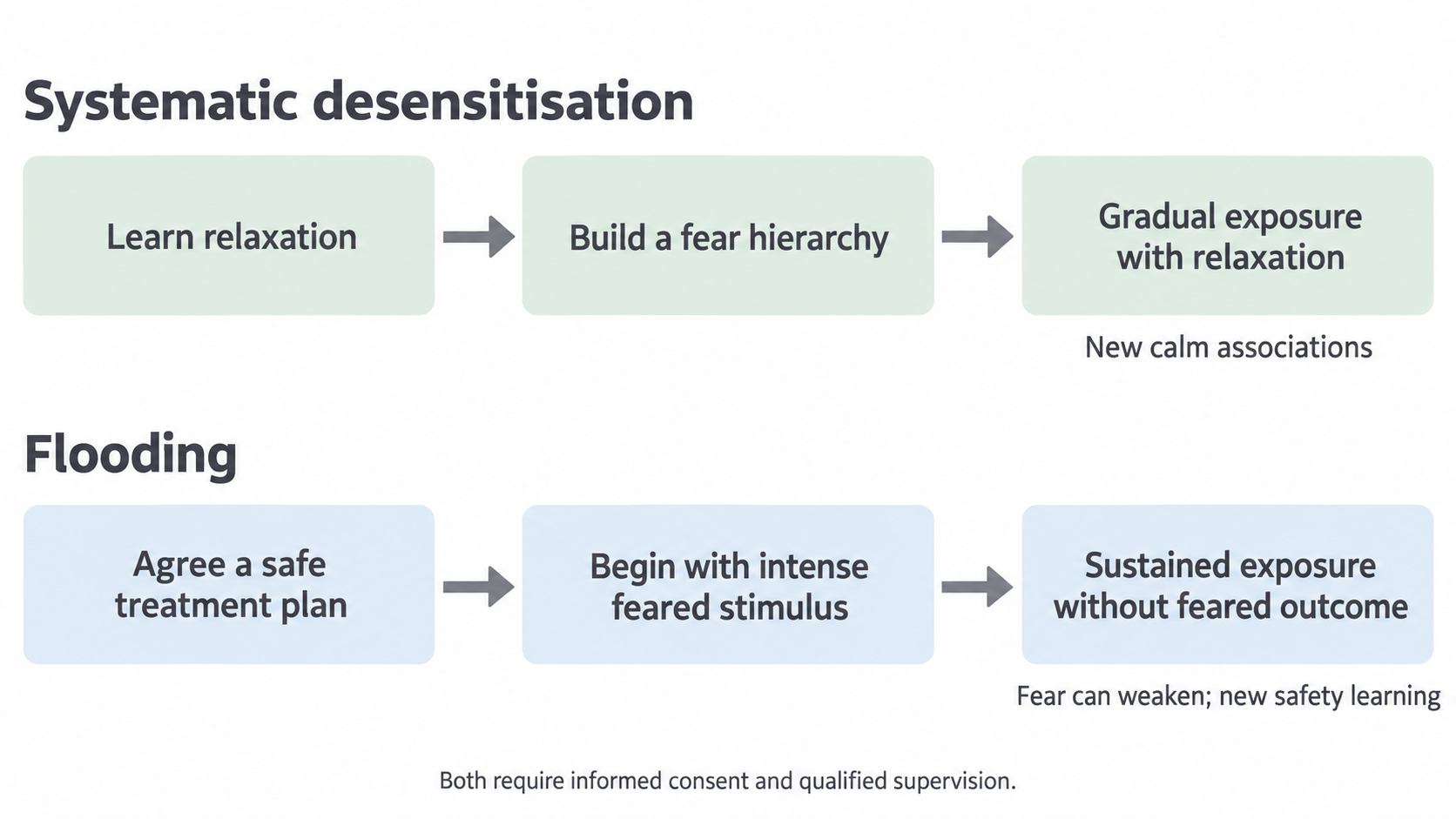
Flooding can avoid spending many sessions on smaller hierarchy steps. However, intense anxiety can make it unacceptable or lead a person to discontinue it. A session count alone does not establish effectiveness or value for money. If exposure ends in immediate escape, relief may reinforce avoidance again. This is a reason for careful planning and support, never a reason to physically prevent withdrawal. Informed consent includes the right to stop; clinical suitability and risk require qualified assessment. Neither treatment is a classroom experiment or a demand that students confront personal fears.
There is evidence for both treatments rather than a universal winner. De Moor's 1970 publisher abstract reports 27 people with severe snake fears in three matched groups: five sessions of systematic desensitisation, five of flooding or a control condition. Both treatments improved more than control; three flooding improvers relapsed at the six-month follow-up, whereas the desensitisation improvement was stable. This small, specific study supports possible benefit and the need to assess durability. It cannot decide which treatment suits every phobia. Capafóns' study below tests a desensitisation programme, not flooding, so it cannot establish that flooding is inferior.
Capafóns' treatment study and measurements
Capafóns, Sosa and Avero investigated whether a structured desensitisation programme could reduce fear of flying compared with waiting for treatment.
Continue this lesson.
You’re previewing NovaLearn without an account. Create a free account to read the rest.
Create free account