2.2.13 - Henry Molaison and memory evidence
Learn how the intensive study of Henry Molaison, historically called H.M., helped distinguish memory abilities. Examine qualitative and quantitative evidence, the strengths and limitations of a brain-damaged-patient case study, and the ethical responsibilities created by profound memory impairment.
History and the case-study method
Henry Molaison’s case arose from treatment for epilepsy rather than an experiment in which researchers randomly assigned brain damage.
In 1953, at age 27, he underwent bilateral medial temporal-lobe surgery intended to reduce severe seizures that medication had not controlled. The operation affected hippocampal tissue and surrounding structures. His seizures became less incapacitating, but he developed profound difficulty forming new lasting memories. Calling this “removal of the whole hippocampus” is too simple: the lesion involved several structures, and later imaging and post-mortem work refined the anatomy. The operation was a clinical intervention; it is not an ethical memory practical for students to reproduce.
Case study
An intensive investigation of a particular person, group or event using one or more sources of evidence.
Scoville and Milner’s 1957 report included ten surgical cases with different degrees of memory impairment; H.M. was one of them. His subsequent research history extended over decades and used interviews, behavioural observations, standardised cognitive tests, skill-learning tasks and later brain imaging. A case study is therefore a research strategy, not necessarily a single interview or exclusively qualitative data. Repeated testing of the same person can show persistence and distinguish abilities that a group average might conceal.
The approach is especially valuable where the condition is rare and cannot be ethically produced. It also requires caution: a detailed observation of one patient is not a randomised comparison of hippocampal damage with no damage. His prior seizures, medication, other affected tissue and individual history are relevant alternatives when interpreting the relationship between surgery and memory.
Qualitative and quantitative evidence
The case combined descriptions of everyday difficulties with numerical comparisons of cognitive abilities.
Qualitative evidence describes experiences or behaviour in words. In the 1957 psychological examination, H.M. did not remember a conversation with a doctor that had occurred just before entering the testing room. Once a new task began, he could not recall the preceding task. These observations reveal the real consequences of memory loss: information could seem new again moments later. They are richer than a single score but depend on observation, interpretation and careful recording. An observer’s expectation could influence which incidents are recorded or how they are described.
Quantitative evidence gives numerical results. The report gives a post-operative intelligence quotient of 112 and a Wechsler memory quotient of 67. These are scores on different standardised scales, not percentages of his brain or a direct measurement of memory “remaining”. The contrast showed that marked memory impairment could coexist with good measured general intelligence. On an associative-learning task, hard word associations produced zero scores and repeated practice did not bring normal learning. Standardised tasks make comparison possible, though each score still measures particular task demands.
Brief retention must be distinguished from remembering a story or establishing a lasting event. Patients in the report’s severe-memory group could retain a three-digit number or two unrelated words for minutes when attention was not diverted, but lost them after distraction. H.M.’s poor performance on stories does not mean he could retain no information for even a second. The combination of short-term retention under maintained attention and severe anterograde amnesia supports a distinction between temporarily holding information and forming new enduring declarative memories.
Anterograde and retrograde amnesia
Anterograde amnesia is difficulty forming new lasting memories after the onset of impairment. Retrograde amnesia is loss of memories acquired before it.
The early report also described partial retrograde loss for the years near the operation, with much earlier memories apparently preserved. It did not show that every pre-operative event remained perfectly available. Combining observations, tests and lesion evidence is triangulation: agreement between different measures can strengthen an interpretation, while disagreement can reveal that “memory” contains different demands.
Preserved abilities and memory systems
H.M.’s ability to acquire a skill despite not remembering the practice showed that lasting learning is not one undifferentiated ability.
In later work reported by Milner, H.M. traced a double-contour star while seeing his hand and the star only in a mirror. This reverses ordinary visual guidance and initially makes accurate tracing difficult. Across practice and testing over three days he improved and retained the skill, yet did not remember having done the task. The historical account is summarised by researcher Larry Squire in The Legacy of Patient H.M. for Neuroscience. This later skill-learning evidence must not be attributed to a mirror-drawing test in the 1957 report.
[DIAGRAM: asset_name: HM memory dissociations; asset_slug: edexcel_9ps0_c07_hm_dissociations; recommended_method: image_gen; description: Three separate rows contrast retained immediate memory, severely impaired new declarative memories and skill learning that improves with practice.; caption: H.M.’s different memory abilities support distinct systems rather than total loss of all memory.]
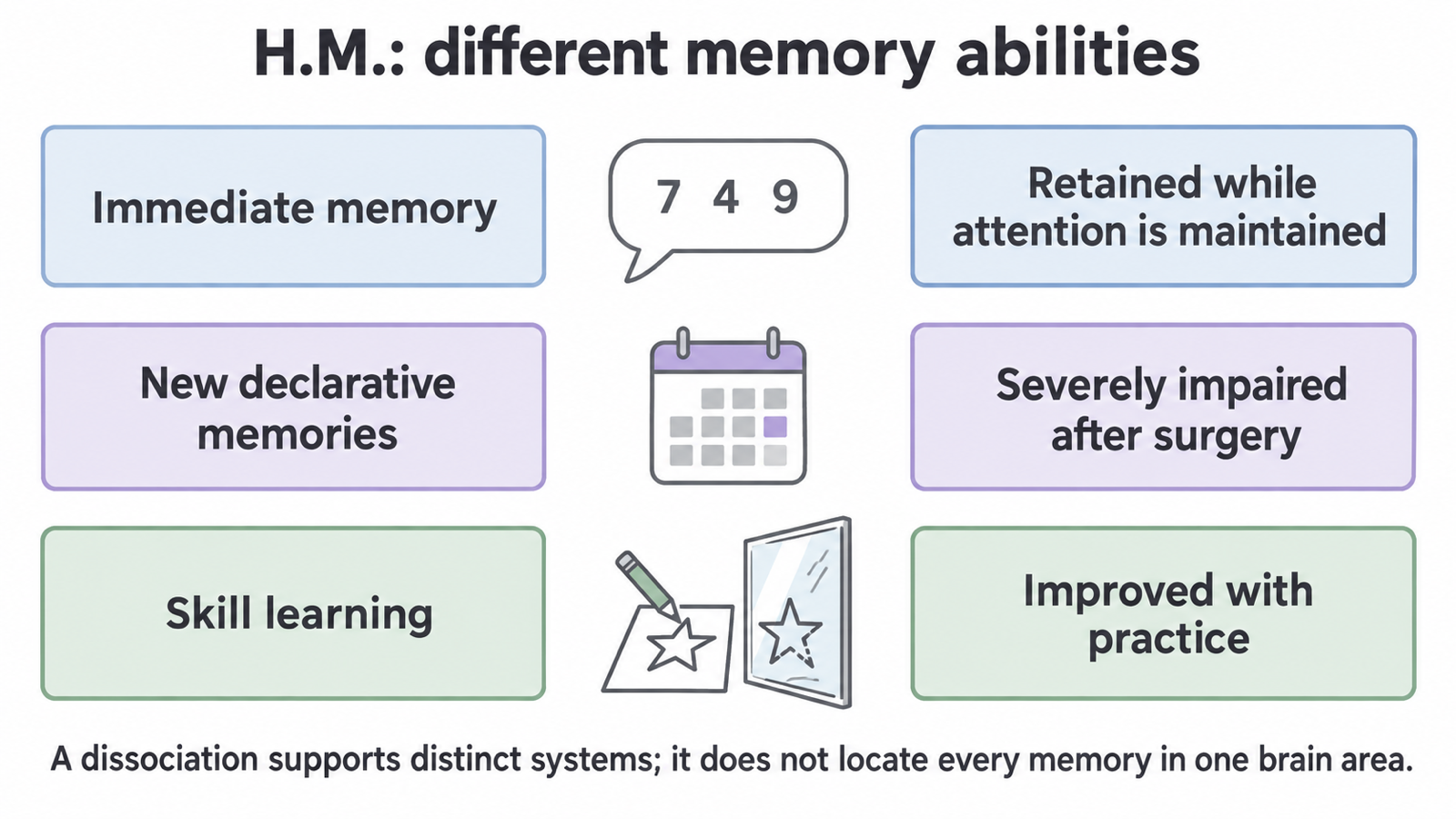
Declarative memory concerns facts and events that can be consciously reported. Procedural learning includes acquiring skills expressed in performance. Improvement on the tracing task is evidence of learning even without conscious recollection of the learning episodes. A dissociation occurs when one ability is impaired while another is relatively preserved. This supports distinct memory processes and challenges treating all LTM as one store with identical properties.
The pattern suggests a crucial role for the medial temporal region in establishing new declarative memories, while some skill learning can depend on other systems. It does not mean the hippocampus stores all memories, that it is irrelevant to every short-term demand, or that tracing alone maps every memory system. A memory model should explain both loss and preservation. H.M.’s case informed later work with additional patients and other methods, rather than providing a complete theory by itself.
Inference and ethical responsibility
The depth of a case study strengthens some conclusions while leaving causal and ethical questions that cannot be settled by detail alone.
Repeated measures over time showed that the severe impairment persisted; multiple tasks clarified what was preserved. The selective pattern is difficult to explain as a general loss of motivation or intelligence. Evidence from other lesion cases can increase confidence beyond this one individual. Nevertheless, the exact case cannot be replicated, there was no random assignment to surgery, and damage involved more than one brain structure. A claim that one structure alone caused every deficit would ignore these limitations. The strongest generalisation concerns a supported mechanism or distinction, tested against other evidence, rather than a claim that all patients have the same scores or life experience.
Confidentiality matters because richly described cases can become identifiable even without a name. Researchers referred to him as H.M. during his lifetime; the full name became public after his death in 2008. That history illustrates protection of identity, not proof that initials alone always guarantee anonymity. Reports should minimise unnecessary identifying details and protect records. Respectful language recognises his contribution and avoids reducing a person to a deficit.
Profound anterograde amnesia complicates informed consent: a participant may understand information at the time but fail to retain it later. Ethical research therefore requires appropriate assessment of decision-making capacity, repeated accessible explanations, assent and attention to dissent, and legally appropriate representative involvement where required. Researchers must monitor fatigue or distress, permit withdrawal, and avoid assuming willingness in one session is permanent agreement. These are safeguards to evaluate research, not claims that every historical session followed modern procedures.
A rare case can reveal a powerful dissociation. Support the inference with converging evidence, keep anatomical claims bounded, and maintain the person’s dignity and consent throughout research.