5.1.3, 5.1.5 - Non-biological schizophrenia account
The selected non-biological account explains schizophrenia through difficulties in cognitive processing, especially monitoring the source of one's own experiences. For 5.1.3 you will connect the proposed mechanism to symptoms and evidence; for 5.1.5 you will consider how culture and experience can shape interpretation and individual differences.
Self-monitoring and source attribution
A cognitive explanation asks how information is processed and interpreted, rather than treating a symptom only as a biological difference.
Self-monitoring concerns tracking one's own mental events and actions. Source monitoring concerns judging where an experience came from: for example, whether a remembered statement was heard from someone else or generated internally. These processes usually help a person recognise the difference between their own inner speech and another person's voice.
Frith's cognitive account proposes that impaired monitoring can weaken this distinction. If an internally generated event is not recognised as self-generated, it may be attributed to an external source. This provides a possible mechanism for an auditory verbal hallucination. If a thought is experienced as originating from an outside agent, the account can also help explain thought insertion or experiences of alien control. These are hypotheses about processing, not evidence that an outside agent is actually controlling the person.
[DIAGRAM: asset_name: Cognitive self-monitoring account; asset_slug: edexcel_9ps0_cl05_self_monitoring; recommended_method: image_gen; description: Usual monitoring recognises inner speech as one's own thought. A proposed monitoring difficulty misattributes its source and may lead to the experience of an external voice.; caption: Source misattribution is one proposed mechanism for some experiences, not a diagnostic test.]
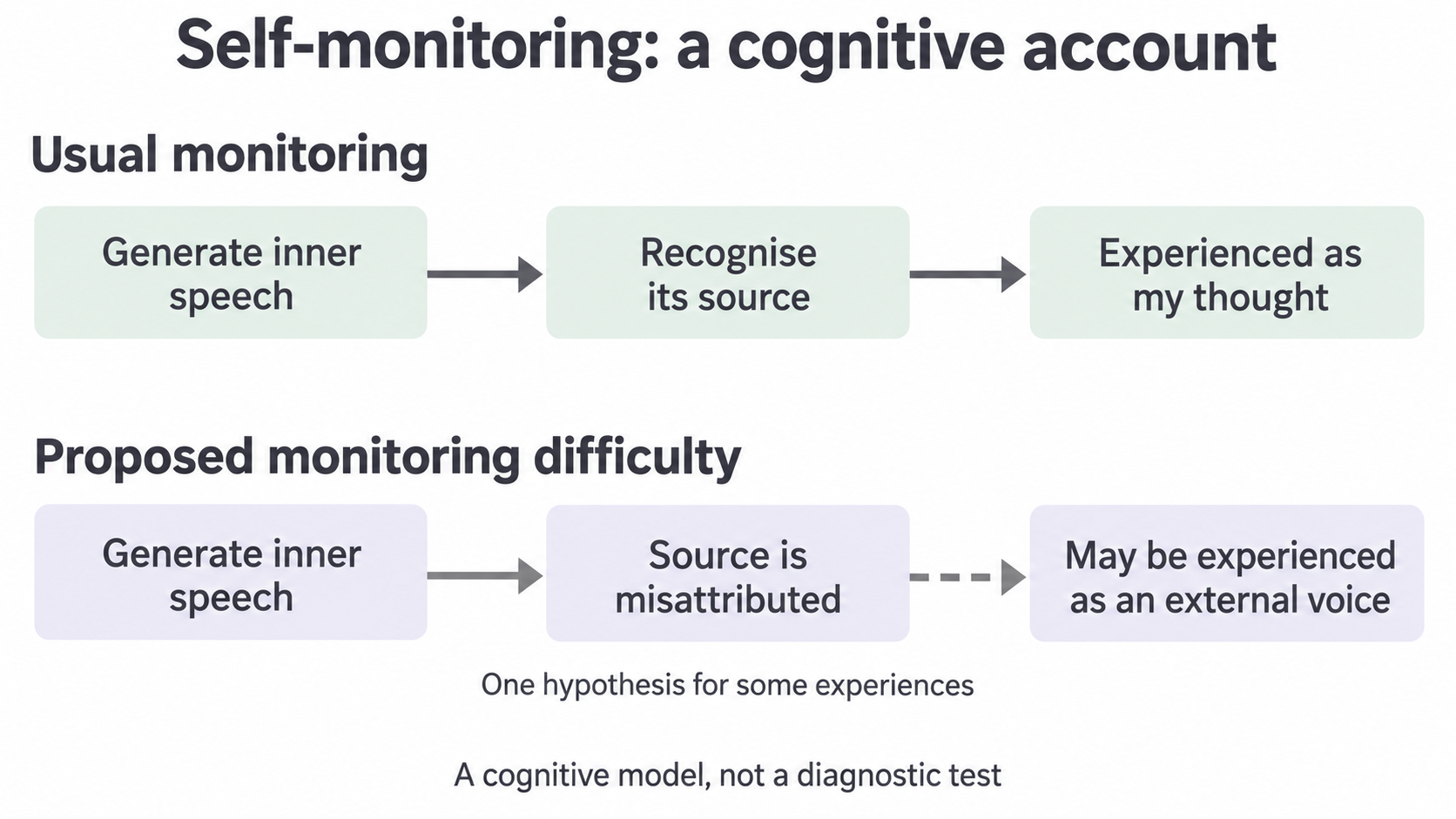
The account does not mean that an unwanted thought is automatically a hallucination. Someone can dislike an intrusive thought while recognising it as their own. The proposed difficulty concerns how origin or agency is attributed. Nor must every hallucination be ordinary inner speech: the model needs evidence about which experiences it explains and which require other mechanisms. Frith and Done's original theoretical paper and the source-monitoring study by Keefe et al. identify this cognitive question.
Culture, experience and interpretation
The meaning assigned to an unusual experience can be shaped by previous experience, cultural expectations and the person's circumstances.
An external attribution alone does not explain the content or emotional impact of a voice. Expectations about agency, threat and relationships can affect how the experience is interpreted. In a fictional illustration, two people might interpret a voice respectively as a hostile intrusion or as familiar guidance. This can change the reported meaning and distress without showing that their underlying experiences or biological vulnerabilities are identical. It is an application of the cognitive account, not a rule about any cultural group.
Luhrmann and colleagues' 2015 interview study compared voice-hearing experiences among people who met schizophrenia inclusion criteria in the USA, India and Ghana. Each local sample contained 20 people. US participants were more likely to report violent commands and use diagnostic labels; participants in India and Ghana more often reported rich relationships with voices. The authors suggested that local culture shapes experience. Original study abstract.
The study supports investigating cultural meanings rather than assuming one universal pattern. However, these were small local samples, not representative descriptions of whole countries. Interviews cannot isolate culture from differences in participants, services, language or other experiences. A difference in reported voices also does not establish a difference in the prevalence or cause of schizophrenia.
Culture can affect diagnosis as well as symptom interpretation. A practitioner who mistakes a culturally shared belief for a delusion may apply a category inaccurately; practitioners with different cultural assumptions may disagree. The appropriate response is to explore the individual's meaning and functioning. No explanation here makes families, communities or the person responsible for causing the disorder.
Continue this lesson.
You’re previewing NovaLearn without an account. Create a free account to read the rest.
Create free account