8.1.3, 8.1.6, 8.1.7 - Learning and individual addiction risk
Use conditioning and social learning to explain alcohol, heroin and nicotine use, then consider how personality, biological differences, development and cultural environments alter risk. Distinguish plausible mechanisms from evidence that a particular influence caused drug misuse.
Reinforcement for each drug
Operant conditioning explains how consequences can make drug-taking behaviour more likely to recur.
Positive reinforcement occurs when an action is strengthened by adding a rewarding consequence. Negative reinforcement occurs when an action is strengthened by removing an unpleasant state. Both increase behaviour; neither definition refers to whether the behaviour is socially desirable. Negative reinforcement is not punishment, which reduces behaviour.
For alcohol, drinking may initially produce enjoyable feelings or rewarding social experiences. If these follow drinking and increase its repetition, they positively reinforce it. During dependence, drinking may relieve withdrawal discomfort; this negatively reinforces further drinking. Short-term relief can maintain a pattern despite serious delayed costs.
For heroin, intense rewarding effects can positively reinforce drug taking. Once physical dependence develops, relief of withdrawal pain and distress can negatively reinforce use. The learned action is strengthened because of its immediate consequence; this does not require a conscious decision that the long-term harm is worthwhile.
For nicotine, nicotine's effects and social rewards can positively reinforce smoking. After dependence develops, a cigarette may relieve craving and irritability, negatively reinforcing the smoking action. Repeated brief episodes can create strongly practised routines. The same learning principles can therefore explain all three drugs while their biological effects and social settings differ.
These are mechanisms, not universal histories: a person need not experience every consequence in this sequence. To demonstrate reinforcement, we need evidence that the consequence increases the behaviour, not simply that an experience was described as pleasant.
Conditioned drug cues
Classical conditioning explains why places, objects or situations can evoke drug-related responses before a drug is taken.
Initially a cue, such as a particular room, may be neutral with respect to craving. Repeated pairing with drug effects can make it a conditioned stimulus. Later the cue alone can evoke a conditioned response, such as craving or physiological preparation for the drug. Alcohol-related responses can be associated with a pub or a familiar glass; heroin-related responses with a location or associated equipment; nicotine-related responses with a coffee break or meeting particular friends. The pairing history, rather than the object itself, explains its significance.
Craving can then prompt drug taking, whose consequences further reinforce the action. Classical and operant conditioning therefore answer different questions: why does a cue evoke a response, and why does an action become more frequent? An association between a coffee break and craving is not itself negative reinforcement. Negative reinforcement requires an action which removes discomfort and is strengthened by doing so.
[DIAGRAM: asset_name: Drug cues and reinforced actions; asset_slug: edexcel_9ps0_h03_conditioning_routes; recommended_method: image_gen; description: Separate left-to-right chains show neutral cues becoming conditioned cues and actions becoming more likely after rewarding or discomfort-removing consequences.; caption: Classical conditioning links a cue with drug effects; operant conditioning strengthens the drug-taking action through its consequences.]
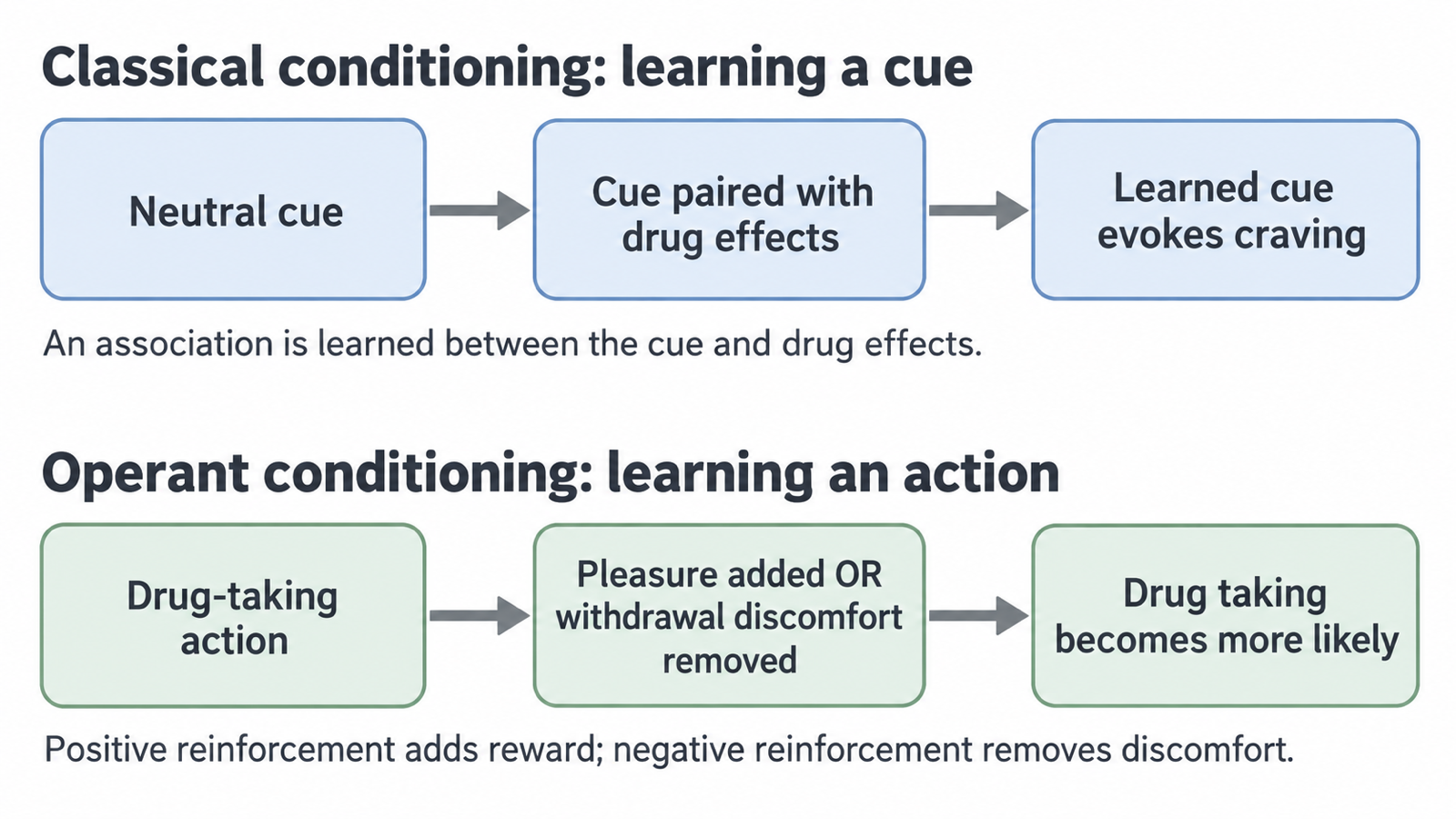
Repeated presentation of a cue without the expected drug outcome can weaken a conditioned response, a process called extinction. However, responding may return with time, stress or a change of context. This helps explain why removal from an old setting can make change easier while returning to it may provoke craving. It does not mean a cue forces a person to take a drug.
Social learning and development
Social interactions during development can affect access to drugs, expectations and models of acceptable behaviour.
Through social learning, a person may attend to a model, remember what the model does, be able to reproduce the action and have motivation to do so. Seeing a respected peer praised or accepted for drinking is vicarious reinforcement: the observer sees the model rewarded and may expect similar rewards. If the observer later receives approval for drinking, that is direct reinforcement. Imitation, direct pressure and direct reinforcement are related but distinguishable mechanisms.
For alcohol, a younger person might see older peers treating drinking as a route to belonging. For nicotine, a friendship group can model smoking at breaks and make it seem normal. Heroin use may also be modelled within some social networks, but it is not reasonable to assume that it has the same visibility, availability or cultural approval as alcohol. Observation alone does not guarantee imitation or addiction.
Continue this lesson.
You’re previewing NovaLearn without an account. Create a free account to read the rest.
Create free account