2.1.4, 2.1.5 - Reconstructive memory and schemas
Remembering an event involves more than replaying a recording. People select information, interpret it using what they already know, and reconstruct a recollection later. This lesson explains Bartlett’s account, the evidence behind it, and how processing speed, schemas and personal experience contribute to individual differences in memory.
Schemas and reconstructive remembering
Previous knowledge can help us understand an experience and also influence how we remember it.
Schema
A schema is an organised framework of knowledge and expectations built through experience. It guides interpretation of new information and can guide its later reconstruction.
For example, a restaurant schema might include being shown to a table, receiving a menu, ordering and paying. It helps you understand what is happening without treating every action as completely new. Different kinds of restaurant, and different personal experiences, can produce different expectations.
Memory begins with encoding: forming a representation of information. Attention is selective, so not every feature of an event is encoded equally. A schema can influence which details seem important and how an ambiguous detail is understood. At retrieval, retained information is used with existing knowledge to construct an account. If a detail is unavailable, an expectation may supply a plausible connection. You might later remember receiving a paper menu because that fits your usual restaurant experience, although this particular restaurant displayed its menu on a wall.
[DIAGRAM: asset_name: Schema-guided reconstruction; asset_slug: edexcel_9ps0_c04_schema_reconstruction; recommended_method: image_gen; description: Experienced events contribute selectively retained information, while prior knowledge guides interpretation and combines with that information when a recollection is reconstructed.; caption: Schemas influence interpretation and recollection without changing the event that actually occurred.]
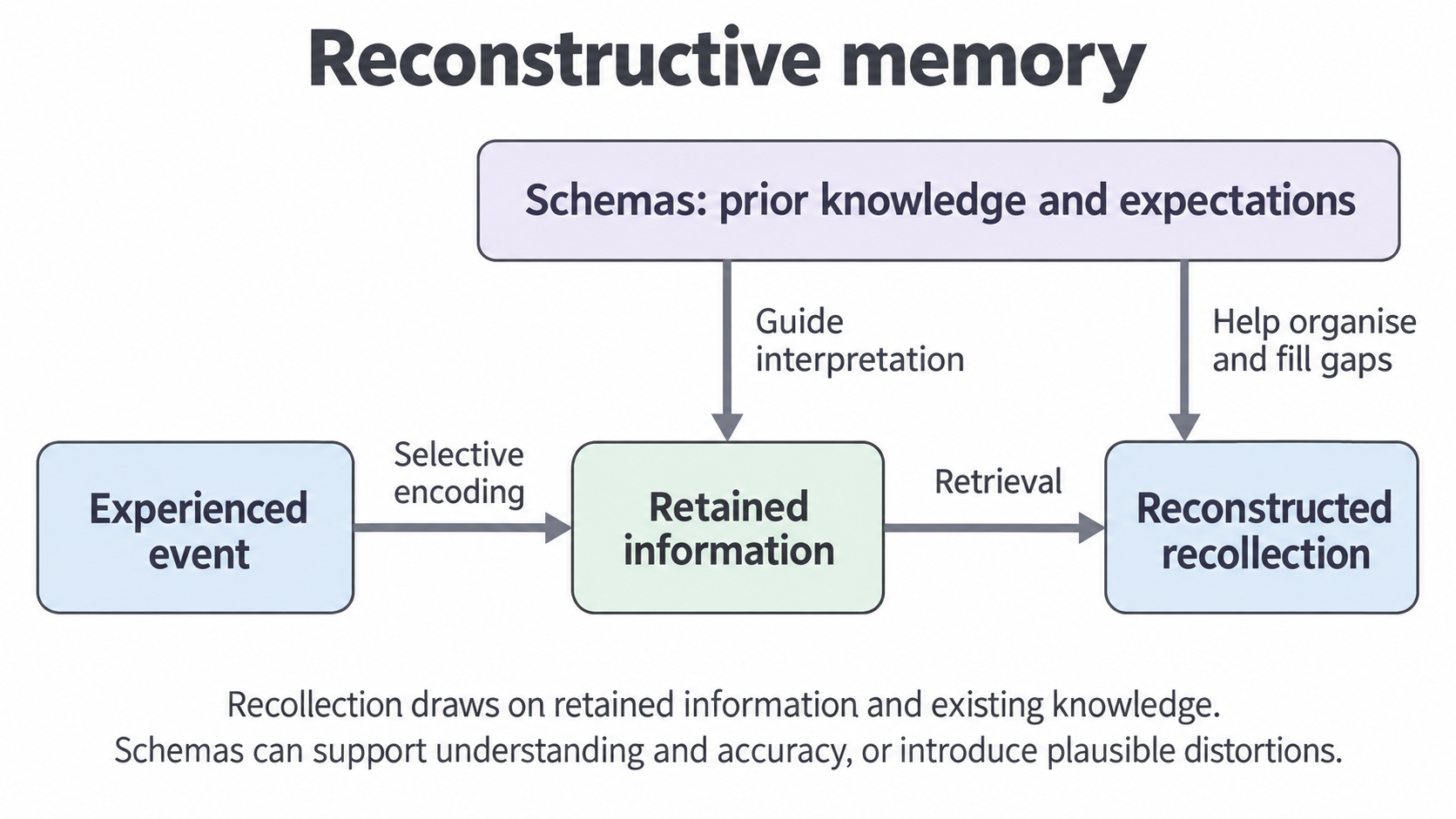
Reconstructive memory therefore describes an active process. It does not mean that a person deliberately invents a story, nor that every recollection is false. Retained detail may be accurate, and knowledge can supply a correct interpretation. A restaurant schema usually helps you understand an order being taken. Distortion arises when a remembered expectation or inference is treated as something actually experienced. A coherent, confident account is consequently not sufficient evidence that every detail is accurate.
Bartlett’s evidence and its limits
Bartlett’s 1932 book investigated how meaningful material changes when people reproduce it from memory.
His aim was to examine the transformations introduced during remembering and how prior experience and social conventions shape them. A prominent example was The War of the Ghosts, adapted from a translated North American folk tale. Its unfamiliar names, events and supernatural elements made it useful for studying how people interpret material from a different cultural setting. Bartlett described his readers as educated and rather sophisticated. The book reports 20 participants for this repeated-reproduction story series; this is not the sample size for every experiment in the book. Their backgrounds were not identical: one described participant came from northern India, so calling the entire sample British would be misleading.
In repeated reproduction, the same person recalls the material on successive occasions. For this story, participants read it silently twice at their normal reading rate and wrote their recollections. The first recall was normally about 15 minutes later, with a reported exception. Further recalls occurred as opportunities arose, sometimes after much longer intervals. The intervals were not identical for everyone. This was a sequence of observations of each person’s recall, rather than a single uniform comparison between a treated group and an untreated group.
In serial reproduction, one person’s recalled version becomes the material for the next person, whose version passes to another person, and so on. This tests transformation through a chain of people, as in transmission of a story. It differs from asking the original reader to recall the original story several times. Bartlett used both methods; their evidence should not be mixed into one procedure.
The repeated-reproduction accounts often became shorter, with unfamiliar names and details omitted or altered. “Canoes” were replaced by the more familiar “boats”, and “paddling” often became “rowing”. Participants also supplied links that made puzzling events more coherent. Bartlett described this rationalisation as making material understandable or acceptable, sometimes without awareness of the changes. The pattern was not a rule that every detail became less accurate at each recall: a general outline could persist, frequent reproduction could stabilise a version, and some details could reappear.
These findings support reconstruction because the changes often had a direction: material became more compatible with the reader’s knowledge and expectations, rather than simply losing random detail. Schemas offer a mechanism for that direction. Nevertheless, this does not identify precisely when a change arose. An unfamiliar incident could have been misunderstood during initial reading, not transformed only at retrieval.
There are further limits. Bartlett examined rich written accounts and participants’ comments, allowing meaningful changes to be studied. However, interpretation of what counts as rationalisation can involve researcher judgement; explicit, consistently applied coding rules would make comparisons more dependable. Variable recall intervals and repeated exposure to one’s own recollections also make it difficult to isolate the effect of elapsed time. More familiar material and controlled intervals could test whether the same patterns occur under other conditions. The unusual story was useful for revealing interpretation, but the extent of distortion cannot simply be assumed to apply to every familiar everyday event or every cultural group.
Processing speed and different schemas
Individuals can differ both in how quickly they process information and in the knowledge they bring to it.
Processing speed concerns the rate at which relevant mental operations are completed. It is different from how much information a person can hold. If rapidly presented instructions require identifying each step, connecting it to a location and retaining the sequence, slower processing may leave less time to complete encoding before the next step arrives. During a multi-step task, an earlier temporary result may also become unavailable before later processing finishes. These are possible routes by which speed differences affect memory performance.
For example, a learner who processes a spoken route slowly may fail to establish the first turning before the next turning is announced. Slowing the presentation or providing more time could help. It would be wrong to infer that slower processing guarantees poor memory: attention, rehearsal strategy, familiarity and the opportunity to revisit information also matter. A slow but knowledgeable learner may recall more than a faster learner who does not understand the material. Speed and storage capacity should not be treated as interchangeable explanations.
Schema differences provide another route. A person familiar with a building can interpret “take the corridor beside the hall” using an existing layout. Someone new to the building must establish more of that layout from the instructions. Prior knowledge can improve understanding and organisation, but a schema based on an old layout could also lead to recalling an incorrect turning after the building has changed.
Schemas differ with experience, interests and cultural practices. These influences are not a claim that every member of a cultural group thinks or remembers alike. Individuals within a group have different learning histories, and the same person may use different expectations in different settings. To interpret a recall difference, consider the demands of the task and the person’s relevant knowledge as well as processing speed. A poorer score alone does not tell us which mechanism caused it.
Why autobiographical memory is individual
Autobiographical memory concerns one’s own life and is inherently shaped by the individual whose life it is.
It includes recollections of personal events, such as a particular holiday, and personal facts, such as knowing where one lived. An event recollection is episodic when a specific experienced occasion is retrieved in its context. A personal fact can be semantic when it is known without recollecting an occasion. Autobiographical memory should therefore not be reduced to either a list of impersonal facts or only vivid episodes.
Two siblings can attend the same holiday yet acquire different autobiographical memories. One may attend closely to a swimming lesson; the other may be worried about losing a toy and notice different details. Their positions, attention, goals and prior experiences differ during the event. Later, their schemas, the cues they receive and the importance they assign to an experience influence what they retrieve and how they organise it. The same shared event does not give them identical information or identical personal meaning.
Repeated telling can stabilise a particular version. A photograph or another person’s account may provide a cue, but information subsequently learned about an event must be distinguished from direct recollection of experiencing it. If a person now knows that a family arrived at noon because a relative said so, this is not sufficient evidence that they recollect seeing the arrival at noon.
This account helps explain why disagreement about a shared event need not imply that someone is lying. It also avoids the opposite mistake of assuming that every difference is a false memory. The siblings could accurately remember different aspects. Checking an available record may resolve a particular factual disagreement, but neither confidence nor vividness by itself guarantees accuracy. A defensible interpretation considers the original opportunities to encode information, subsequent knowledge and the individual perspective from which the event is reconstructed.